
Osaka’s Fukushima ward has a practical, station-side curry culture where speed, spice and value matter more than ceremony. Spice Curry Tairiku belongs to that lane: a 20-seat curry counter-and-table room near Shin-Fukushima, selected for Tabelog Curry WEST 100 in 2019, 2020, 2022, 2023 and 2024, with English support and a no-reservations rhythm.
Pearl is the En Primeur Club membership app — saves, bookings, and concierge access live there. Same editors, same standards.
- Address
- 2 Chome-9-23 Fukushima, Fukushima Ward, Osaka, 553-0003, Japan
- Phone
- +81 6-7508-1508
- Website
- u-en.jp
 Saves & bookings on Pearl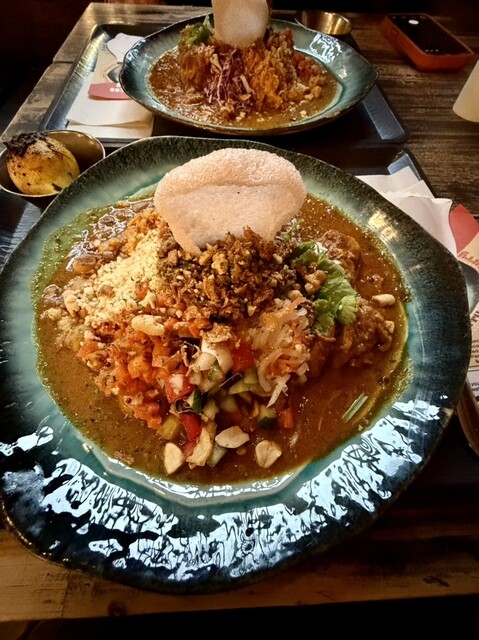
In Fukushima, the approach to curry rooms is rarely theatrical. Around Shin-Fukushima, the ritual is compact and urban: arrive between train stops, read the room, choose without lingering, eat while the kitchen keeps pace, then make space for the next solo diner or small group. Spice Curry Tairiku fits that pattern with counter and table seating, a no-smoking room and a curry-led format rather than the broader izakaya sprawl that defines much of Osaka after dark.
That matters because Osaka’s curry culture is not a side note to ramen, sushi or okonomiyaki. The city has built a serious spice-curry circuit, especially in neighbourhoods where independent kitchens can work at modest scale and diners accept sharper, more personal curry rice. Fukushima, just west of Umeda’s commercial gravity, suits that habit: close enough for office workers and travellers, small enough for specialised rooms to survive on repeat traffic.
Osaka spice curry, served as a quick urban ritual
Japanese curry has a broad national grammar, but Osaka spice curry rewards a different diner. It is less about thick nostalgic roux than layered spice, rice as structure and a plate assembled for pace. The meal is not slow dining; the discipline is sequence. Queue or arrive quieter, scan the menu, commit, eat while the plate is at its intended temperature, and leave without turning the table into a lounge.
Spice Curry Tairiku’s recognition places it inside the city’s specialist curry conversation, not just the casual neighbourhood-lunch category. Selection for Tabelog Curry WEST 100 in 2024, with earlier selections in 2019, 2020, 2022 and 2023, gives the room a track record across multiple editions. A Tabelog score of 3.70 reinforces the point: this is not a luxury address, but it is judged within a competitive curry field where small differences in consistency, spice balance and throughput matter.
The price band also tells the story. Fukushima has dinner-driven restaurants, including shabu-shabu and yakitori counters with far higher budgets, while curry remains more democratic. That contrast helps with Osaka planning: curry here can carry lunch or an early casual dinner without consuming the evening’s budget. For a heavier comparison in the neighbourhood, Agu Buta Shabushabu Senmon Ten Toriou Bettei occupies another price lane, while coffee and lighter stops such as CAFE BAHNHOF show how Fukushima supports specialist addresses across the day.
Fukushima's appeal is variety at close range
The neighbourhood’s strength is not one genre. It is compression. A diner can move from curry to coffee, from casual Asian cooking to French-leaning bistro dining, without changing the evening’s basic geography. That makes Fukushima useful for travellers who want Osaka’s food culture without defaulting to Namba and Dotonbori’s most photographed corridors.
Within that pattern, Spice Curry Tairiku reads as a practical anchor: compact, recognisable to curry-focused diners, and accessible for visitors who do not read Japanese fluently. English menu support, English-speaking staff availability and photo menus are not trivial in a category where small independent rooms can be difficult to parse. Take-out broadens the use case, but the stronger reason to come is the counter-and-table rhythm: curry in a room designed for concentration, not ceremony.
The physical context adds another layer. It operates at Akutagawa Coffee, attached to Guest House Uen, a hostel converted from a former traditional Japanese restaurant. That setting suits the area’s hybrid character: old building stock, younger travellers, office-adjacent dining and small-format food businesses sharing the same few blocks. The point is not nostalgia; it is how Fukushima turns modest spaces into credible dining addresses.
For mapping the area, Our full Fukushima restaurants guide gives the wider restaurant frame, while Our full Fukushima hotels guide, Our full Fukushima bars guide, Our full Fukushima wineries guide and Our full Fukushima experiences guide place the meal inside a broader stay. Nearby references such as age, Asia Shokudo Chouku and Bistro Mikasa show how the ward’s appeal depends on range rather than a single prestige format.
How to read the meal: speed, restraint and evidence
Expect a focused curry stop with enough recognition to justify seeking it out, not a chef-led tasting-menu narrative. The chef’s name is not the useful lens. The stronger reading comes from format and repetition: 20 seats, counter availability, no private rooms, no reservations, multiple Tabelog Curry selections and a price band that keeps the meal in everyday Osaka territory.
That combination is more interesting than it first appears. In many cities, awards push diners toward expense and formality. Osaka’s curry scene complicates that assumption. A small room can sit on a respected category list while remaining inexpensive by city standards, and the experience can centre on a single plate rather than a long sequence. The ritual is closer to a practiced local habit than a special-occasion performance.
There is also a travel lesson in how this kind of place compares outside its category. A visitor seeking Japanese comfort food might consider a curry specialist in Sapporo such as [Curry Senmon Ten] Maruyama Kyoju. an onigiri counter in California like Onigiri Time in Pasadena, or a sake-led room such as Jōdo Saké Bar in Los Angeles. The common thread is not luxury; it is narrow focus. The more precise the format, the more important it is to understand the house rhythm before walking in.
That same logic applies across Japan’s casual-specialist dining map. A beef sukiyaki address such as -Grilled beef Sukiyaki- KAMAKURA TANUKIAN 鎌倉 たぬき庵 in Kamakura, a charcoal-and-tuna room like. 鮪と炭火焼き うお炭 秋葉原店 in Tokyo.cafe in Osaka.know in Kumamoto and (Shoku) Vietnam in Kawasaki each ask the diner to accept the premise of the room. At the restaurant, the premise is clear: curry as a concise Osaka meal, supported by enough recognition to make the detour credible and enough practicality to fold it into a Fukushima day.
Cuisine-First Comparison
Side-by-side context: comparable cuisine and price.
| Venue | Cuisine | Price | Notes |
|---|---|---|---|
| Spice Curry TairikuThis venue — the venue you are viewing | Osaka-style spice curry | $ | Not listed |
| Ramen Jinsei JET | Japanese Ramen | $ | Fukushima |
| Sumibiyakitori Coquelet | Modern Yakitori Izakaya | $$ | Fukushima |
| KANNOSUKE | Yoshoku (Japanese-style Western cuisine) & Hamburg steak | $ | Fukushima |
| Ichijuu | Yakitori & Izakaya | $$ | Fukushima |
| Mitsuboshi Seimenjo Fukushima honten | Ramen & Tsukemen Shop | $ | Fukushima-ku |
Recognition history
Dated appearances from independent guides and award organizations, with the underlying list record or original source where available.
Tabelog 100 #45 · No. 45
Tabelog · Tabelog 100 - Curry - WEST - 2024
Continue exploring
More in Fukushima
Restaurants in Fukushima
Browse all →




Bars in Fukushima
Browse all →



Hotels in Fukushima
Browse all →



Wineries in Fukushima
Browse all →
At a Glance
- Cozy
- Lively
- Solo
- Casual Hangout
- After Work
- Hotel Restaurant
Current opening hours
- Monday
- 11 AM–9 PM
- Tuesday
- 11 AM–9 PM
- Wednesday
- 11 AM–9 PM
- Thursday
- 11 AM–9 PM
- Friday
- 11 AM–9 PM
- Saturday
- 11 AM–9 PM
- Sunday
- 11 AM–8 PM
Hours can change for holidays and private events. Last verified .
Casual and cozy cafe-like atmosphere on the first floor of a guesthouse, with counter and table seating, relaxed noise level, and the warm smell of spices and freshly roasted coffee.