
spice curry mokuromi puts Koshigaya into Japan’s serious spice-curry conversation, not through luxury signals but through a small counter format and repeated Tabelog Curry Hyakumeiten selections. The appeal is narrow and specific: a six-seat curry room in Sengendainishi where sourcing, spice balance, and lunch pacing matter more than ceremony.
Pearl is the En Primeur Club membership app — saves, bookings, and concierge access live there. Same editors, same standards.
- Address
- 埼玉県越谷市千間台西5-2-30 2F
- Website
- tabelog.com
- Directions
- Get directions
 Saves & bookings on Pearl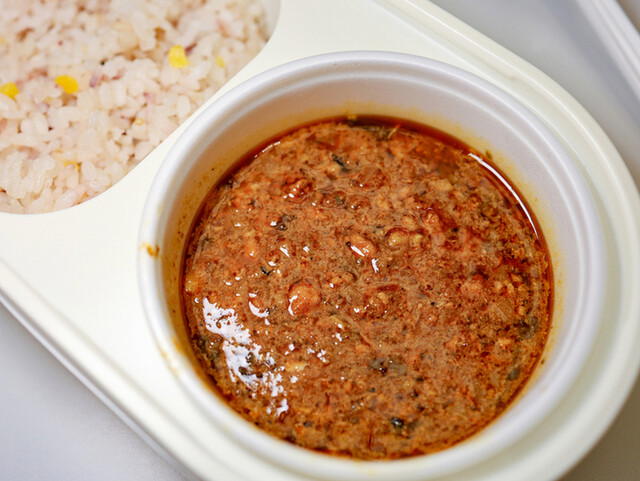
Approaching a second-floor curry counter in Sengendainishi is a useful corrective to the way Japan’s serious dining is often discussed. The room is not built around ceremony, tablecloth theatre, or a long-form tasting menu. It is built around proximity: six counter seats, a compact kitchen rhythm, and curry as a focused craft rather than a casual default. In Koshigaya, that matters. The city sits outside central Tokyo’s restaurant gravity, so recognition here tends to attach to places with a clear reason for the detour.
Japan’s contemporary spice-curry movement has never been only about heat. Its sharper kitchens work with layering: whole and ground spices, vegetable sweetness, oil management, rice texture, and the question of how much Japanese comfort to leave in the bowl. In that context, spice curry mokuromi belongs to the small-format, ingredient-led side of the category. The scale makes the point. A counter this limited cannot hide behind volume, and curry at this level is judged on balance across a short service window rather than on a sprawling menu.
A small counter in Saitama's ingredient-led curry tier
Curry in Japan splits into several traditions: yoshoku-style roux curry, regional comfort counters, South Asian specialist rooms, and the newer Japanese spice-curry idiom that borrows techniques without simply replicating another country’s template. Koshigaya’s stronger dining addresses often sit between suburban practicality and destination intent. That tension is visible across the local field, from Kuriya Sawa at a higher spend level to モデスト in the city’s broader restaurant mix. Curry occupies a different lane: lower spend, faster turnover, but no less dependent on precision.
The sourcing angle is not a decorative detail in this genre. Spice curry rewards kitchens that treat ingredients as structure, not garnish. Aromatics determine the opening register; vegetables and proteins set sweetness and body; rice decides whether the plate feels heavy or clean. When a curry counter earns repeat attention, the signal is usually consistency across these small decisions. spice curry mokuromi has been selected for Tabelog Curry EAST Hyakumeiten in 2019, 2020, 2023, and 2024, with an additional Curry Hyakumeiten selection in 2022. For a six-seat counter in Saitama, that history places it in a competitive conversation normally dominated by Tokyo and other dense urban dining zones.
The Tabelog score of 3.87 reinforces the same point without turning the meal into a ratings exercise. Japanese curry culture is crowded with low-cost, high-frequency eating; many good bowls never become destination dining. Recognition at this level suggests a kitchen whose ingredient handling and spice architecture travel beyond local convenience. The comparison is not with luxury restaurants. It is with specialist counters such as Niboshi Ranbu and 3931WORKS. where modest pricing and narrow formats can carry serious followings when execution is disciplined.
Why the format changes the meal
A six-seat counter alters the way curry is experienced. There is less distance between preparation and service, and less room for a leisurely, multi-course arc. The meal depends on compression: the first impression of spice, the way rice absorbs sauce, the pacing of the plate before the room turns over. This is why counter curry can feel more like a workshop than a restaurant in the conventional sense. The format asks diners to pay attention to sequence and proportion rather than décor.
Koshigaya’s location also changes the editorial reading. In central Tokyo, a small curry counter can disappear into abundance. In Sengendainishi, the same format carries a stronger local signal. It tells the reader that Saitama’s commuter-belt dining is not only about convenience near stations or family restaurants on arterial roads. Specialist food culture has moved outward, and the more compelling examples do not need to imitate metropolitan luxury. They compete through concentration: a short category, a small room, and repeatable control.
That makes the venue useful for travellers who already understand Japan’s curry range and want a sharper read on the suburban scene. For a broader Koshigaya itinerary, the contrast with Girassol, Kuriya Sawa, and モデスト is instructive: the city’s dining identity is not defined by one cuisine or price band. It is a patchwork of compact specialists, local regulars, and restaurants with enough confidence to pull diners away from Tokyo’s default routes.
How to read it within a Koshigaya trip
The smart way to frame spice curry mokuromi is as a specialist stop rather than a grand dining anchor. It suits a day built around Koshigaya or the Tobu Skytree Line, particularly for travellers interested in how Japanese curry has evolved outside the capital’s headline neighbourhoods. The venue’s non-smoking policy and counter-only setup also point toward solo dining and small-party meals rather than a lingering group occasion.
Readers mapping the city more broadly should use Our full Koshigaya restaurants guide for the dining spread, then cross-check the surrounding hospitality and after-hours options through Our full Koshigaya hotels guide, Our full Koshigaya bars guide, Our full Koshigaya wineries guide, and Our full Koshigaya experiences guide. For a wider Japan food map, the contrast with [Curry Senmon Ten] Maruyama Kyoju. in Sapporo, (Shoku) Vietnam in Kawasaki, [ki:] in Kyoto.cafe in Osaka.know in Kumamoto, -Grilled beef Sukiyaki- KAMAKURA TANUKIAN 鎌倉 たぬき庵 in Kamakura. 鮪と炭火焼き うお炭 秋葉原店 in Tokyo, and #肉といえば松田 奈良本店 in Kashihara shows how narrow-format restaurants operate across different categories.
International readers can also use the page as a reminder that Japanese dining abroad and Japanese dining in Japan often reward different expectations. Jōdo Saké Bar in Los Angeles and Onigiri Time in Pasadena speak to translation and audience-building overseas; a small Saitama curry counter speaks to local repetition, station-area habits, and the quiet authority of a room that has to earn its queue one service at a time.
Comparable Spots, Quickly
Comparable venues by cuisine and price in the same metro.
| Venue | Cuisine | Price | Notes |
|---|---|---|---|
| spice curry mokuromi | Spice Curry | $ | Sengendai |
| Girassol | Yoshoku (Japanese-style Western cuisine) & curry | $$ | Gamo |
| Kuriya Sawa | Japanese-style Western (Yoshoku) | $$ | Sengendai Nishi |
| モデスト | Seasonal French Innovative | $$$ | Matsuocho, Matsubushi-machi |
| Indian Fu Curry Rice Supaisu | Indian-style Japanese Curry | $ | Suginami |
| Curry Shop Hatsukoi | Creative Spice Curry & Craft Biryani | $ | Shibuya |
Recognition history
Dated appearances from independent guides and award organizations, with the underlying list record or original source where available.
Tabelog 100 #91 · No. 91
Tabelog · Tabelog 100 - Curry - EAST - 2024
Continue exploring
More in Koshigaya
Restaurants in Koshigaya
Browse all →




Bars in Koshigaya
Browse all →




At a Glance
- Cozy
- Minimalist
- Solo
- Casual Hangout
- Standalone
Small, focused, and casual counter-service atmosphere with an intimate feel; the venue is described as a compact curry shop rather than a full-service dining room.