Seoul K-food
Seoul K-food occupies a unit on Powis Street in Woolwich, southeast London, placing Korean cooking inside one of the capital's more culturally layered high streets. The venue sits within a part of London where independent food businesses increasingly define the local character, offering a Korean dining ritual at a remove from the West End's more polished Korean dining corridor.
Pearl is the En Primeur Club membership app — saves, bookings, and concierge access live there. Same editors, same standards.
- Address
- Unit19, 125 Powis St, London SE18 6JL, United Kingdom
- Phone
- +447312163428
- Website
- woolwichkfood.co.uk
- Directions
- Get directions
 Saves & bookings on Pearl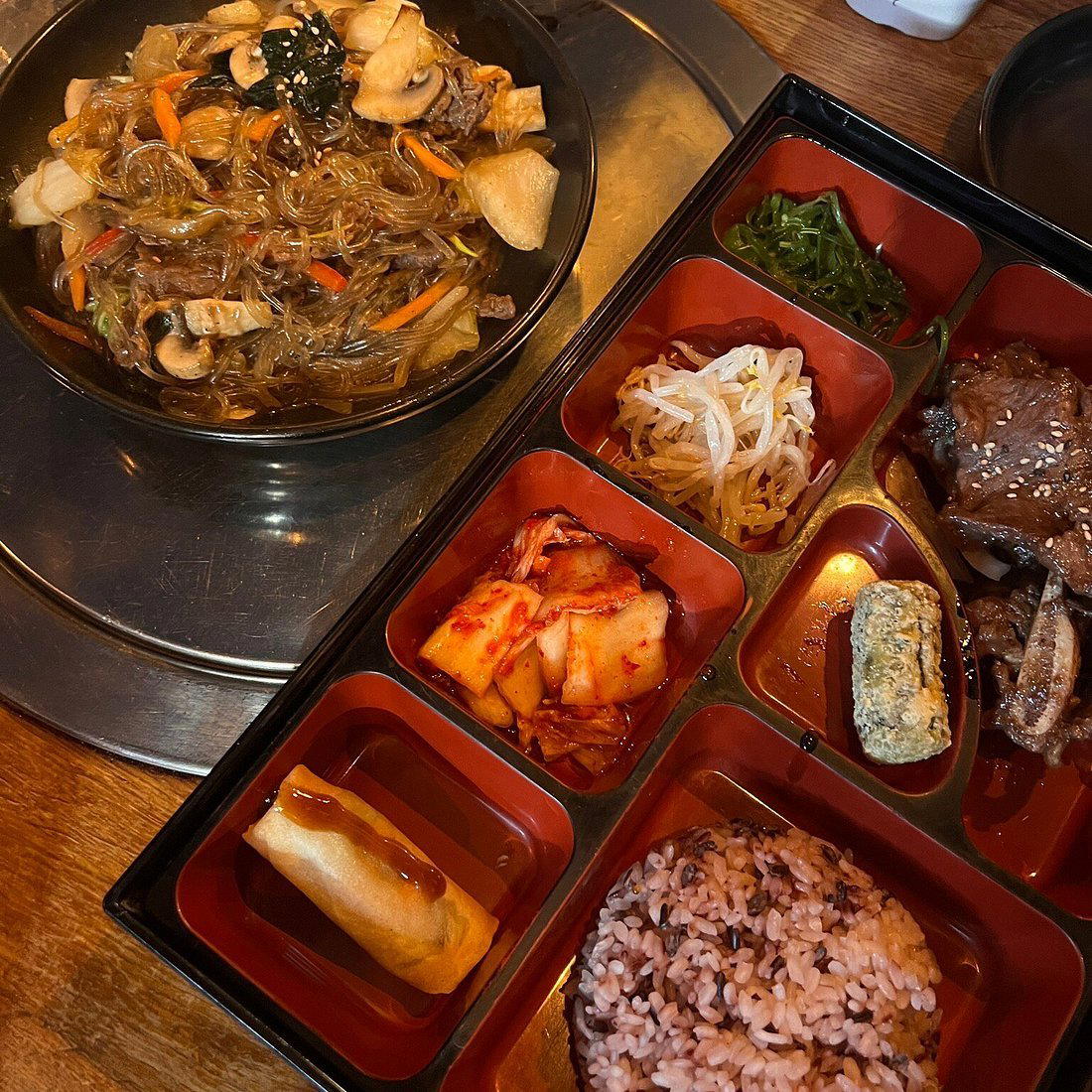
Woolwich and the Korean Dining Ritual
Korean food has a grammar of its own at the table. The meal typically arrives not as a sequence of courses but as a simultaneous spread: small dishes of banchan surrounding a central protein, the whole thing assembled by the diner rather than the kitchen. This model of communal, participatory eating sits at some distance from the European fine-dining ritual that structures places like CORE by Clare Smyth, Sketch, The Lecture Room and Library, or Restaurant Gordon Ramsay, where pacing is entirely the kitchen's domain. At a Korean table, the diner exercises considerably more agency: what to eat first, what to combine, how much of each component to take. It is a format that rewards attention and punishes hurry.
Seoul K-food operates from Unit 19 on Powis Street in Woolwich, SE18, a postcode that places it firmly outside the zones where London's Korean dining scene has historically concentrated. New Malden, in the southwest, has functioned for decades as the practical centre of Korean food in the capital, its high street running a density of Korean grocers, barbecue restaurants, and casual lunch spots that serves both the resident Korean community and visitors who make the trip specifically. The West End and Soho have developed a parallel tier of Korean-influenced restaurants pitched at a broader audience and priced accordingly. Woolwich is neither of these things, and that positioning has its own logic.
Southeast London's Food Identity
Woolwich's food character is shaped by proximity to several different urban pressures: the arrival of the Elizabeth line, which brought Crossrail connectivity and a measurable increase in footfall from central London; the ongoing development of the Arsenal yards; and a pre-existing, diverse residential base that has long supported independent food businesses across multiple cuisines. The result is a high street that operates less like a curated dining district and more like a working neighbourhood that happens to have a range of options. That context matters for understanding where Seoul K-food fits.
Korean food in this kind of setting tends to be less performative than its West End equivalents. The ritual of the Korean meal, the shared table, the banchan laid out before the main dish arrives, the expectation that diners will manage their own plates, translates well to a casual, neighbourhood register. In contrast to the tasting-menu architecture of destinations like The Ledbury or Dinner by Heston Blumenthal, where the kitchen controls every beat of the experience, a Korean spread hands considerable authority back to the people seated at the table. For some diners, that is the more interesting proposition.
Korean Cuisine in the London Context
London's Korean food scene has expanded considerably over the past decade, though it remains smaller and less codified than the city's Japanese, Chinese, or Indian dining cultures. The format question is significant: Korean restaurants in London range from barbecue houses where the cooking happens at the table, to pojangmacha-style casual operations, to the newer wave of Korean-influenced tasting menus that have emerged in central London and attracted critics. Each of these formats carries a different ritual logic, a different set of expectations about how long you stay, who does the work, and what the meal is for.
The barbecue format, in particular, is worth pausing on. Tabletop grilling in Korean tradition is a social act as much as a culinary one: the grilling is shared, the meat is cut and wrapped, the soju or beer moves around the table. It is a format with its own etiquette, wrapping the meat in lettuce with a smear of ssamjang, adding a sliver of garlic, not over-filling the wrap, that a first-time visitor might not know but that regular diners follow without thinking. The learning curve is real, and it is part of what makes the Korean dining ritual distinct from Western models where the kitchen does all the technical work and the diner simply receives it.
For comparison points beyond London, Atomix in New York City represents one end of the Korean dining spectrum in Western cities: a two-Michelin-star tasting counter that translates Korean culinary tradition into a fine-dining framework. At the other end sit the neighbourhood operations that maintain the communal, everyday character of Korean food without the tasting-menu overlay. Most Korean restaurants in London, including those in New Malden and Woolwich, operate closer to the latter register.
Placing Seoul K-food in Its comparable set
Seoul K-food sits within the London Korean dining market as a casual neighbourhood restaurant in Woolwich. What the address communicates is a neighbourhood orientation rather than a destination one. Powis Street in Woolwich is not a street that draws diners from across the city on the basis of a restaurant's reputation alone; it serves the surrounding area and those passing through for other reasons. That is a different competitive set from the Korean-influenced venues that have attracted London press coverage in recent years.
For readers building a picture of what premium Korean dining looks like across different price tiers and formats, the spectrum runs wide. In New York, Atomix operates at the tasting-counter level with significant critical recognition. In London, the Korean dining scene has not yet produced a Michelin-starred Korean restaurant, which separates it from cities like New York and Seoul itself. That gap is part of the story of how Korean food is valued and positioned in the UK market.
Across the rest of the UK, the Michelin-starred dining scene is anchored by places like Waterside Inn in Bray, Le Manoir aux Quat'Saisons in Oxford, L'Enclume in Cartmel, Moor Hall in Aughton, Gidleigh Park in Chagford, Hand and Flowers in Marlow, hide and fox in Saltwood, Midsummer House in Cambridge, Opheem in Birmingham, and Restaurant Andrew Fairlie in Auchterarder, all operating in Western European fine-dining formats. Whether that changes in the next decade is one of the more interesting questions in London dining.
Planning Your Visit
The restaurant is located at Unit 19, 125 Powis Street, London SE18 6JL. Woolwich is served by the Elizabeth line, National Rail, and the DLR, making it accessible from central London without a significant journey. Powis Street has parking and is a walkable distance from Woolwich Arsenal station.
A Quick Peer Check
Comparable venues nearby, for context on price, style, and recognition.
| Venue | Cuisine | Price | Notes |
|---|---|---|---|
| Seoul K-foodThis venue — the venue you are viewing | Authentic Korean Comfort Food | $$ | Not listed |
| KKINI | Korean BBQ | $$ | Kentish Town |
| Byblos Harbour | Authentic Lebanese Brasserie | $$ | Millwall |
| Sohaila | Contemporary Lebanese Small Plates | $$ | Shoreditch |
| La Vina Leadenhall Market | Authentic Spanish Tapas | $$ | Bishopsgate |
| Radio Alice | Dining | Not listed | Hoxton |
Continue exploring
More in London
Restaurants in London
Browse all →
Bars in London
Browse all →
Hotels in London
Browse all →
Wineries in London
Browse all →
At a Glance
- Cozy
- Casual Hangout
Current opening hours
- Monday
- Closed
- Tuesday
- Closed
- Wednesday
- 12–10 PM
- Thursday
- 12–10 PM
- Friday
- 12–10 PM
- Saturday
- 12–10 PM
- Sunday
- 12–9 PM
Hours can change for holidays and private events. Last verified .
Cosy and welcoming family-run atmosphere