Sanjugo Shoreditch
Sanjugo Shoreditch occupies a stretch of Great Eastern Street where East London's creative density and its appetite for Japanese-inflected dining have converged over the past decade. Positioned in a neighbourhood that has repeatedly reinvented its dining identity, it sits at a different price point and register from the Michelin-chasing rooms of Mayfair and Chelsea, offering a format shaped more by the area's pace than by fine-dining convention.
Pearl is the En Primeur Club membership app — saves, bookings, and concierge access live there. Same editors, same standards.
- Address
- 13-15 Great Eastern St, London EC2A 3EJ, United Kingdom
- Phone
- +442045978055
- Website
- sanjugo.co.uk
- Directions
- Get directions
 Saves & bookings on Pearl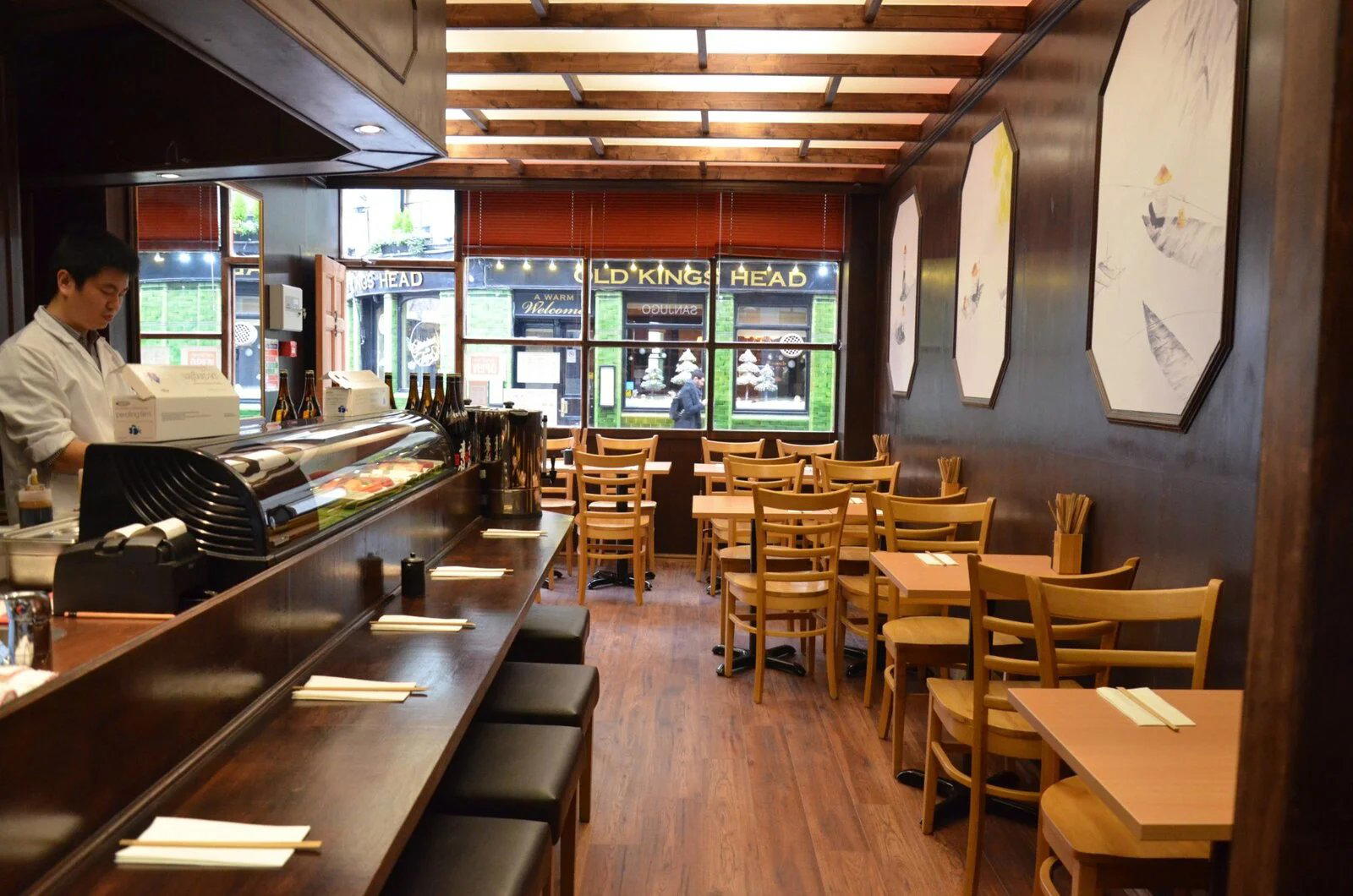
Great Eastern Street and the Shifting Shoreditch Dining Register
Great Eastern Street has changed character more than once. A decade ago it was arterial infrastructure between Shoreditch High Street and Old Street, with restaurants that served the creative-industry lunch crowd rather than destination diners. The neighbourhood's evolution since then has followed a pattern visible in several East London corridors: initial colonisation by low-cost independents, followed by the arrival of formats with more considered design and higher ambition, followed eventually by a consolidation phase in which only the operations with a clear identity survive. Sanjugo Shoreditch, at 13-15 Great Eastern Street, sits in that consolidated middle ground, shaped by the area's trajectory rather than positioned against the trophy-room dining of Mayfair or the tasting-menu circuit further west.
This is worth stating clearly because it changes the frame of evaluation. The comparison set for a Shoreditch restaurant operating at this address is not CORE by Clare Smyth or Restaurant Gordon Ramsay. It is also not the same conversation as the destination dining that defines Sketch's Lecture Room and Library, The Ledbury, or Dinner by Heston Blumenthal. Those rooms draw on different economics, different booking horizons, and a different relationship between the chef's name and the customer's decision. Shoreditch operates on loyalty, neighbourhood frequency, and format agility.
How East London Dining Has Reinvented Itself
The broader East London dining story is one of repeated reinvention. The area that once defined itself against the formality of central London has, in places, become its own kind of formal. Japanese and Japanese-inflected concepts have been part of that story for some time: ramen formats arrived early, robatayaki-style grilling and izakaya registers followed, and higher-ambiguity formats that blend Japanese technique with European ingredients have since established themselves as a recognisable East London idiom. The name Sanjugo, the Japanese word for thirty-five, signals a deliberate connection to that register, positioning the venue within an identifiable tradition rather than presenting itself as a generic neighbourhood restaurant.
That kind of naming precision is characteristic of the current phase of East London dining, where operators are more deliberate about signal than they were during the area's earlier, more chaotic expansion. It also reflects a wider pattern visible across cities with strong Japanese dining communities: as the category matures, operators move from format generalism toward more defined identities. For a point of comparison at the international level, the evolution of Japanese-influenced dining in New York, from broad category awareness to the surgical specificity of places like Atomix or the fish-centric precision of Le Bernardin's European-technique equivalents, charts roughly the same arc, compressed into a shorter time window in London.
The Physical Environment on Great Eastern Street
Approaching 13-15 Great Eastern Street from the Old Street end, the building sits within a terrace that has absorbed multiple previous tenants without entirely erasing them. The EC2A postcode carries industrial-residential density: warehouse conversions above, retail and hospitality at street level, and the particular acoustic texture of a street that functions as a through-route rather than a destination corridor. The experience of arriving is less ceremonial than at the Mayfair rooms and more in keeping with the surrounding neighbourhood's working character. That is not a deficiency; it is the appropriate register for an area that has consistently resisted the kind of stage-managed approach-and-arrival sequences common in central London destination dining.
What this means in practical terms is that the first impression is internal rather than external. The interior is where the operational identity has to do its work, establishing the tone and format that the street frontage does not telegraph in advance. This is a common challenge for Shoreditch operators, and it tends to separate the venues that have thought carefully about their own proposition from those that have not.
Contextualising the Reinvention Angle
The EA-GN-20 editorial frame, reinvention, pivots, current direction, is useful here because Great Eastern Street addresses have tended to accrue multiple identities over time. A restaurant at this address is, almost by definition, operating in a space that has been something else. That institutional memory shapes customer expectations in ways that differ from a venue that has defined its own site from the outset. The question for any operator in this position is whether the current iteration is coherent enough to displace the memory of its predecessor, and whether the format choice reflects genuine market intelligence or merely follows the area's prevailing trend.
Japanese and Japanese-adjacent formats have shown enough durability in East London to qualify as more than trend-following at this point. The category has deepened and differentiated. Where early adopters competed primarily on novelty, current operators compete on execution quality, sourcing specificity, and the kind of repeat-visit logic that sustains a neighbourhood restaurant beyond its opening quarter. Sanjugo's positioning on Great Eastern Street reads as a bet on that durability, and on the continued appetite among the EC2A dining public for formats that sit outside the European fine-dining template.
For readers who want to cross-reference what rigorous execution looks like at the other end of the British dining spectrum, the country's destination restaurant circuit, Waterside Inn in Bray, Le Manoir aux Quat'Saisons in Oxford, L'Enclume in Cartmel, Moor Hall in Aughton, Gidleigh Park in Chagford, Hand and Flowers in Marlow, hide and fox in Saltwood, Midsummer House in Cambridge, Opheem in Birmingham, and Restaurant Andrew Fairlie in Auchterarder, operates in a fundamentally different register. Those venues are defined by their remove from urban density. Sanjugo's identity is constructed from being inside it. See our full London restaurants guide for a broader map of how these registers distribute across the city.
Planning Your Visit
Sanjugo Shoreditch is located at 13-15 Great Eastern Street, London EC2A 3EJ, in the Old Street area of Shoreditch, within walking distance of Old Street and Shoreditch High Street stations. Given the sparse public data currently available on booking format, hours, and pricing, one reliable approach is to verify current details directly through search or mapping platforms before visiting. The EC2A area sees high footfall on Thursday and Friday evenings; weekday lunch and earlier evening slots tend to be easier to secure without advance planning.
Quick reference: 13-15 Great Eastern St, London EC2A 3EJ. Verify hours and booking via current listings.
A Tight Comparison
Comparable venues nearby, for context on price, style, and recognition.
| Venue | Cuisine | Price | Notes |
|---|---|---|---|
| Sanjugo ShoreditchThis venue — the venue you are viewing | Shoreditch, Japanese Izakaya | $$ | Not listed |
| Sticks'n'Sushi | Not listed | $$ | Nine Elms, Japanese-Danish Sushi & Yakitori |
| wagamama westfield stratford | Stratford, Japanese Asian Ramen Bar | $$ | Not listed |
| Sushi Bar Makoto | Chiswick, Fresh Sushi Bar | $$ | Not listed |
| Rokkon | Chiswick, Authentic Japanese Sushi | $$ | Not listed |
| wagamama covent garden | Not listed | $$ | Covent Garden, Japanese-inspired Asian Fusion |
Continue exploring
More in London
Restaurants in London
Browse all →
Bars in London
Browse all →
Hotels in London
Browse all →

At a Glance
- Trendy
- Cozy
- Modern
- Casual Hangout
- Date Night
- Open Kitchen
- Sake Program
Current opening hours
- Monday
- 12–3 PM, 5:30–10:30 PM
- Tuesday
- 12–3 PM, 5:30–10:30 PM
- Wednesday
- 12–3 PM, 5:30–10:30 PM
- Thursday
- 12–3 PM, 5:30–10:30 PM
- Friday
- 12–3 PM, 5:30–10:30 PM
- Saturday
- 12–4 PM, 5:30–10:30 PM
- Sunday
- 12–4 PM, 5:30–10:30 PM
Hours can change for holidays and private events. Last verified .
Comfortable and stylish with counter seating for watching chefs, blending modern London design with inviting Japanese izakaya warmth.