Sakis sits on Mykonos's Nikolaou Kaloggera street, one of the island's most-walked pedestrian lanes, where the Greek taverna tradition of shared plates and straightforward grilling holds its ground against the resort-hotel dining that dominates the broader scene. For visitors looking for a more grounded meal amid the island's more theatrical dining options, this address is worth knowing. See our full Mykonos guide for broader context.
 Discover on Pearl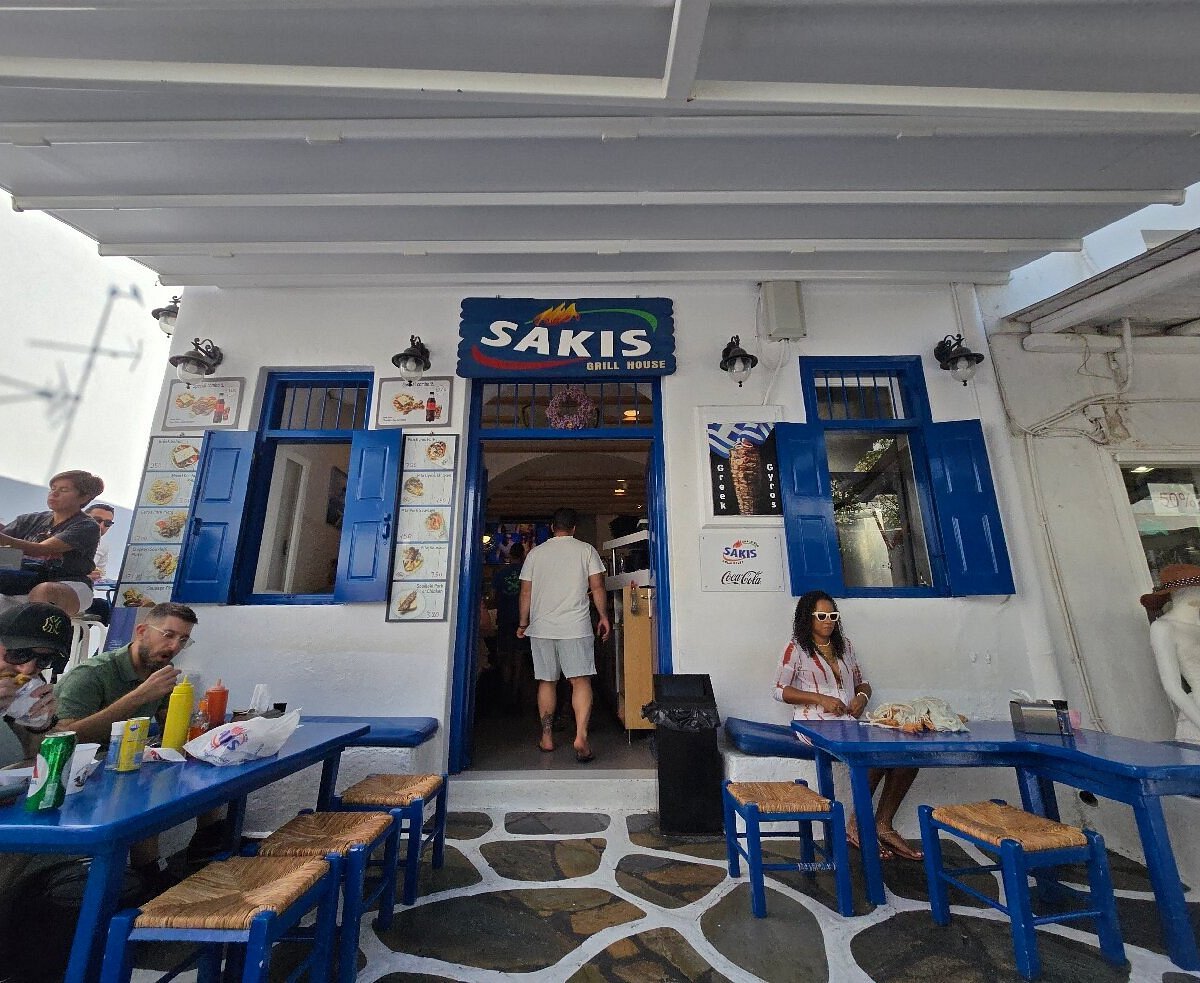
Kaloggera Street and the Taverna That Holds Its Ground
Approach Nikolaou Kaloggera on foot, as nearly everyone does, and you pass a sequence of whitewashed facades broken by bougainvillea, boutique storefronts, and the low hum of tables filling up before sunset. The street is one of Mykonos Town's main pedestrian arteries, and its pace is different from the port or the beach clubs: slower, more residential in character, the kind of lane where the same address can survive multiple tourist seasons because it earns repeat custom from people who actually live on or return to the island. Avli tou Thodori (Αυλή του Θοδωρή) operates in a similar neighbourhood register, where the setting does editorial work before a dish arrives. Sakis occupies that same tradition on Kaloggera.
The Greek Taverna in an Island Context
To understand where Sakis fits in Mykonos's dining picture, it helps to trace what the Greek taverna format actually represents. The word itself comes from the Latin taberna, a shop or inn, and the modern Greek taverna has evolved into something more specific: a venue where grilling and shared plates take precedence over composed tasting sequences, where the wine list is shorter and often locally sourced, and where the measure of a meal is conviviality rather than technical precision. In a city like Athens, tavernas exist at every price tier, from neighbourhood spots serving barrel wine to addresses like Delta in Athens, where the format has been reinterpreted through a more contemporary lens. On the Cycladic islands, the tradition holds somewhat differently: proximity to the Aegean shapes menus toward fish and seafood, olive oil from the broader Greek islands replaces heavier sauces, and the outdoor terrace or courtyard becomes as central to the experience as anything on the plate.
The shortlist, unlocked.
Hard-to-book tables, cellar releases, and concierge-planned trips.
Get Exclusive Access →Mykonos has complicated that tradition in recent decades. The island's transformation into one of Europe's most expensive summer destinations has pulled the dining scene toward international formats: Japanese-influenced concepts, branded beach clubs, and references from global cities. Zuma represents the international end of that spectrum, a format that travels to high-spend resort destinations rather than emerging from them. Smash Tag addresses a different segment. The taverna, in this context, becomes an act of retention rather than nostalgia, keeping a local format legible amid a scene that has largely repriced and repositioned around international visitors.
What the Address Signals on Kaloggera
Nikolaou Kaloggera 7 is a specific coordinate in Mykonos Town (Chora), the island's main settlement, where the Cycladic maze of narrow lanes makes precise address knowledge more practically useful than it might be in a grid-plan city. Mykonos Town is compact enough to walk entirely, but disorienting enough that addresses on named streets carry real navigational weight. Kaloggera is one of the town's better-signposted pedestrian streets, running through a section of Chora that balances commercial activity with residential texture. The full address, Νικολάου Καλογερά 7, 846 00 Μύκονος, Κυκλάδες, places Sakis within the Cyclades prefecture, the island group that also contains Feredini in Σαντορίνη, Cacio e Pepe in Thira Municipality, and a broader network of island dining documented in the EP Club Greek islands coverage.
For visitors arriving by ferry from Piraeus, where Jimy's Fish in Piraeus serves as a useful pre-departure meal, Mykonos Town is the primary landing point, and Kaloggera is reachable on foot from the old port in under ten minutes. From the new port, taxis or buses connect to Chora, and Kaloggera sits within the walkable core from there. The practical geography matters because Mykonos Town is where the island's more locally-rooted dining survives; the further you move toward beach club territory, the more the pricing and format shift away from traditional taverna registers.
Cycladic Food Culture and What It Expects of a Venue
The Cyclades have a specific culinary logic that distinguishes them from mainland Greece. The islands' relative agricultural poverty historically produced a cuisine of preserved and pickled ingredients, legumes, fresh fish, and limited but quality meat, supplemented by trade-route ingredients like capers from Santorini and the particular texture of island cheeses. This is a tradition built on constraint producing flavour, which is a different proposition from the abundance-led cooking of, say, northern Greece. Venues like Aktaion in Firostefani and Bony Fish Santorini in Imerovigli operate within a Santorini version of this same island cooking tradition, where proximity to caldera views has been layered onto the underlying food culture.
On Mykonos, that food culture has had to survive more aggressively than on quieter Cycladic islands. The volume of international visitors and the island's positioning as a party destination have created pressure on any venue that wants to hold a local culinary identity. The tavernas that persist on Kaloggera and similar streets are the ones that have found a clientele willing to engage with the format, whether returning Greek visitors, longer-stay international guests, or the island's own resident population during shoulder season. Across the wider Greek hospitality network, venues from Lake Vouliagmeni in Vouliagmeni to Alykes in Palaio Faliro demonstrate that the taverna format sustains a wide range of settings when the core proposition, quality ingredients and direct preparation, remains intact.
Planning Your Visit
Mykonos operates on a sharp seasonal curve: the island between July and August runs at full capacity, with restaurant queues, peak pricing across accommodation, and the characteristic noise that comes with 100,000-plus monthly arrivals during high summer. June and September offer meaningfully different conditions, with shorter waits, more willing staff, and prices that reflect an island rather than a resort at maximum load. Venues on pedestrian streets like Kaloggera see consistent foot traffic through the main season, which means that arriving earlier in the evening, before the post-sunset rush that typically begins around 9pm Greek island time, gives you a more considered meal. Our full Μύκονος restaurants guide maps the broader dining scene by neighbourhood and format, and is a useful planning reference for visitors building an itinerary beyond a single address. For context on how island dining compares to Cretan taverna culture, Knossos Greek Taverna Gouves in Gouves offers a useful point of contrast. And for those whose Aegean itinerary extends to the Peloponnese coast, Beauvoir in Katakolo and Lure Restaurant in Oia represent adjacent stops in the broader EP Club Greek coverage. For those arriving from international cities and accustomed to the kind of precision dining represented by Le Bernardin in New York City or Atomix in New York City, a Mykonos taverna like Sakis occupies a deliberately different register, one where the value is in the culinary tradition itself rather than in the technical performance of it. Similarly, Cash in Kifisia shows how Athens's northern suburbs have their own distinct dining registers separate from resort island formats.
Frequently Asked Questions
- What should I order at Sakis?
- The venue database does not confirm specific menu items or signature dishes for Sakis, so we cannot responsibly recommend individual plates. What the Greek taverna format reliably delivers in a Cycladic island context includes fresh grilled fish priced by weight, shared cold starters (mezedes), and house-poured local wine. For the most current menu guidance, checking directly with the venue on arrival is the practical approach, as island menus at this level shift with the day's catch and seasonal availability.
- Can I walk in to Sakis?
- Mykonos Town restaurants on pedestrian streets like Kaloggera typically accept walk-ins, but during July and August, peak-evening seatings at addresses with any local reputation fill quickly. Arriving before 8pm substantially improves your chances of being seated without a reservation. The broader Mykonos dining scene at the international end of the market, from venues like Zuma to brand-name beach clubs, requires advance booking; a traditional taverna format generally operates with less rigidity on this, though policies vary and confirming ahead during high season is always advisable.
- Is Sakis suitable for a longer, leisurely dinner or is it more of a quick-eat stop on Kaloggera?
- The Greek taverna tradition is structurally built for extended, unhurried meals: shared plates arrive in sequence rather than all at once, wine is ordered by carafe or bottle, and the expectation on both sides of the table is a dinner that runs two hours or more. On Kaloggera, a pedestrian street with ambient foot traffic and the characteristic Mykonos evening energy, that pace fits naturally. Visitors looking for a quick meal before moving to bars or clubs are better served by the island's faster-format options; those wanting to anchor an evening around a table will find the taverna format accommodates that intention well.
Pricing, Compared
A fast peer set for context, pulled from similar venues in our database.
| Venue | Price | Awards | Notes |
|---|---|---|---|
| Sakis | This venue | ||
| Avli tou Thodori (Αυλή του Θοδωρή) | |||
| Smash Tag | |||
| Zuma |
Need a table?
Our members enjoy priority alerts and concierge-led booking support for the world's most difficult tables.
Get Exclusive AccessThe shortlist, unlocked.
Hard-to-book tables, cellar releases, and concierge-planned trips.
Get Exclusive Access →