
Sake to Misonikomi Misonikomin sits in Tokyo’s Hongo pocket, where everyday noodle craft meets a more adult drinking format. Its Tabelog 100 Udon EAST 2024 selection, compact 14-seat room, sake focus, and miso-nikomi udon identity place it in a different bracket from quick lunch counters, with the feel of a neighborhood specialist rather than a destination tasting room.
Pearl is the En Primeur Club membership app — saves, bookings, and concierge access live there. Same editors, same standards.
- Address
- 東京都文京区本郷3-31-15 菅谷ビル
- Phone
- +81338122286
- Website
- misonikomin.net
 Saves & bookings on Pearl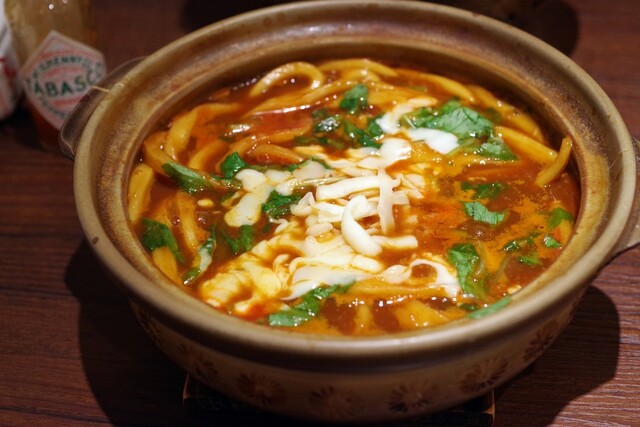
Hongo Sanchome has a quieter dining rhythm than Ginza or Shinjuku: university buildings, office blocks, old bookish streets, and small rooms built for regulars rather than spectacle. In that setting, miso-nikomi udon reads differently from the city’s ramen queues and tempura counters. The appeal is not ceremony. It is heat, wheat, fermentation, and the slower tempo of a bowl that belongs as much to drinking culture as to noodle culture.
Sake to Misonikomi Misonikomin works inside that register. The room is compact, with counter seating and tables rather than a grand dining-room format, and its selection for Tabelog 100 Udon EAST 2024 signals a recognized place in the eastern Japan udon conversation. Tokyo has countless noodle specialists, but udon houses with a clear miso-nikomi identity occupy a narrower lane: less about speed, more about regional memory adapted to the capital’s after-work dining habits.
Miso-nikomi udon, treated as a Tokyo drinking format
Miso-nikomi udon is most closely associated with Nagoya and the broader Aichi food canon, where firm wheat noodles meet a miso-rich broth built for depth rather than delicacy. In Tokyo, that tradition can become either nostalgic comfort food or a sharper, sake-friendly counterpoint to the city’s lighter noodle styles. Here the editorial interest is the second category: indigenous Japanese fermentation and wheat noodle craft placed into a small urban format with nihonshu, shochu, wine, and cocktails on the drinks side.
That combination matters because Tokyo’s noodle culture often divides by occasion. Ramen and soba can be solo, fast, and transactional; udon can be just as quick, but miso-nikomi pulls the category toward the table. It invites side dishes, alcohol, and longer conversation. The 300 yen evening appetizer charge tied to alcohol orders is a small but telling signal: dinner is framed partly as a drinking session, not only a bowl-and-go stop.
The comparison set around Hongo helps sharpen the point. Chuka Soba Nishino and Menya Suzuharu sit in the ramen-adjacent noodle orbit, while TOKYO LIGHT BLUE HONGO-3 represents the lower-priced casual end of the area’s dining economy. Jumbo Hanare moves the neighborhood toward yakiniku, and Katsuzen toward a more traditional Japanese restaurant register. Against that spread, the miso-nikomi format occupies a practical middle ground: more specialized than a quick counter, less formal than a full evening restaurant.
For travelers mapping Tokyo by appetite rather than monuments, this is the kind of place that explains a neighborhood’s texture. Pair it mentally with other small-format Tokyo meals such as . 鮪と炭火焼き うお炭 秋葉原店, 12/10 Shinjuku ten, 124. KAGURAZAKA (Yakitori), 2D Cafe, and 3 Chome no Curry Ya San: each says something specific about how Tokyo breaks dining into highly focused rooms rather than broad menus.
Why the recognition matters in an everyday price tier
Tabelog’s Hyakumeiten lists are useful because they often spotlight everyday categories that Michelin-style coverage can miss. Udon is not a luxury genre by default, yet the difference between a generic bowl and a specialist shop is significant: noodle texture, broth concentration, seasoning balance, and the way alcohol fits around the meal all become markers of seriousness. A Tabelog score of 3.69 and repeated Hyakumeiten udon selections across 2017, 2018, 2019, 2020, 2022, and 2024 give the venue a track record rather than a single-year spike.
The global-technique angle here is quiet, not flashy. The drinks list reaches beyond nihonshu into wine and cocktails, but the gravitational center remains Japanese: miso, udon, sake, shochu. That is a useful Tokyo pattern in 2026. Many small restaurants now borrow the pacing and beverage breadth of contemporary dining while keeping the core product rooted in local or regional foodways. The result is not fusion for its own sake; it is a traditional dish given the social structure of a modern city meal.
There is also a capacity signal. Fourteen seats, including four counter places, changes how a restaurant behaves. Small rooms concentrate regulars, limit large-group flexibility, and reward diners who understand the format before arriving. The counter is not merely a seating type in Tokyo; it is a way of watching a specialist category at close range, even when the cooking is not staged as theater.
For broader planning, Our full Tokyo restaurants guide gives the dining context, while Our full Tokyo hotels guide, Our full Tokyo bars guide, Our full Tokyo wineries guide, and Our full Tokyo experiences guide help place the meal inside a wider itinerary. Tokyo rewards this kind of sequencing: a compact noodle dinner in Bunkyo can sit more convincingly in a trip than another oversized multi-course booking.
Who should make room for it
This is strongest for diners who care about category depth: udon as craft, miso as structure, and sake as part of the meal’s logic. It is less suited to anyone seeking chef biography, luxury service language, or a long tasting-menu arc. The value lies in specificity. Tokyo has enough grand rooms; the more revealing meals often come from single-subject restaurants with a clear reason to exist.
It also fits travelers using Tokyo as a base for understanding Japanese casual dining beyond sushi and ramen. A useful national comparison can be built through small specialists elsewhere: -Grilled beef Sukiyaki- KAMAKURA TANUKIAN 鎌倉 たぬき庵 in Kamakura.cafe in Osaka.know in Kumamoto, (Shoku) Vietnam in Kawasaki, [Curry Senmon Ten] Maruyama Kyoju. in Sapporo, and [ki:] in Kyoto. Even outside Japan, the rise of focused Japanese formats is visible at Jōdo Saké Bar in Los Angeles and Onigiri Time in Pasadena, though Tokyo’s advantage remains density and context.
The editorial call is clear: choose it when the aim is to understand a specific noodle tradition in a city that often turns specialization into culture. The draw is not rarity theater. It is a disciplined bowl, a compact room, and the way fermented depth can anchor an evening without the machinery of formal dining.
Cuisine and Awards Snapshot
Comparable options at the same price tier.
| Venue | Cuisine | Price | Notes |
|---|---|---|---|
| Sake to Misonikomi MisonikominThis venue — the venue you are viewing | Japanese Udon / Miso Nikomi | $$ | Not listed |
| Gavial | European-style Japanese curry | $$ | Chiyoda |
| . 鮪と炭火焼き うお炭 秋葉原店 | Maguro and Charcoal-Grilled Fish Izakaya | $$ | Chiyoda |
| Masudaya | Traditional Sukiyaki & Shabu-Shabu | $$ | Shinjuku |
| Ishiusuhiki Teuchi Kyorakutei | Traditional Japanese Soba and Tempura | $$ | Shinjuku |
| Ogawa | Traditional Yakitori | $$ | Chūō |
Recognition history
Dated appearances from independent guides and award organizations, with the underlying list record or original source where available.
Tabelog 100 #85 · No. 85
Tabelog · Tabelog 100 - Udon - EAST - 2024









At a Glance
- Cozy
- Classic
- Casual Hangout
- Solo
- Group Dining
- Late Night
- Standalone
- Sake Program
- Beer Program
- Street Scene
Traditional, neighborhood-focused, and intimate, with a simple small-restaurant feel that suits a warm udon meal by day and relaxed drinks with savory bites at night.