
In Kyoto's Shimogyo Ward, Ryoriya EN frames its cooking around direct relationships with farmers in the Kamigamo and Shugakuin Imperial Villa areas, harvesting vegetables the same morning they reach the table. The shop curtain, marked with a single bold brushstroke circle, signals the restaurant's defining idea: that connection between grower, cook, and guest is the meal itself.
Pearl is the En Primeur Club membership app — saves, bookings, and concierge access live there. Same editors, same standards.
- Address
- Japan, 〒600-8018 Kyoto, Shimogyo Ward, Ichinocho, 260-1 仏光 寺角
- Phone
- +81 75-353-3805
- Website
- toki-kyoto.com
- Directions
- Get directions
 Saves & bookings on Pearl
A Circle Drawn in Brushstroke
Ryoriya EN is a restaurant in Kyoto’s Shimogyo Ward serving Traditional Kyoto Kaiseki. The first thing you register at Ryoriya EN is the noren. The fabric curtain hanging at the entrance carries a single brushstroke circle, the EN of the restaurant's name, rendered in one deliberate movement. In Japanese, en (縁) carries meanings of circle, connection, and fate-driven encounter. That symbol is not decorative shorthand; it functions as a statement of method. The cooking here is built on relationships that run from a specific plot of farmland to the rice bowl in front of you, and the curtain announces that before you've taken a seat.
Shimogyo Ward sits in central Kyoto, south of Nijo Castle and close to the Shijo commercial corridor, a district where working restaurants and small tradespeople have coexisted for generations. Its Shimogyo Ward setting gives Ryoriya EN a different register from the city's most formal dining rooms. The kaiseki tier in Kyoto, represented by addresses like Gion Sasaki, Hyotei, Kikunoi Honten, Mizai, and Isshisoden Nakamura, operates through highly codified seasonal progressions and multi-course architecture. EN occupies a different position: its anchor is freshly cooked white rice accompanied by a full range of accompaniments, a format rooted in the Japanese teishoku and gohan tradition rather than kaiseki ceremony.
The Supply Chain as Editorial Statement
The kitchen at Ryoriya EN sources vegetables through sustained relationships with farmers in two specific areas north of the city: Kamigamo and the grounds surrounding the Shugakuin Imperial Villa. Both locations sit in the Rakuhoku district, where alluvial soil and mountain-fed water have supported kitchen gardens supplying Kyoto's restaurants for centuries. Vegetables are picked in the morning and arrive at the restaurant the same day. That compression between field and kitchen is not universal even among Kyoto's serious vegetable-focused restaurants, and it shapes what ends up in the bowl.
This model of direct farm relationship has become a meaningful marker across Japan's regional fine-dining scene. Restaurants in Nara, like akordu, and in Fukuoka, like Goh, have made provenance specificity central to their identity in ways that older institutional restaurants rarely did. At EN, the gesture is more intimate in scale but no less deliberate: the named farms, the morning harvest, the explicit framing of vegetable freshness as a culinary value, these are choices that position the restaurant as a considered participant in a broader conversation about what Kyoto cooking can mean outside formal kaiseki structures.
The Table as a Point of Convergence
The editorial angle assigned to this restaurant in any serious assessment is collaboration, and at EN that collaboration has an unusual structure. The connection is not primarily between a named chef and a sommelier building a wine-and-food pairing system, as one might frame the dynamics at Le Bernardin in New York or Atomix. Here, the operative relationships are between the kitchen and the farmers, between the restaurant and its guests, and between the food and the broader Kyoto vegetable tradition. The restaurant's stated conviction, that cooking reflects the person who prepares it, extends outward to include everyone involved in getting a vegetable from soil to table.
Front-of-house at this kind of rice-centered restaurant carries specific responsibilities that differ from those of a tasting-menu room. There is no wine progression to orchestrate and no amuse-bouche sequence to time. Instead, the team's function is to present accompaniments, the range of okazu and condiments that surround the rice, in a way that helps guests understand the season and the sourcing behind each element. That requires a kind of agricultural literacy from the floor staff that is different from, but no less demanding than, the sommelier knowledge required at Harutaka in Tokyo or HAJIME in Osaka.
Rice as the Organizing Principle
In Kyoto's dining hierarchy, rice is not incidental. The city's traditional meal structure treats freshly cooked short-grain rice as the center of the plate rather than a backdrop, and the quality of the rice, its variety, milling, water source, and cooking method, is taken as seriously as the grade of fish at a sushi counter. A restaurant built around this format is making a statement about value and restraint: the premium ingredient is the grain itself, and the accompaniments exist to draw out its qualities rather than to eclipse them.
The accompaniment range at EN is described as generous, which within this format signals kitchen confidence. A broad okazu selection requires the kitchen to execute across multiple preparation styles simultaneously, pickles, simmered vegetables, grilled or braised components, and to ensure that each arrives in a condition that flatters the rice rather than competing with it. Achieving coherence across that range is the technical challenge that defines this kind of cooking, and it is a challenge that receives less critical attention than the artistry of kaiseki plating but is no less substantive.
For visitors already exploring the range of Kyoto's rice and vegetable traditions, EN sits at a meaningful point on the map. Those moving across Japan's dining scene can place it in context alongside 1000 in Yokohama or 6 in Okinawa, restaurants that have each found a specific regional idiom and built a coherent format around it. For a fuller view of what Kyoto offers across categories, the full Kyoto restaurants guide maps the city's dining range in detail, alongside guides to hotels, bars, wineries, and experiences.
Planning Your Visit
The restaurant is located in Shimogyo Ward at 260-1 Ichinocho, Shimogyo Ward, Kyoto 600-8018. The address places it within reach of the central Shijo and Karasuma subway corridor. Reservations are essential, and the restaurant is open Monday, Tuesday, Thursday through Sunday from 5:00 to 9:30 PM; it is closed Wednesday.
Frequently Asked Questions
What's the leading thing to order at Ryoriya EN?
The organizing logic of the menu points clearly toward the freshly cooked white rice and the full accompaniment selection. The kitchen's stated commitment is to same-day harvested vegetables from named farms in the Kamigamo and Shugakuin Imperial Villa areas, and those vegetables form the core of the okazu spread that surrounds the rice. Ordering the full accompaniment range rather than a partial selection gives the clearest picture of what the kitchen can do on any given day, because the vegetable selection will reflect what was harvested that morning. Among Kyoto's kaiseki addresses, Gion Sasaki, Hyotei, Mizai, the seasonal vegetable progression is a structural element of a multi-course format. At EN, the same seasonal intelligence is compressed into the accompaniments beside a bowl of rice, which makes the selection at the table the primary editorial decision.
Do they take walk-ins at Ryoriya EN?
Reservations are essential. Because the kitchen relies on same-day morning harvests from specific farms, the volume of fresh produce is determined before service begins. Restaurants operating on this model in Kyoto and across Japan's regional dining scene tend to have limited daily covers, and arriving without a reservation during peak travel periods, spring cherry blossom season and autumn foliage, both of which draw heavy visitor traffic to the city, carries a real chance of the kitchen being at capacity. Advance booking is advisable. Kyoto's dining scene rewards planning: the same is true at the leading kaiseki addresses and at rice-centered restaurants operating on supply-constrained models.
Cuisine Context
Comparable venues nearby, for context on price, style, and recognition.
| Venue | Cuisine | Price | Awards | Notes |
|---|---|---|---|---|
| Ryoriya ENThis venue — the venue you are viewing | Traditional Kyoto Kaiseki | $$$ | Michelin Plate | Not listed |
| Keri | Kamo-ryori (Duck Specialties) | $$$ | Michelin Plate | Higashiyama |
| Niomon MUI | Kappo Japanese | $$$ | Michelin Plate | Sakyō |
| Matakichi | Refined Kyoto Omakase & Kaiseki | $$$$ | Michelin Plate | Higashiyama |
| Pontocho Masuda | Kyoto-style Obanzai | $$$ | Michelin Plate | Nakagyō |
| Nonkiya Mune | Kyoto Izakaya | $$$ | Michelin Plate | Nakagyō |
Recognition history
Dated appearances from independent guides and award organizations, with the underlying list record or original source where available.
Michelin Plate
Michelin
Continue exploring
More in Kyoto
Restaurants in Kyoto
Browse all →
Bars in Kyoto
Browse all →

Hotels in Kyoto
Browse all →

Wineries in Kyoto
Browse all →
At a Glance
- Elegant
- Intimate
- Quiet
- Classic
- Special Occasion
- Date Night
- Chefs Counter
- Sake Program
- Sommelier Led
- Local Sourcing
- Farm To Table
Current opening hours
- Monday
- 5–9:30 PM
- Tuesday
- 5–9:30 PM
- Wednesday
- Closed
- Thursday
- 5–9:30 PM
- Friday
- 5–9:30 PM
- Saturday
- 5–9:30 PM
- Sunday
- 5–9:30 PM
Hours can change for holidays and private events. Last verified .
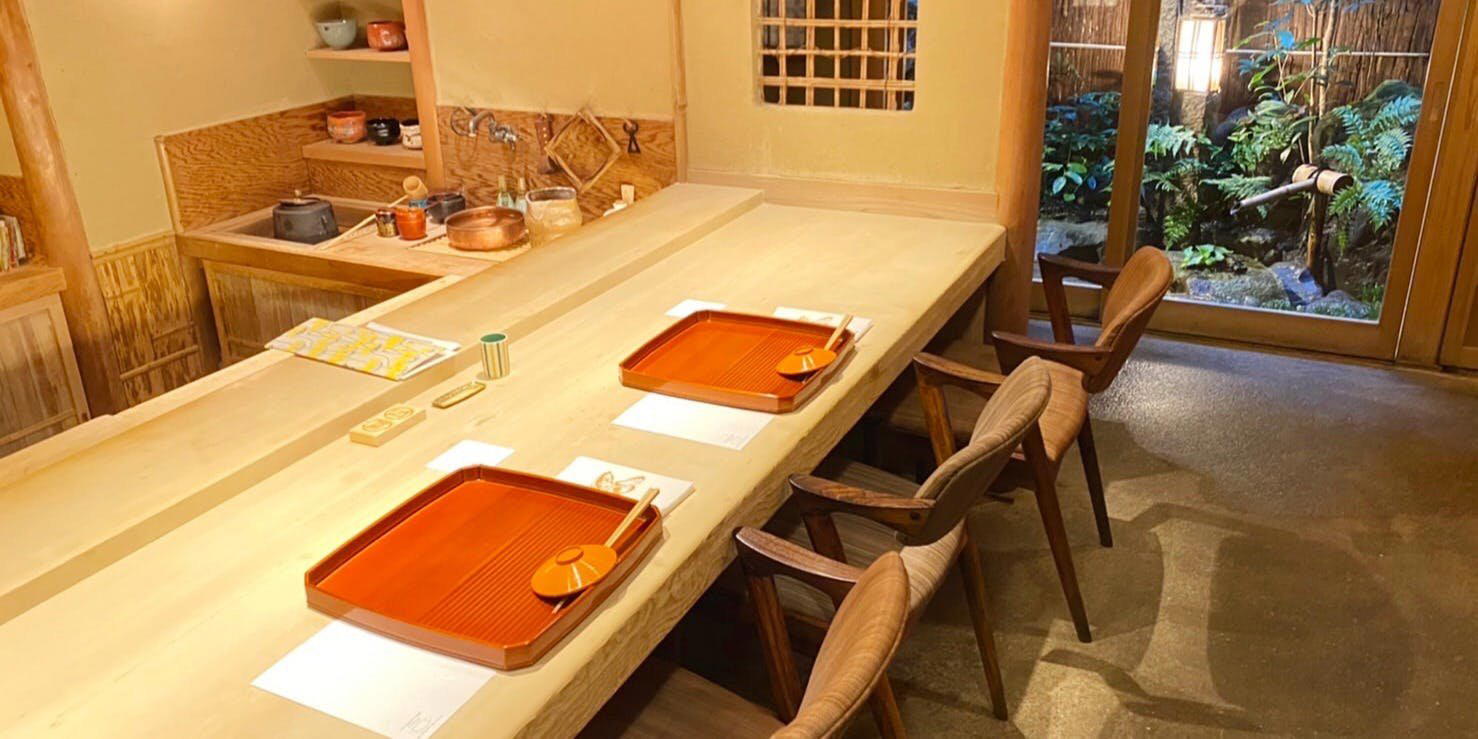
Warm, serene, and refined atmosphere with traditional Japanese aesthetic; intimate setting that encourages mindful dining and appreciation of each carefully crafted dish.