Russian Samovar
Russian Samovar has anchored Midtown's Theatre District dining scene for decades, drawing a loyal mix of Russian emigres, arts community regulars, and curious visitors to its 52nd Street address. The room trades in a particular kind of old-world conviviality, infused vodkas, classical Russian fare, and an atmosphere shaped as much by its cultural history as its menu.
Pearl is the En Primeur Club membership app — saves, bookings, and concierge access live there. Same editors, same standards.
- Address
- 256 W 52nd St, New York, NY 10019
- Phone
- +12127570168
- Website
- russiansamovar.com
- Directions
- Get directions
 Saves & bookings on Pearl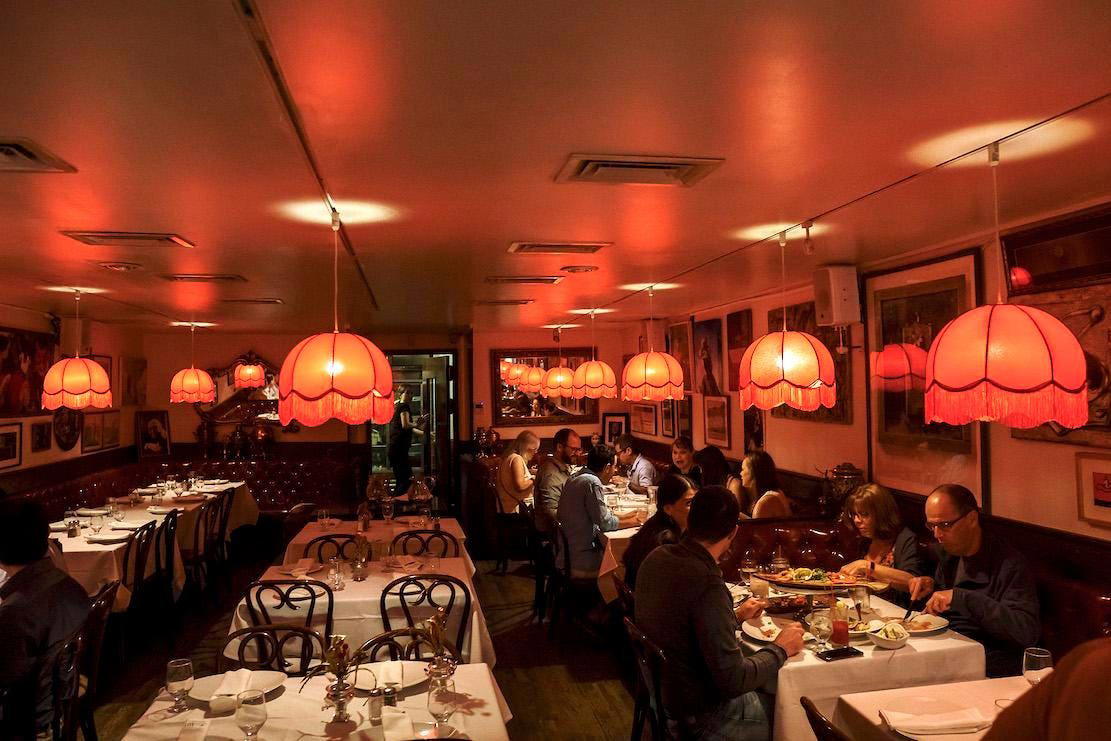
A Room With Institutional Weight
Midtown's Theatre District operates on a particular logic: proximity to Carnegie Hall and the Broadway corridor means restaurants here serve among the more socially layered dining publics in New York. Russian Samovar, at 256 West 52nd Street, has occupied that position long enough to become something of a fixed point in the neighbourhood's cultural geography. Where much of Midtown dining skews toward expense-account internationalism, see the formal French seafood register of Le Bernardin or the precise tasting-counter format of Per Se, Russian Samovar operates in a different register entirely: the convivial, vodka-forward dining room with roots in the Russian emigre community that reshaped parts of New York's arts and literary scene.
That history matters because it shaped the room's identity in ways that are difficult to manufacture. The clientele has always included Russian and Eastern European artists, musicians, writers, and performers, a community with a strong gravitational pull toward spaces that function as social institutions rather than simply restaurants. That social function, as much as any kitchen credential, is what Russian Samovar has built its reputation on across decades of operation.
The Vodka Program as Cultural Artifact
In many New York dining rooms, the beverage program functions as a complement to the kitchen. At the restaurant, the house-infused vodka selection operates closer to the center of the experience. Infused vodkas, prepared in-house with ingredients ranging from horseradish to citrus to herbs, have a long tradition in Russian hospitality culture, where the practice predates modern cocktail programming by centuries. The ritual of selecting from a list of house infusions, poured into chilled shot glasses and paired with traditional accompaniments, is less a cocktail-bar gesture and more a continuation of a specific cultural practice.
This puts the restaurant in an interesting position relative to the broader arc of New York's drinking culture, which has moved steadily toward transparent technical programs, clarified spirits, and the kind of precision associated with venues like Atomix or Jungsik New York in their respective beverage pairings. The restaurant's approach is not a counter-movement to that trend so much as a parallel tradition that never intersected with it, the infused vodka table-service format belongs to a different lineage entirely.
The Team Dynamic: Hospitality as Collective Memory
Russian-style hospitality has long been defined by a particular kind of orchestrated warmth, the interplay between the floor, the drinks team, and the kitchen, all working in concert to produce something that feels less like a timed service and more like an extended gathering. That dynamic is worth noting in the context of how New York's higher-end dining rooms have evolved. At venues like Masa, the entire front-of-house apparatus is oriented around a single counter experience; at Blue Hill at Stone Barns outside the city, the interplay between kitchen and floor is governed by a farm-to-table ideology. The restaurant's team dynamic is shaped by something different: a service tradition where the expectation is that guests linger, that rounds of vodka extend naturally into conversation, and that the floor staff operate as participants in the social occasion rather than managers of a transaction.
That model produces a different kind of evening than what you find at the Michelin-tracked tasting-menu tier represented by The French Laundry, Alinea, or Providence. It is not competing on precision or innovation; it is competing on atmosphere, cultural continuity, and the kind of ease that comes from a room that knows exactly what it is and has been doing it for a long time.
Where It Sits in New York's Dining Map
New York supports a range of European-heritage dining traditions that exist somewhat outside the mainstream critical conversation. The city's French fine-dining tier gets consistent coverage; its Korean progressives, from Atomix to Jungsik, have attracted significant critical attention; its Japanese omakase counters compete with particularly expensive rooms in the world. Russian cuisine, by contrast, occupies a less visible tier in the city's food media coverage, despite New York's historically significant Russian-speaking population concentrated in Brighton Beach and, historically, in the arts communities of Midtown and the Upper West Side.
That relative under-coverage has protected venues like Russian Samovar from the pressure to modernize in ways that might dilute their identity. The dining room has not pivoted to incorporate tasting-menu formats or contemporary Russian cuisine in the mode that, say, a progressive kitchen at Single Thread Farm or Addison has brought to their respective regional traditions. It serves the food that belongs to its particular cultural moment and community, which is a coherent position to hold, and one that regulars, many of whom have been coming for years, depend on.
For visitors arriving from outside New York, the broader context matters. Midtown's dining options range from the technically ambitious to the purely transactional. The restaurant occupies a specific niche: the storied room with genuine community roots, a beverage program that carries cultural meaning, and a front-of-house tradition built on generosity of time rather than efficiency of service. That positions it closer in spirit to a certain kind of European institution, the Parisian brasserie that feeds neighbourhood regulars and visiting artists alike, than to the chef-driven destination dining found at Emeril's, Lazy Bear, or Bacchanalia.
Internationally, the model has parallels in dining rooms that carry the weight of diaspora communities and cultural identity, venues like 8 1/2 Otto e Mezzo Bombana in Hong Kong or Alain Ducasse at Louis XV in Monte Carlo operate in different price tiers but share the quality of being rooms that mean something to a specific community, not just to passing visitors. The restaurant's version of that dynamic is more democratic in price and more rooted in a specific emigre history, but the structural similarity holds. And for the range of what serious dining looks like elsewhere on the East Coast, The Inn at Little Washington represents the formal country-house end of the American fine-dining tradition.
Know Before You Go
Credentials Lens
Comparable venues nearby, for context on price, style, and recognition.
| Venue | Cuisine | Price | Notes |
|---|---|---|---|
| Russian SamovarThis venue — the venue you are viewing | Traditional Russian | $$$ | Not listed |
| Schilling | Modern Austrian Bistro | $$$ | Financial District-Battery Park City |
| BXL Cafe | Belgian Bistro | $$ | Midtown-Times Square |
| Kafana | Authentic Serbian | $$ | East Village |
| Let's Chama! | Georgian Bakery and Restaurant | $$ | Bushwick |
| La Fusta | Authentic Argentine Steakhouse | $$ | Elmhurst |
Continue exploring
More in New York City
Restaurants in New York City
Browse all →
Bars in New York City
Browse all →
Hotels in New York City
Browse all →





At a Glance
- Elegant
- Classic
- Cozy
- Well Known
- Sophisticated
- Date Night
- Special Occasion
- Group Dining
- Late Night
- Live Music
- Historic Building
- Sake Program
- Craft Cocktails
Current opening hours
- Monday
- 5 PM–2 AM
- Tuesday
- 12 PM–2 AM
- Wednesday
- 12 PM–2 AM
- Thursday
- 12 PM–2 AM
- Friday
- 12 PM–3:59 AM
- Saturday
- 12 PM–3:59 AM
- Sunday
- 12 PM–3:59 AM
Hours can change for holidays and private events. Last verified .
Elegant 19th-century Russian decor with rich green and red tones, folk prints, cozy seating, and live piano or jazz music creating a warm, nostalgic atmosphere.