On a quiet street in Leuven's historic centre, Rossi occupies a position in the city's mid-to-upper dining tier, where Italian-inflected cooking meets the Belgian preference for produce-led simplicity. The address on Standonckstraat places it within walking distance of the university quarter, putting it in regular rotation for both academics and out-of-town visitors seeking something less formal than the city's flagship fine-dining rooms.
Pearl is the En Primeur Club membership app — saves, bookings, and concierge access live there. Same editors, same standards.
- Address
- Standonckstraat 2, 3000 Leuven, Belgium
- Phone
- +3216624848
- Website
- ristoranterossi.be
- Directions
- Get directions
 Saves & bookings on Pearl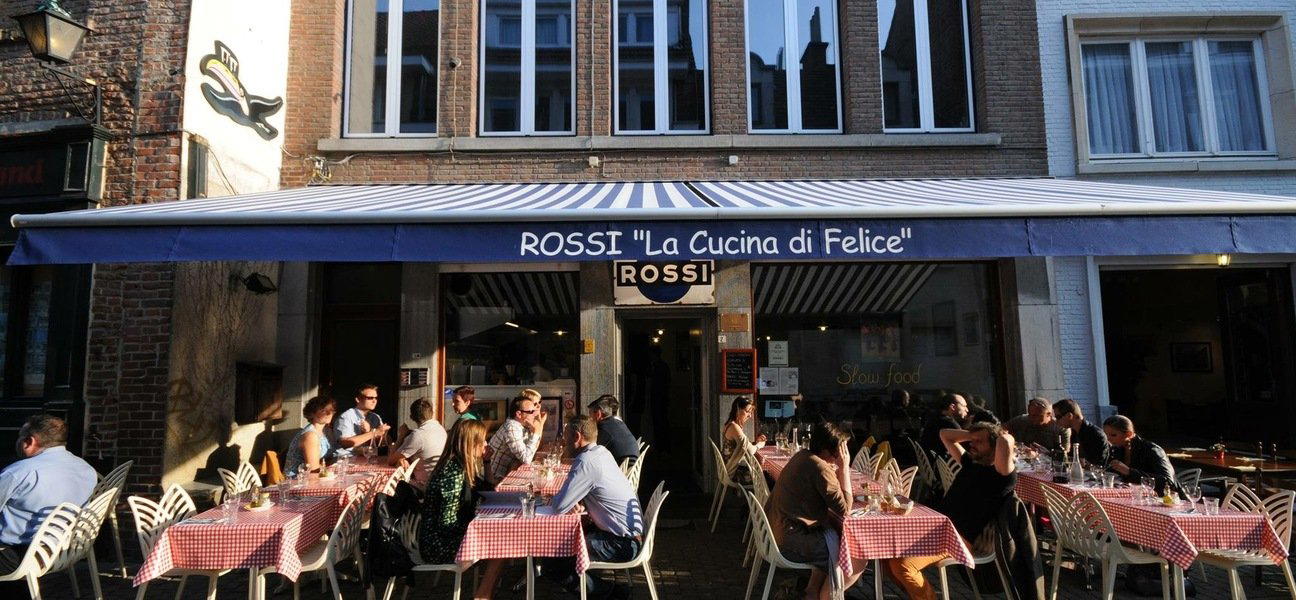
A Street-Level Entry into Leuven's Serious Dining Scene
Standonckstraat is not a restaurant street in the obvious sense. It lacks the foot traffic of Leuven's market square and the animated terrace culture of the Oude Markt. What it offers instead is a quieter proposition: the kind of address that rewards advance research rather than impulse decisions. Rossi sits on this street as a deliberate choice for a particular kind of evening, one where the setting does not compete with the food for attention, and where the room's character is legible from the moment you step inside rather than assembled from design gestures.
Leuven has developed a dining scene that punches well above its size. The city of roughly 100,000 people, anchored by KU Leuven, one of Europe's older universities, sustains a range of serious kitchens that would be unremarkable in a capital but are notable for a Flemish university town. At the more intensive end of that range sit places like EED, with its Flemish-focused tasting format, and EssenCiel, which takes a French contemporary approach at the €€€€ tier. Rossi occupies a different register within this compact field, one that is worth understanding before you book.
What the Room Communicates
Italian-named restaurants in Belgian cities occupy a broad spectrum, from neighbourhood trattorias with laminated menus to addresses that take Italy as a culinary reference point rather than a theme-park version of it. The better ones in Flemish cities tend to apply the same produce discipline that characterises the local fine-dining tradition to techniques and flavour combinations drawn from the Italian peninsula. The room itself in this type of address is typically spare rather than theatrical: natural materials, modest table spacing, lighting calibrated for conversation rather than spectacle.
At Standonckstraat 2, the physical address anchors Rossi near the university's historic core, a neighbourhood where architecture from multiple centuries sits in close proximity and where the ambient sound of the street tends toward the calm rather than the festive. Arriving on foot from the train station, which is roughly twenty minutes away through the old town, the approach through quieter streets is part of how the evening begins to settle. That kind of atmospheric build-up, arriving through a neighbourhood rather than a commercial strip, is something the better Leuven addresses share. It is also the experience at Alfalfa and Allison, both of which draw their regulars partly through location logic as much as menu logic.
The Leuven Mid-Tier and Where Rossi Fits
Belgium's serious restaurant culture is heavily concentrated in a few cities, with Ghent and Antwerp carrying significant weight at the high end. At the national level, addresses like Hof van Cleve in Kruishoutem and Boury in Roeselare define what the country's top tier looks like in a Michelin-starred context. Zilte in Antwerp and Willem Hiele in Oudenburg represent further points on that map. Within Leuven specifically, the competitive set is more concentrated and functions at a different scale. Restaurants like Baracca serve a crowd that values a certain informality alongside quality ingredients; the city's dining scene broadly values craft without ceremony.
In that context, an Italian-reference restaurant in Leuven is not competing with Brussels addresses like Bozar Restaurant or with the international-level ambition of places like Le Bernardin in New York or Atomix. Leuven's dining public is, by virtue of the university's international intake, more culinarily literate than the city's size might suggest.
What to Expect in Practice
For visitors arriving from outside Leuven, the city is most practically reached by train from Brussels, a journey of around twenty-five minutes from Brussels-Central. The compact historic centre means that most restaurant addresses are walkable from the station, which removes the logistics that complicate dining in larger cities. That accessibility is part of why Leuven has sustained a serious dining scene despite its scale: the friction of getting to a good meal is low, which encourages regulars to commit to addresses with longer lead times on bookings.
However, at this tier in a compact city with a loyal local dining public, planning at least one to two weeks ahead for a weekend table is a reasonable baseline, and further in advance for any Friday or Saturday evening. The university calendar also shapes demand: term-time periods see stronger local competition for tables, while summer months bring a different visitor mix. Other well-regarded Leuven addresses, including those in the €€€ tier such as the farm-to-table-oriented options in the city, follow similar seasonal demand patterns.
The Broader Belgian Context
Belgian dining culture places a premium on sourcing specificity and on the kind of technical care that does not require elaborate table-side production. The country's restaurant tradition, particularly in Flanders, has long favoured the well-sourced product treated with restraint over the heavily constructed dish. This applies whether you are looking at addresses with Michelin recognition, like Bartholomeus in Heist or Castor in Beveren, or at the mid-tier rooms that serve as the daily infrastructure of serious eating in smaller cities.
Italian cooking, when approached through this Flemish lens, tends to shed its more theatrical elements and retain the foundational logic: good fat, good acid, good timing. That sensibility fits naturally into Leuven's dining culture, where the expectation is that the kitchen is doing the work so the room does not have to perform. Addresses elsewhere in Belgium, like d'Eugénie à Emilie in Baudour or De Jonkman in Sint-Kruis, demonstrate that the country's kitchen culture is consistently produce-first regardless of the cuisine reference. L'air du temps in Liernu extends that logic into a more elaborated format.
For a full picture of where Rossi sits among Leuven's options and how the city's dining scene is structured, the EP Club Leuven restaurants guide maps the field by tier and cuisine type, with comparative context across the city's key addresses.
Planning Your Visit
Rossi's address at Standonckstraat 2 in the 3000 postal district places it in the heart of old Leuven, within easy reach of the main sights and the university's central buildings. The street itself is quiet enough that the approach on foot feels deliberate rather than accidental, which is consistent with how the better Leuven restaurants position themselves: as destinations you choose, not venues you stumble into. For visitors using the city as a day or overnight stop between Brussels and Germany or the Netherlands, it fits naturally into an evening that begins late afternoon and does not require returning to Brussels the same night.
Continue exploring
More in Leuven
Restaurants in Leuven
Browse all →
Bars in Leuven
Browse all →
Hotels in Leuven
Browse all →
Wineries in Leuven
Browse all →
At a Glance
- Cozy
- Classic
- Intimate
- Rustic
- Date Night
- Group Dining
- Special Occasion
- Open Kitchen
- Terrace
- Historic Building
- Local Sourcing
Current opening hours
- Monday
- Closed
- Tuesday
- 12–2 PM, 6:30–10 PM
- Wednesday
- 12–2 PM, 6:30–10 PM
- Thursday
- 12–2 PM, 6:30–10 PM
- Friday
- 12–2 PM, 6:30–10 PM
- Saturday
- 12–2 PM, 6:30–10 PM
- Sunday
- Closed
Hours can change for holidays and private events. Last verified .
Simple and convivial osteria-style atmosphere with vintage Italian décor, red and white checked tablecloths, and professional kitchen visible from dining area.
Know Before You Go
- Getting there
- Standonckstraat 2, 3000 Leuven, Belgium