Rock and Sole Plaice
On Endell Street in Covent Garden, Rock and Sole Plaice occupies a particular position in London's fish and chip tradition: one of the oldest surviving chippies in the city, trading in an area that has seen the neighbourhood transform around it while the format has remained largely unchanged. For visitors and locals alike, it represents a direct line to one of Britain's most enduring culinary traditions.
Pearl is the En Primeur Club membership app — saves, bookings, and concierge access live there. Same editors, same standards.
- Address
- 47 Endell St, London WC2H 9AJ, United Kingdom
- Phone
- +442078363785
- Website
- rockandsoleplaice.com
- Directions
- Get directions
 Saves & bookings on Pearl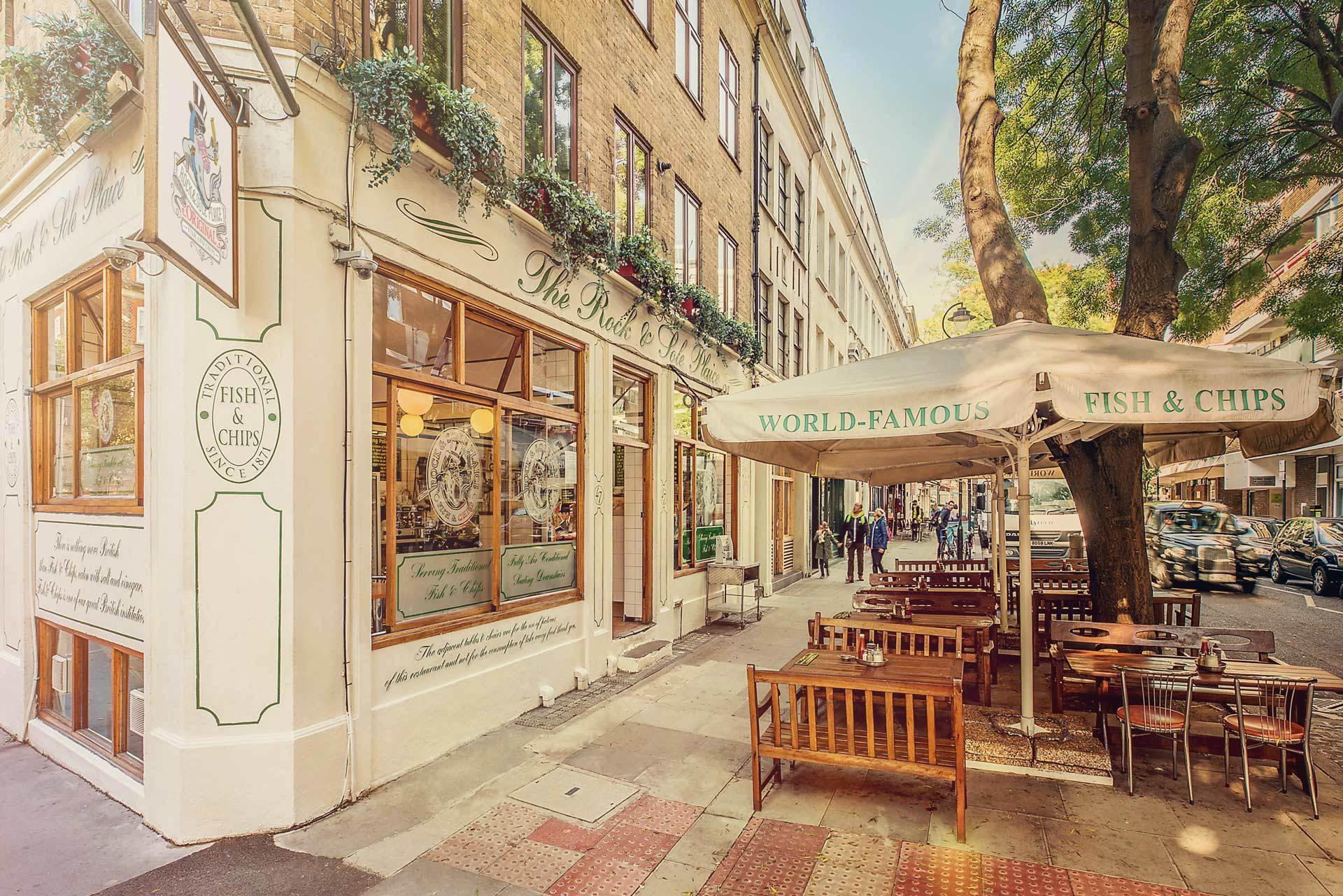
Rock and Sole Plaice is a traditional British fish and chips restaurant in London, at 47 Endell St, with.
Endell Street runs quietly between the theatre crowds of Covent Garden and the legal quarter to the east, a stretch that has absorbed waves of gentrification without fully surrendering its working character. Rock and Sole Plaice sits at number 47, a spot that has been serving fried fish in some form since the late nineteenth century, making it one of the longest-operating fish and chip shops in London. The category of institutions that have survived that long in central London, through two world wars, the post-war reconstruction of the city's retail geography, and the aggressive rent inflation of the past two decades, is a short one.
Fish and chips as a format has a specific cultural weight in Britain that distinguishes it from most other national dishes. It emerged in the industrial north and east of England in the mid-1800s, when cheap railway freight made fresh fish accessible inland and dripping provided an affordable frying medium. By the early twentieth century it had become one of the primary sources of hot, affordable protein for working-class households across the country. The dish's durability in the national consciousness owes less to refinement than to accessibility: a format that has never required a reservation, a dress code, or a particular social register to enjoy.
What the Format Represents in 2024
The fish and chip shop now occupies an interesting position in London's broader dining picture. On one end of the spectrum, Covent Garden holds some of the capital's most formal dining rooms. CORE by Clare Smyth and Restaurant Gordon Ramsay represent London's ££££ tier, where tasting menus run well into three figures and the cultural freight is entirely different. Sketch, The Lecture Room and Library, The Ledbury, and Dinner by Heston Blumenthal occupy the same tier, where the dining experience is structured around formal service, extensive wine programs, and kitchen teams numbering in the dozens.
Rock and Sole Plaice operates from a completely different premise. The value of a good chippie in central London is not measured against those rooms; it is measured against how well it executes among the more technically demanding simple preparations in British cooking. Frying fish properly requires precise oil temperature control, fresh batter mixed to the right consistency, and fish sourced and stored with care. The margin between a competent fry and a poor one is narrower than most casual diners appreciate. Across London, the number of fish and chip shops that consistently maintain quality in a high-footfall central location has always been smaller than the number of shops trading on proximity to tourists.
The Scene on Endell Street
Approaching from the Long Acre end, the shop's external seating area is visible before the frontage itself, a handful of pavement tables that fill quickly on dry days with a mix of neighbourhood workers, tourists from the adjacent Covent Garden piazza, and the occasional regular who has been coming for years. The interior is compact, with the counter taking up a significant proportion of the floor space, as it should in a working chippie. Orders go through quickly. The rhythm is transactional in the way that the category demands: this is not a room built for lingering over a second bottle.
The experience sits clearly in the walk-in, order-at-the-counter tradition rather than the sit-down restaurant tradition. That distinction matters for anyone calibrating expectations. London has a parallel category of smarter fish restaurants, some with full table service and wine lists, that sit between the chippie format and fine dining. Rock and Sole Plaice is not in that tier. It is the older form: a shop where the product is the point and the environment supports the transaction without overwhelming it.
Cultural Roots and the Question of Authenticity
The cultural significance of fish and chips is sometimes overstated in a tourist-facing register and sometimes dismissed in a food-critical one. Neither stance is particularly useful. The dish has a genuine working history that predates most of London's celebrated dining institutions. The chippie as a format served as a social leveller in British cities for the better part of a century, a place where access was determined by price rather than by social connection or advance planning.
In that context, a shop like Rock and Sole Plaice carries a different kind of historical legitimacy than, say, a modern British restaurant referencing nostalgic British flavours through a tasting menu format. The legitimacy is not about nostalgia; it is about continuity of function. The shop is doing now what it was doing a century ago, for roughly the same reasons and in roughly the same way. That is not a common thing in central London, where the economics of real estate tend to force reinvention or closure on shorter cycles.
Across Britain, the debate about what constitutes a proper fish and chip shop touches on sourcing (fresh versus frozen fish, beef dripping versus vegetable oil), portion size, the quality of the chip (floury potato varieties versus waxy, the double-fry question), and condiment provision. These are not trivial distinctions to people who care about the category. For visitors to London who want to understand British food culture at something other than the fine-dining level, the chippie tradition deserves engagement on its own terms rather than as a lesser alternative to the rooms covered elsewhere in our full London restaurants guide.
Waterside Inn in Bray, Le Manoir aux Quat'Saisons in Oxford, L'Enclume in Cartmel, Moor Hall in Aughton, Gidleigh Park in Chagford, Hand and Flowers in Marlow, hide and fox in Saltwood, Midsummer House in Cambridge, Opheem in Birmingham, and Restaurant Andrew Fairlie in Auchterarder. These are the rooms where the structural ambition of British fine dining is most visible. The restaurant is the other end of the same national food culture, and both ends are worth knowing. For international context, the distance between a neighbourhood institution like this and technically demanding seafood rooms such as Le Bernardin in New York City or precision-driven tasting formats like Atomix in New York City measures the full range of what serious engagement with food can look like.
Planning Your Visit
Side-by-Side Snapshot
Comparable venues nearby, for context on price, style, and recognition.
| Venue | Cuisine | Price | Notes |
|---|---|---|---|
| Rock and Sole PlaiceThis venue — the venue you are viewing | Traditional British Fish & Chips | $$ | Not listed |
| The Hart | Modern British Gastropub | $$ | Marylebone |
| Anya Cafe | Whimsical British Bakery Cafe | $$ | Belgravia |
| Only Running Footman | British Gastropub | $$ | Mayfair |
| Smokehouse | British Gastropub with Smoked Meats | $$ | Canonbury |
| Grind | Modern British Brasserie | $$ | St Luke's |
Continue exploring
More in London
Restaurants in London
Browse all →
Bars in London
Browse all →
Hotels in London
Browse all →



At a Glance
- Classic
- Cozy
- Well Known
- Casual Hangout
- Family
- Historic Building
- Standalone
- Local Sourcing
- Sustainable Seafood
- Street Scene
Current opening hours
- Monday
- 12–9 PM
- Tuesday
- 12–9 PM
- Wednesday
- 12–9 PM
- Thursday
- 12–9 PM
- Friday
- 12–9 PM
- Saturday
- 12–9 PM
- Sunday
- 12–8 PM
Hours can change for holidays and private events. Last verified .
Cosy seating across two floors with an al fresco patio, evoking classic British chip shop charm in the bustling heart of Covent Garden.