At 64 Rue Vieille du Temple in the Marais, Robert et Louise is one of Paris's most enduring addresses for wood-fired meat cookery. The open hearth in the dining room has been a fixture in this neighbourhood for decades, drawing locals and visitors who want something closer to a farmhouse table than a formal bistro. It operates at a pace and price point that places it firmly in the everyday Paris eating tradition.
Pearl is the En Primeur Club membership app — saves, bookings, and concierge access live there. Same editors, same standards.
- Address
- 64 Rue Vieille du Temple, 75003 Paris, France
- Phone
- +33142785589
- Website
- robertetlouise.com
- Directions
- Get directions
 Saves & bookings on Pearl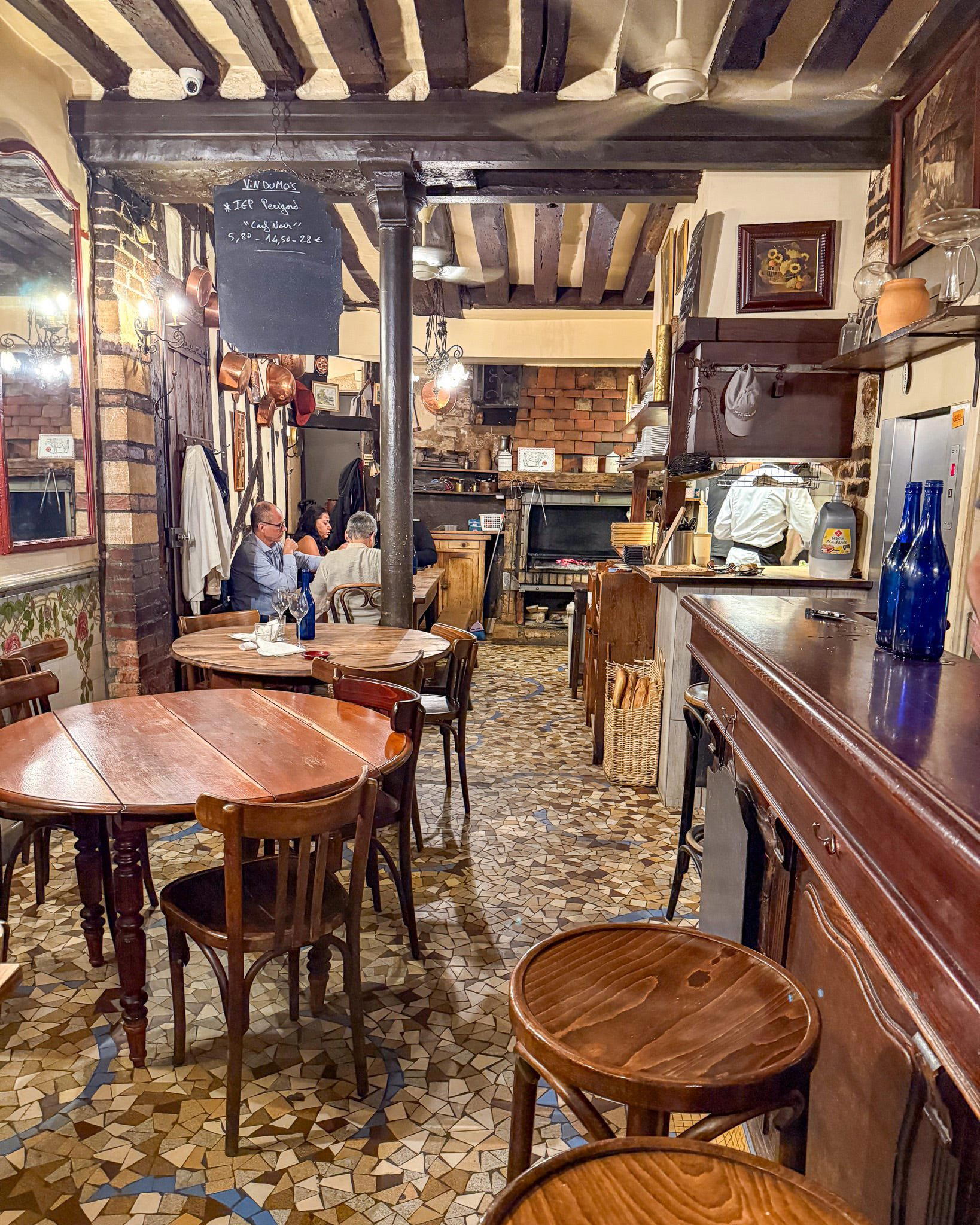
The Marais and Its Carnivore Tradition
Paris's third arrondissement has always maintained a split identity: one foot in the contemporary gallery circuit that has colonised the upper Marais since the 1990s, another in the older working-class trades that shaped the neighbourhood before the art world arrived. Rue Vieille du Temple sits squarely in that overlap, and the restaurants that have survived here longest tend to share a common characteristic: they serve food that requires no explanation. Robert et Louise, at number 64, belongs to that category. It is a wood-fire meat house in a city that has many them, but it has held its address long enough to be woven into the texture of the neighbourhood rather than simply inhabiting it.
French regional cooking — particularly the tradition of cooking large cuts over open flame — is a discipline that Paris imports rather than originates. The capital's leading fire-based cooking draws from the Auvergne, the Basque country, and the Limousin, where breed, pasture, and butchery are treated as the primary craft. What Paris does is concentrate that tradition and hold it in a form accessible to a dense urban population. In the Marais specifically, where the clientele skews toward a mix of long-term residents and visitors who have done their research, the market for this kind of direct, fire-led cooking remains consistent.
Lunch, Dinner, and Where the Difference Lives
The lunch-versus-dinner divide at a Paris meat house like Robert et Louise is less about menu variation and more about tempo and company. At midday, the room draws a working neighbourhood crowd: the pace is brisk, tables turn, and the mood is closer to a cantine than a destination. The open hearth is already working by service, and the smell of wood smoke registers before you reach the door. Daytime eating in the Marais has a particular quality in addresses like this, less performative than the evening, more in line with how Parisians actually eat when they are not entertaining.
Evening service shifts the register. Tables fill more slowly, groups linger, and the room accumulates a warmth that is partly social and partly literal, an open fire in a low-ceilinged Paris dining room is not a trivial atmospheric fact. This is the session that draws visitors who have planned ahead, and also the one where the full character of the space shows. A wood-fired grill imposes a certain pace on cooking, and dinner is where that pace makes sense. There is no rushing a côte de boeuf over an open flame, and the room's rhythm reflects that.
For value, lunch is the cleaner proposition. Paris's traditional bistro model has always concentrated its leading pricing in the midday formula, and a meat-focused address like Robert et Louise is no different in that structural respect. Evening pricing at this category of restaurant in the Marais typically runs higher for the same cuts, reflecting demand rather than any change in what is served. If you are calibrating a Paris itinerary and want to understand the fire-cooking tradition without committing to a full evening, lunch is the entry point.
Where This Fits in Paris's Dining Hierarchy
The Paris restaurant spectrum runs from three-star addresses like L'Ambroisie in the Place des Vosges and Alléno Paris au Pavillon Ledoyen at the leading, through contemporary fine dining addresses like Kei and Le Cinq at the Four Seasons George V, and down into the everyday bistro tier that constitutes the city's actual daily eating. Robert et Louise operates in that everyday tier. It does not compete with the formal dining circuit, and it does not try to.
That approach connects the restaurant more directly to France's regional fire-cooking heritage than to any Parisian culinary movement. The tradition it draws from is the same one explored at different registers by addresses like Bras in Laguiole or Auberge de l'Ill in Illhaeusern, the idea that French cooking is most itself when it is most regional, most tied to a specific ingredient or method. At the restaurant, that method is the open hearth, and everything on the plate follows from it.
For a broader map of where this address sits among Paris's options, see our full Paris restaurants guide. Readers interested in how fire-led cooking operates at the fine-dining end of the French spectrum might also look at Flocons de Sel in Megève, Troisgros in Ouches, or Mirazur in Menton. For comparison with how the French classical tradition plays out in other countries, Le Bernardin in New York offers a useful counterpoint, and Atomix shows how far contemporary fine dining has moved from the same base.
French regional addresses like Auberge du Vieux Puits in Fontjoncouse, Paul Bocuse in Collonges-au-Mont-d'Or, Au Crocodile in Strasbourg, Assiette Champenoise in Reims, and AM par Alexandre Mazzia in Marseille each represent a different expression of France's regional cooking tradition, and together they frame the culinary distance between the starred restaurant circuit and the everyday Paris meat house. And at the creative end of the Parisian spectrum, Arpège offers a strong counterpoint for readers who want to understand how radically the city's leading tables have moved away from the fire-and-meat tradition.
Planning Your Visit
| Detail | The restaurant | Comparable Marais bistros | Formal Paris dining |
|---|---|---|---|
| Price tier | Mid-range bistro | Mid-range bistro | €€€€ (tasting menus) |
| Booking lead time | Short to medium | Short to medium | Weeks to months ahead |
| Leading session | Lunch for value; dinner for atmosphere | Lunch formula typically leading value | Dinner dominant |
| Walk-in viability | Possible off-peak; weekends harder | Generally similar | Rarely possible |
| Address | 64 Rue Vieille du Temple, 75003 | Various, 3rd and 4th arr. | Scattered across arrondissements |
How Robert et Louise Paris compares with similar nearby venues.
| Venue | Cuisine | Price |
|---|---|---|
| Breizh Café | Breton - Crepes | Not listed |
| Dessance | Modern Cuisine | €€€ |
| Baffo | Italian | €€€ |
Continue exploring
More in Paris
Restaurants in Paris
Browse all →
Bars in Paris
Browse all →
Hotels in Paris
Browse all →



At a Glance
- Rustic
- Cozy
- Classic
- Intimate
- Casual Hangout
- Group Dining
- Special Occasion
- Open Kitchen
Current opening hours
- Monday
- 5:30–11 PM
- Tuesday
- Closed
- Wednesday
- Closed
- Thursday
- 5:30–11 PM
- Friday
- 5:30–11 PM
- Saturday
- 12–3 PM, 5:30–11 PM
- Sunday
- 12–11 PM
Hours can change for holidays and private events. Last verified .
Rustic with exposed wooden beams, crackling open fireplace, rough wooden tables shared with strangers, and a warm, convivial atmosphere.