Road to Seoul Korean BBQ
Our verdict
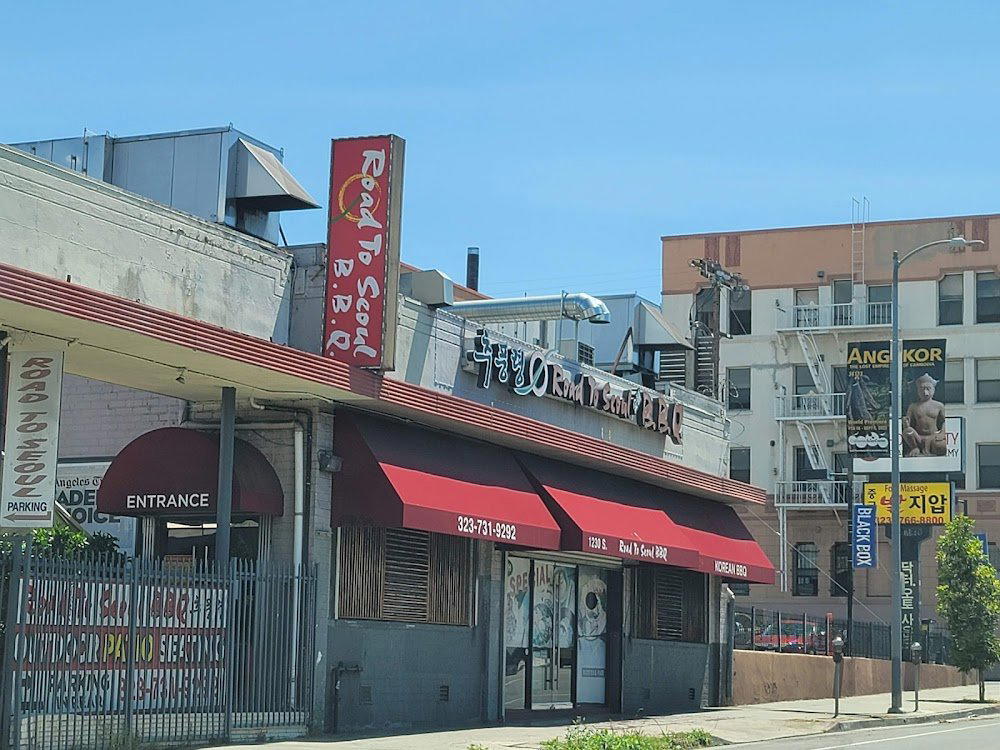
On South Western Avenue in Koreatown, Road to Seoul Korean BBQ sits inside one of Los Angeles's most concentrated corridors of Korean dining. The format follows the grill-at-table tradition central to Korean BBQ culture, where the menu's architecture — cuts, accompaniments, and sequence — does the work that a tasting menu might elsewhere. For visitors moving between LA's broader dining circuit and its ethnic dining enclaves, this is a useful and honest address.

Pearl is the En Primeur Club membership app — saves, bookings, and concierge access live there. Same editors, same standards.
- Address
- 1230 S Western Ave, Los Angeles, CA 90006
- Phone
- (323) 731-9292
- Hours
- Mon–Thu 11:30 AM–11:30 PMFri–Sat 11:30 AM–1 AMSun 11:30 AM–12 AM
- Website
- roadtoseoul.net
- Directions
- Get directions
- Booking
- Book on the venue's website
The menu
What to order
- Marinated Beef Short Ribs
- Grilled Octopus
- Bulgogi
- LA Kalbi
South Western Avenue and the Grammar of Korean BBQ
Koreatown's dining density is unlike anywhere else in Los Angeles. The stretch of Western Avenue running south from Olympic Boulevard into the mid-Wilshire grid holds more Korean restaurants per block than most American cities hold in total. Road to Seoul Korean BBQ, at 1230 S Western Ave, operates inside that competitive ecosystem — not on its periphery. Understanding what the restaurant does requires understanding what Korean BBQ, as a format, actually demands of a kitchen and a dining room.
Korean BBQ is one of the few dining traditions where the menu functions as a set of instructions rather than a list of choices. The cuts selected, the order in which they are grilled, the banchan (side dishes) that arrive alongside, and the way proteins move from raw to ready at the table — all of this constitutes a structure as deliberate as a tasting menu at, say, Hayato or Kato, though the register is entirely different. Where those counters impose sequence through a chef's decision, Korean BBQ hands sequencing authority to the table itself, which is either liberating or disorienting depending on the diner's familiarity with the format.
What the Menu Architecture Tells You
The editorial angle most useful for a venue like Road to Seoul is not what the menu contains but how it is organized, what that organization reveals about the kitchen's priorities and the style of experience on offer. Korean BBQ menus in LA's Koreatown typically segment across two axes: cut quality (from entry-level samgyeopsal, or pork belly, up through premium beef cuts like galbi and chadolbaegi) and table management style (whether staff handle the grill or diners do). These choices are not cosmetic; they determine the pace, the interaction, and the ultimate cost of the meal.
Across Koreatown, the restaurants that have built the most durable reputations tend to specialize rather than generalize: a tight selection of well-sourced cuts, consistent banchan quality, and grills that are maintained rather than ignored. The format rewards specificity. A menu that sprawls across too many proteins often signals a kitchen managing volume over precision. The better addresses, and this is true in Seoul's Mapo district as much as in LA's Koreatown, edit deliberately.
Road to Seoul operates at 1230 S Western, an address that places it within easy reach of Koreatown's heaviest foot traffic, giving it access to both the neighborhood's Korean-American regulars and the wider Los Angeles dining public that has, over the past decade, made Korean BBQ one of the city's most frequently searched dining categories. That demographic breadth is reflected in how Koreatown venues have evolved: English-language menus, QR code ordering, and tableside service have become standard, lowering the barrier to entry without fundamentally altering the tradition.
Koreatown in the Broader LA Dining Picture
Los Angeles has a dining scene that operates across dramatically different registers simultaneously. On any given night, the city sustains tasting-menu counters at the level of Somni and Providence, as well as neighborhood institutions in Koreatown, East LA, and the San Gabriel Valley that draw no critical attention and need none. Road to Seoul belongs to the latter category, a working restaurant in a working neighborhood, priced and formatted for repeat visits rather than occasion dining.
This is worth stating plainly because it affects how you should frame a visit. The comparison set for a Koreatown Korean BBQ is not Osteria Mozza or Le Bernardin in New York City or Atomix in New York City, the last of which represents the fine-dining interpretation of Korean cuisine at its most technically rigorous. The comparison set is the block itself: the other grill houses within a quarter mile, the ones that have been feeding Koreatown since the 1980s and the ones that opened in the past five years chasing the same audience.
South Western Avenue is one of the busier corridors in Koreatown, which means a restaurant here benefits from walk-in traffic, proximity to transit, and the kind of ambient visibility that drives repeat visits. Those structural advantages are worth more in this category than a single glowing review.
The Tradition Behind the Grill
Korean BBQ as practiced in Los Angeles carries the same core logic it holds in Korea: the grill is communal infrastructure, not just a cooking method. The meal is built around shared plates, accumulating flavors, and a pace that resists the American tendency to hurry through courses. This is why the format has proven so durable in LA, it aligns with how the city's multicultural dining public already eats, which is to say, collectively and over time.
Banchan, the rotating selection of fermented, pickled, and seasoned side dishes that arrive before the meat, is where a kitchen signals its seriousness most quietly. A kimchi that has been aged rather than rushed, a japchae with proper glass noodle texture, a kongnamul that is seasoned with restraint: these details are invisible to a first-time visitor and obvious to anyone who eats Korean food regularly. They are also the details most frequently cut when a restaurant is managing volume over quality.
For context on how Korean cuisine has evolved at the fine-dining end of the American spectrum, Atomix in New York City represents one pole, an omakase-format Korean restaurant with a highly controlled menu structure and significant critical recognition. Road to Seoul represents the other pole: the everyday, democratic, grill-at-table format that predates fine-dining Korean by several decades and will likely outlast it. Both traditions are legitimate. They are simply not in conversation with each other.
Planning Your Visit
Road to Seoul Korean BBQ is located at 1230 S Western Ave, Los Angeles, CA 90006, in the heart of Koreatown. The address is accessible by Metro (Wilshire/Western station on the Purple Line sits nearby) and has the parking conditions typical of this part of LA, street parking requires patience, and nearby lots are the practical alternative. Koreatown restaurants in this corridor tend to be busiest on weekend evenings, when wait times at the most established grill houses can extend considerably; arriving before 6:30pm on a Friday or Saturday is a reliable way to reduce that friction.
For visitors building a broader Los Angeles dining itinerary, our full Los Angeles restaurants guide maps the city's dining across neighborhoods and price tiers, from Koreatown's grill houses to the tasting-menu counters of the Westside. Additional reference points for the national fine-dining context include Lazy Bear in San Francisco, Alinea in Chicago, The French Laundry in Napa, Addison in San Diego, Single Thread Farm in Healdsburg, Blue Hill at Stone Barns in Tarrytown, The Inn at Little Washington, Bacchanalia in Atlanta, Emeril's in New Orleans, and 8 1/2 Otto e Mezzo Bombana in Hong Kong, each representing a different national or regional tradition at a different price point.
Quick reference: 1230 S Western Ave, Los Angeles, CA 90006. Korean BBQ format. Koreatown neighborhood. Metro-accessible via Purple Line.
Frequently asked questions
Does Road to Seoul Korean BBQ work for a family meal?
Korean BBQ is structurally well-suited to groups of mixed ages. The communal grill format at the center of the table keeps the meal interactive, and the variety of banchan and proteins means different preferences can be accommodated without ordering separately. Road to Seoul sits in Koreatown on S Western Ave, a corridor where family dining is the norm rather than the exception — the surrounding neighborhood is built around that format.
What is the atmosphere like at Road to Seoul Korean BBQ?
Western Avenue through Koreatown operates at a different pitch than LA's more scenester-driven dining corridors. Expect a room where the energy comes from the grills themselves — smoke, sound, the pace of service managing multiple tables at once. Road to Seoul at 1230 S Western Ave sits inside one of the densest concentrations of Korean dining in North America, which sets a baseline expectation of authenticity over performance.
How does Road to Seoul Korean BBQ compare to other Korean BBQ restaurants in Koreatown?
Koreatown's S Western Ave corridor is among the most competitive stretches of Korean dining outside Seoul, with multiple well-established BBQ houses operating within blocks of each other. Road to Seoul at 1230 S Western Ave competes in that same local context, where the comparison set is entirely Korean-operated and the standards are set by a community that eats this food daily rather than occasionally. That peer pressure tends to keep quality consistent across the strip.
What should I order at Road to Seoul Korean BBQ?
At a Korean BBQ house on the Western Ave corridor, the grill proteins are the organizing logic of the meal — galbi and samgyeopsal are the structural benchmarks by which Koreatown regulars read a kitchen. The banchan spread arriving before the grill heats up signals the kitchen's attention to detail as much as any main order does. Specific menu details for Road to Seoul are best confirmed directly at the venue, as offerings can shift seasonally.
Where do I go for Road to Seoul Korean BBQ?
Road to Seoul Korean BBQ is located at 1230 S Western Ave, Los Angeles, CA 90006, Los Angeles.
Credentials Lens
Comparable venues nearby, for context on price, style, and recognition.
| Venue | Cuisine | Price | Notes |
|---|---|---|---|
| Road to Seoul Korean BBQThis venue — the venue you are viewing | All-You-Can-Eat Korean BBQ | $20–30 | Not listed |
| KingChang-La | Authentic Korean BBQ | $30–50 | Wilshire Center |
| Chimmelier | Korean Fried Chicken & Street Food | $20–30 | Westlake |
| Seogwan by Yellow Cow | Korean BBQ & Naengmyeon | $30–50 | Koreatown |
| Yuk Dae Jang | Traditional Korean Soup Specialist | $10–20 | Wilshire Center |
Continue exploring
More in Los Angeles
Restaurants in Los Angeles
Browse all →
Bars in Los Angeles
Browse all →

Hotels in Los Angeles
Browse all →
Wineries in Los Angeles
Browse all →
Details
- Lively
- Trendy
- Energetic
- Group Dining
- Casual Hangout
- Late Night
- Open Kitchen
- Sake Program
- A La Carte
- Buffet
- Gluten Free Options
Current opening hours
- Monday
- 11:30 AM–11:30 PM
- Tuesday
- 11:30 AM–11:30 PM
- Wednesday
- 11:30 AM–11:30 PM
- Thursday
- 11:30 AM–11:30 PM
- Friday
- 11:30 AM–1 AM
- Saturday
- 11:30 AM–1 AM
- Sunday
- 11:30 AM–12 AM
Hours can change for holidays and private events. Last verified .