Yuk Dae Jang
Our verdict
Yuk Dae Jang sits on West 6th Street in Koreatown, one of Los Angeles's most concentrated corridors for Korean dining.

Pearl is the En Primeur Club membership app — saves, bookings, and concierge access live there. Same editors, same standards.
- Address
- 3033 W 6th St ste 104-105, Los Angeles, CA 90020
- Phone
- (213) 352-1331
- Hours
- Mon–Thu 11 AM–9 PMFri–Sat 11 AM–11 PMSun 11 AM–9 PM
- Website
- rebrand.ly
- Directions
- Get directions
- Booking
- Book on the venue's website
The menu
What to order
- Original YukGaeJang
- Handmade steamed dumpling (Pork)
- Marinated pork belly
Koreatown's Cooking Register
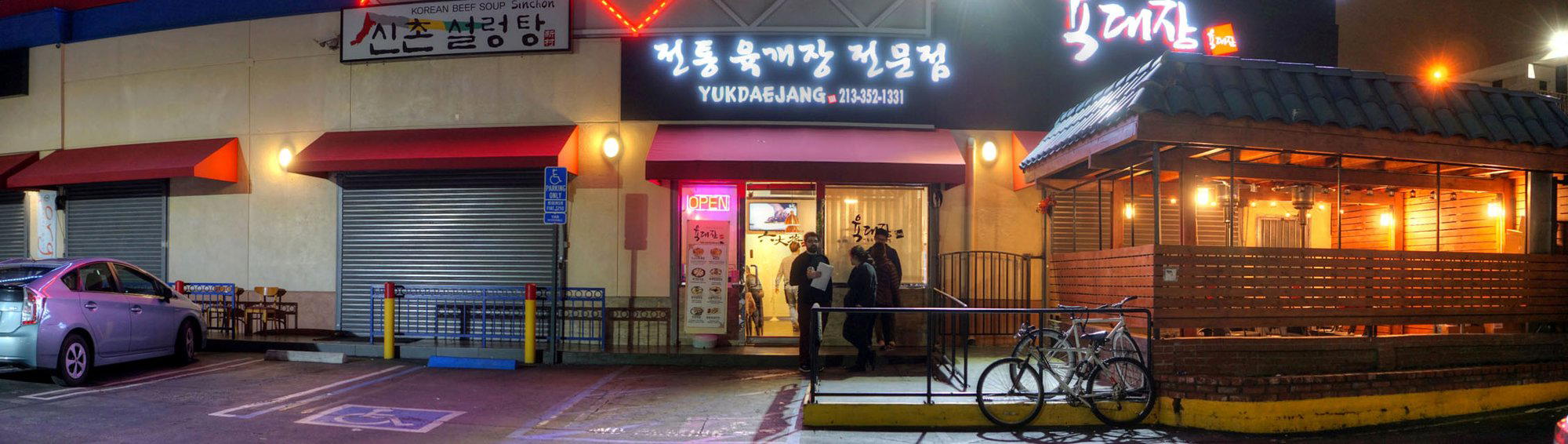
West 6th Street runs through the commercial spine of Koreatown, a district that functions less like a tourist destination and more like a working neighbourhood with one of the highest concentrations of Korean-owned restaurants in the continental United States. The cooking here is not calibrated for outside audiences. It runs on broth that simmers overnight, banchan that arrives without being ordered, and a rhythm of service that assumes the diner already knows how things work. Yuk Dae Jang, at the corner of 6th and Catalina inside a low-rise retail complex, sits squarely inside that register.
The name itself signals the kitchen's orientation. Yukgaejang, the fiery, slow-cooked beef and vegetable soup from which the restaurant takes its identity, is a dish that rewards patience in preparation and familiarity in consumption. It is not the kind of food that performs well on a tasting menu or photographs easily. It rewards return visits more than first impressions, which is the operating logic of most serious neighbourhood restaurants in this part of the city.
What the Neighbourhood Demands
Koreatown operates on a different scheduling logic than the reservation-heavy dining corridors further west. The blocks around Wilshire and 6th are dense with lunchtime workers, late-night diners, and weekend family groups who move between restaurants with a fluency that reflects long familiarity. Many of the neighbourhood's most-frequented spots hold no online reservation system and accept walk-ins as a default. The result is a dining culture where wait times and crowd dynamics matter more than advance booking strategy, and where the relationship between kitchen output and diner expectation is unusually direct.
For visitors accustomed to the reservation infrastructure that governs access to places like Kato, Hayato, or Somni, the Koreatown model requires a different kind of planning. There is no weeks-ahead reservation to secure, but there is real competition for seats during peak hours, particularly on weekend evenings and Sunday lunch. Arriving before the rush, or timing a visit to a weekday midday, tends to reduce friction substantially.
The Booking Experience at Yuk Dae Jang
Based on available data, Yuk Dae Jang does not publish a phone number or website through standard listing channels, which places it in a category of Koreatown restaurants that operate largely through foot traffic, community word-of-mouth, and repeat clientele rather than digital booking infrastructure. This is not unusual for the neighbourhood. A significant portion of the Korean dining scene on this corridor functions without OpenTable or Resy integration, and the restaurants that do not advertise aggressively often develop some of the most consistent local followings.
The practical implication for first-time visitors is direct: plan to arrive in person, treat timing as your primary variable, and consider a weekday visit if weekend queues are a concern. The address, 3033 W 6th Street, Suite 104-105, places the restaurant inside a multi-tenant retail complex that can require a brief search to locate if you are approaching from an unfamiliar direction. Street parking on 6th is possible but frequently competitive; the surrounding blocks and surface lots are a more reliable option during busy periods.
This walk-in, community-facing model connects Yuk Dae Jang to a longer tradition of Korean restaurant culture that prizes consistency and neighbourhood loyalty over visibility in national dining circuits. The restaurants in this tier are not trying to compete with the tasting menu format of Providence or the wine-forward Italian register of Osteria Mozza. They operate in a parallel economy of value, repetition, and specificity that defines how the neighbourhood actually eats.
Broth-Led Cooking and the Logic of Return
The broth-led cooking that Yuk Dae Jang draws from is a category with its own internal hierarchy in Korean culinary tradition. Yukgaejang sits alongside gomtang, seolleongtang, and galbi-tang as soups that require long extraction times and careful seasoning calibration. The difference between a version that has been rushed and one that has been given the necessary hours is immediately legible in the bowl. Regulars to restaurants of this type develop a preference based on accumulated visits rather than a single assessment, which is part of what sustains these kitchens over time.
This is a different kind of dining proposition from the destination restaurants that draw visitors to the west side or downtown. Places like Le Bernardin in New York City, The French Laundry in Napa, or Blue Hill at Stone Barns in Tarrytown operate on a logic of occasion and event. The Korean broth restaurants of Koreatown operate on a logic of sustenance and recurrence. Both are legitimate, but they require different frameworks for evaluation and different strategies for access.
For a broader picture of how these restaurants fit into the city's full dining range, the EP Club Los Angeles restaurants guide maps the scene across cuisine types, price tiers, and neighbourhoods, from Koreatown to the Westside to downtown's evolving dining corridor.
Planning Your Visit
| Venue | Cuisine | Price Tier | Booking Method | Advance Required |
|---|---|---|---|---|
| Yuk Dae Jang | Korean (Broth/Soup) | Not published | Walk-in (no website/phone listed) | No |
| Kato | New Taiwanese, Asian | $$$$ | Online reservation | Weeks ahead |
| Hayato | Japanese | $$$$ | Online reservation | Months ahead |
| Somni | Molecular | $$$$ | Online reservation | Months ahead |
Frequently asked questions
Where do I go for Yuk Dae Jang?
Yuk Dae Jang is located at 3033 W 6th St ste 104-105, Los Angeles, CA 90020, Los Angeles.
Is Yuk Dae Jang a good option for solo diners in Koreatown?
Soup-house dining in Koreatown is one of the more solo-friendly formats in Los Angeles, with counter or small-table seating common across the neighbourhood. Yuk Dae Jang's walk-in model at 3033 W 6th Street means there is no minimum party size or reservation required, making a single-bowl lunch visit straightforward.
What's the best thing to order at Yuk Dae Jang?
Start with the yukgaejang. The restaurant's name signals its focus: this is a kitchen organised around that specific broth, a long-simmered spicy beef and vegetable soup that sits at the serious end of Korean cooking. Everything else on the menu exists in relation to that anchor dish.
How hard is it to get a table at Yuk Dae Jang?
Yuk Dae Jang does not publish a reservation system, so access works on a walk-in basis. The restaurant sits at 3033 W 6th Street in Koreatown, a corridor where soup houses tend to fill quickly at peak lunch and dinner hours. A weekday visit before noon or after the main lunch rush is the most reliable approach.
What's Yuk Dae Jang best at?
Broth-led cooking in the yukgaejang tradition. In Koreatown's competitive soup-house category, a restaurant that names itself after a single dish is making a clear declaration about where its kitchen focuses. That specificity is the clearest reason to visit.
Do they accommodate allergies at Yuk Dae Jang?
No phone number or website is publicly listed for Yuk Dae Jang at 3033 W 6th Street, which makes advance communication about dietary requirements difficult. If allergies are a concern, arriving in person during a quiet service period gives the best chance of a direct conversation with staff before ordering.
Nearby-ish Comparables
Comparable venues nearby, for context on price, style, and recognition.
| Venue | Cuisine | Price | Awards | Notes |
|---|---|---|---|---|
| Yuk Dae JangThis venue — the venue you are viewing | Traditional Korean Soup Specialist | $10–20 | Not listed | Not listed |
| Jeon Ju Korean Bibimbap Restaurant | Korean Bibimbap Specialist | Not listed | Not listed | Pico-Union |
| Hanbat Sul Lung Tang | Traditional Korean Sul Lung Tang | $10–20 | Not listed | Wilshire Center |
| Eight Korean BBQ | Modern Korean BBQ | Not listed | Not listed | Koreatown |
| Origin Korean Barbecue | Authentic Korean BBQ | $50–100 | LA Times 101 Best Restaurants #96 | Wilshire Center |
| Terracotta | Korean-Asian Fusion with Japanese Influences | $50–100 | Not listed | Wilshire Center |