
Tabelog 100 #51
Our verdict
Restaurant Tsujikawa sits in Osaka’s creative dining lane, where French technique, Japanese structure, fish-led cooking and wine service meet in a compact counter-and-table format. Its 2025 Tabelog 100 selection for Innovative / Creative cuisine places it in a serious local category rather than the casual fusion bracket.

Pearl is the En Primeur Club membership app, where members save venues, book tables and use the concierge.
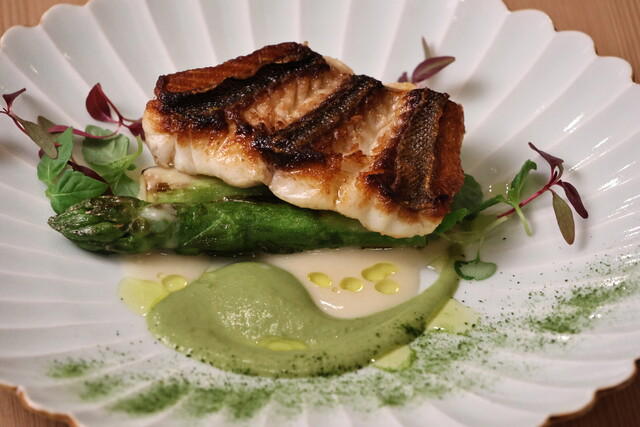
The menu
What to order
- Seasonal French–Japanese fusion tasting course
- Original chocolate terrine
- Parfait dessert
Osaka changes register quickly: retail pressure gives way to quieter entrances and dining rooms built for concentration rather than spectacle. In that setting, Restaurant Tsujikawa belongs to Osaka’s creative-cuisine tier, the kind of room where the meal is judged by pacing, composition and restraint rather than spectacle alone.
Osaka is often flattened into takoyaki, kushikatsu and late-night appetite, but the city’s higher-end dining culture has another rhythm. Creative restaurants here can borrow freely from French kitchens while keeping Japanese habits of seasonality, balance and course progression. Tsujikawa’s listed categories, Creative, French and Japanese Cuisine, place it inside that cross-current rather than in a single national tradition. The point is not novelty for its own sake; it is a style of dining where technique, Japanese sensibility and composed-course thinking can share the same table without feeling like a theme.
French-Japanese creative cooking, read through Osaka restraint
The useful comparison is not with Osaka’s everyday counters or nostalgic comfort-food stops, though those define another part of the city’s appetite. Curry Ya Dekkao and Spice Curry Te sit in a different dining lane, while Usami Tei Matsubaya reflects another side of the city’s range. Restaurant Tsujikawa occupies its own bracket: a meal built around a more composed format, a creative category and a level of recognition that sets it apart from casual dining.
That distinction matters because Osaka’s creative dining is less easily reduced to one template than many first-time visitors expect. The better local examples tend to prize proximity and focus. Dining rooms in this genre can turn preparation into atmosphere: quiet movement, plate changes, glassware, the small pause before the next course. Tsujikawa’s appeal sits in that close-range register. It is not a restaurant best understood as background to a night out; it is a focused format where the kitchen’s decisions are central to the experience.
The restaurant’s 2025 selection for Tabelog Hyakumeiten in its relevant creative-dining context is the key external signal. Tabelog’s Hyakumeiten lists are category-specific rather than broad luxury rankings, which makes the recognition especially relevant here: it places the restaurant among venues being assessed for creative and innovative cooking, not merely for price or ceremony. A listed score of 3.67 also gives useful context in Japan, where Tabelog ratings tend to cluster tightly and decimal movement carries more weight than it would on many international platforms.
The room is focused enough for timing to matter
Atmosphere in this genre is not only visual. It is the tempo of a course arriving before conversation drifts, the careful reset between plates, the difference between a dish shaped by Japanese habits and one that merely borrows Japanese ingredients. Tsujikawa’s category signals a meal closer to a focused creative progression than a flexible all-evening bistro, and its price bracket points to a restaurant where the evening should be planned rather than treated as a casual drop-in.
The cross-current between French and Japanese Cuisine is also telling. Osaka has deep food culture and a practical relationship with ingredients, but creative restaurants use that base differently from more narrowly defined specialist rooms. In a French-Japanese context, technique becomes the point of attention: heat, sauce, garnish, acidity, texture and service temperature. Without naming dishes that are not publicly specified, the category itself tells an informed diner what to watch for. The success of this style rests on whether the creative structure sharpens the meal rather than weighing it down.
For travelers mapping a broader Osaka itinerary, Tsujikawa fits as a planned restaurant choice within the city rather than as an incidental snack stop. Osaka makes sense for diners who want to pair shopping, bars and dinner without turning the evening into a logistics exercise. For a wider edit of the city, start with Our full Osaka restaurants guide, then widen the planning lens with Our full Osaka hotels guide, Our full Osaka bars guide, Our full Osaka wineries guide and Our full Osaka experiences guide.
How to place it in a city built on appetite
Osaka rewards diners who separate categories rather than chase a single grand meal to explain the city. Everyday snacks, bakeries, coffee stops, casual counters and more ambitious dining rooms all tell different stories about the same city. Tsujikawa’s role is narrower and more deliberate: it shows how Osaka handles creative dining when the cuisine crosses borders and the meal asks for attention.
The practical reading is clear. This is not the address for diners seeking a casual walk-in snack or a children-first family meal. It is better suited to solo diners comfortable with focused dining, couples who prefer concentration over spectacle, or friends who want a composed dinner in the conversation. Private-room or large-party expectations should be checked directly with the restaurant; the appeal is the focused dining format, not a sense of separation from it.
Within Osaka, the comparison set should stay grounded in category and purpose. Oimatsu Hisano, Tonkatsu Koshirou and Usami Tei Matsubaya speak to different dining moods, while Curry Ya Dekkao and Spice Curry Te show how much range the city can hold. Other unnamed dining rooms in Osaka add still more context, but Tsujikawa’s point is specific: Japanese dining language changes meaning depending on setting, price, category and intent.
Restaurant Tsujikawa is strongest as a choice for diners who want Osaka without caricature. The meal sits away from the city’s loudest shorthand and closer to its skilled, compact, ingredient-aware dining culture. In a city where appetite is public, fast and generous, this is the quieter counterpoint: a creative frame, a serious price bracket and enough recognition to justify taking it seriously.
Frequently asked questions
Is Restaurant Tsujikawa open every day?
Check Restaurant Tsujikawa’s current opening days and hours directly before visiting, as schedules can change.
Is Restaurant Tsujikawa expensive?
Pricing at Restaurant Tsujikawa is listed as Dinner: JPY 10,000 - JPY 14,999; Lunch: JPY 4,000 - JPY 4,999.
What's Restaurant Tsujikawa's location?
Restaurant Tsujikawa is located in Osaka.
What's the signature at Restaurant Tsujikawa?
The house style sits in the Creative, French and Japanese Cuisine categories. Its 2025 Tabelog Hyakumeiten recognition and listed score of 3.67 are the clearest external signals of how it is positioned.
What if I have allergies at Restaurant Tsujikawa?
Use the reservation line, +81-6-6241-5677, or contact the restaurant before visiting. Advance discussion is the sensible way to handle allergies or dietary restrictions.
Snapshot
Comparable venues at similar price and category levels.
| Venue | Cuisine | Price | Awards | Notes |
|---|---|---|---|---|
| Restaurant TsujikawaThis venue (the venue you are viewing) | French–Japanese Creative Cuisine | $50–100 | Tabelog 100 #51 | Not listed |
| MAKE ONE TWO | Asian Stand Bar / Izakaya | $10–20 | Tabelog 100 #97 | Chūō |
| Makisumi Madara | Creative wood & charcoal Japanese-Italian with yakitori focus | $50–100 | Tabelog 100 #27 | Kita |
| SANADA | Innovative Fusion Tasting Menu | $150–200 | Tabelog 100 #95 | Kita |
| IAKU | Innovative French–Italian Tasting Menu | $150–200 | Tabelog 100 #42 | Kita |
| Taishu Shokudo Kawaramachi Blanc | Japanese Western (Yoshoku) Bistro | $50–100 | Tabelog 100 #1 | Kita |
Recognition history
Dated appearances from independent guides and award organizations, with the underlying list record or original source where available.
Tabelog 100 #51 · No. 51
Tabelog · Tabelog 100 - Innovative / Creative cuisine - 2025
Continue exploring
More in Osaka
Restaurants in Osaka
All restaurants in Osaka →



Bars in Osaka
All bars in Osaka →

Hotels in Osaka
All hotels in Osaka →



Wineries in Osaka
Browse all →
Details
- Cozy
- Elegant
- Intimate
- Sophisticated
- Date Night
- Special Occasion
- Celebration
- Business Dinner
- Solo
- Chefs Counter
- Standalone
- Design Destination
- Extensive Wine List
- Local Sourcing
- Tasting Menu
- Set Menu
- Wine
Current opening hours
- Monday
- Closed
- Tuesday
- 6–10 PM
- Wednesday
- 6–10 PM
- Thursday
- 6–10 PM
- Friday
- 6–10 PM
- Saturday
- 12–2 PM, 6–10 PM
- Sunday
- 12–2 PM, 6–10 PM
Hours can change for holidays and private events. Hours as of .
A small, hidden dining room just off bustling Shinsaibashi that feels calm and quietly elegant, with soft lighting and a relaxed, unpretentious atmosphere that lets the seasonal course and delicate plating take center stage.