
R-S places Matsudo’s burger culture in a suburban, ingredient-led register rather than a Tokyo imitation game. Its Tabelog Hamburger 100 selections across multiple years, 19-seat format, sandwich-and-cafe overlap, and modest JPY 1,000–1,999 bracket make it a useful address for reading how Japan treats the American burger as craft food rather than fast food.
Pearl is the En Primeur Club membership app — saves, bookings, and concierge access live there. Same editors, same standards.
- Address
- 千葉県松戸市小金原6-2-6
- Phone
- +81473126668
- Website
- tabelog.com
 Saves & bookings on Pearl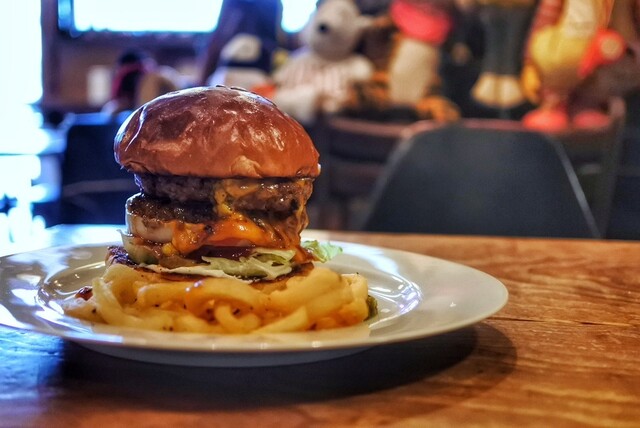
Approaching Koganehara, Matsudo feels less like a restaurant district than a lived-in suburb: shopping arcade parking, bus routes, family errands, and the low-rise rhythm of Chiba outside central Tokyo’s glare. That setting matters. Japan’s serious burger shops often work outside luxury dining codes, where the evidence is not white tablecloth theatre but repeat recognition, tight seating, and a menu language that crosses hamburger, sandwich, and cafe culture.
R-S belongs to that category. The address is in Koganehara, with Tokiwadaira listed as the nearest station area, and the room runs to 19 seats: five at the counter and 14 at tables. That scale puts the experience closer to a craft counter than a casual chain, even before the awards enter the discussion. Tabelog selected it for the Hamburger 100 in 2017, 2018, 2019, 2021, 2022, 2024, and 2026, with a 3.73 score attached to the current listing. In a genre often dismissed as simple comfort food, that run of recognition is the point: burgers in Japan have become a precision category.
Japan's burger craft is about sourcing discipline, not American nostalgia
The Japanese burger scene has its own grammar. A strong shop does not merely copy the American diner; it treats the burger as an assembly problem, where bread, patty, seasoning, vegetables, sauce, and service timing have to hold together without excess. Ingredient sourcing is central because the format is unforgiving. A weak bun collapses, a dry patty has nowhere to hide, and badly handled garnish turns structure into noise.
R-S is useful because it sits in the hamburger, sandwich, and cafe overlap, a combination that signals attention to bread and build as much as meat. That is a different value proposition from ramen houses or bakeries in the same city, even when the bill lands in the same everyday bracket. Matsudo can support a serious bread destination such as Backstube Zopf, noodle-focused addresses such as Chuka Soba Yanagi and Chuka Soba Maruki, and Western-leaning comfort formats such as baga tokidoki youshokutei. The city’s appeal is not a single grand dining strip; it is a set of specialist rooms scattered through residential Chiba.
Price sharpens the argument. The listed lunch and dinner budget is JPY 1,000–1,999, which places R-S in a tier where execution has to justify attention without leaning on luxury ingredients or elaborate service. That bracket also makes comparison within Matsudo more revealing than comparison with central Tokyo’s premium counters. The question is not whether this is a grand occasion restaurant. It is whether a compact suburban burger shop can operate with enough consistency to remain in Tabelog’s Hamburger 100 conversation across several selection years. The answer, on the public evidence, is yes.
A compact room changes the way the burger reads
Small rooms are not neutral. Nineteen seats create a different tempo from a high-volume burger outlet: fewer tables, closer sightlines, and less distance between kitchen rhythm and dining room mood. Counter seating also changes the experience, especially in Japan, where counter formats carry cultural weight from sushi, ramen, tempura, and kappo traditions. Even in a burger context, the counter tells diners to pay attention to sequence and assembly rather than treat the meal as background fuel.
The listed services add another layer to the room’s everyday character: take-out is available, children are welcome, and pets are marked as suitable. Those details do not make the restaurant casual in the careless sense; they place it within neighbourhood life. A burger shop in Matsudo has to serve regular patterns, not just destination dining. That balance, specialist recognition inside a family-friendly suburban format, is what separates this kind of place from the more theatrical end of Tokyo food culture.
For travellers, the better frame is a Matsudo food day rather than a single-venue pilgrimage. Pairing a burger stop with the city’s other specialist addresses shows how Chiba’s outer-city dining works: not as a compressed entertainment zone, but as a map of tightly focused operators. Ajitokoro Musashino gives another read on local dining depth, while our full Matsudo restaurants guide is the cleaner planning base for building a route across categories.
How to place it in a Matsudo itinerary
Matsudo rewards practical planning. The transportation note points to a bus approach from Kita-Kogane Station’s south exit, using the Matsudo Shinkeisei Bus toward the Koganehara Danchi Loop or Bus Information Center, then getting off at Gyosei Center and walking two minutes. Parking is also part of the equation: the paid lot at Koganehara Central Shopping Arcade is listed, with a free one-hour ticket for restaurant users. For diners used to Tokyo station-exit dining, this is a reminder that outer-Chiba food finds often depend on bus timing and neighbourhood geography.
The restaurant operates as a no-smoking venue, with private rooms and private use unavailable. Payment is another planning point: credit cards, electronic money, and QR code payments are listed as not accepted. Reservations are unavailable, which makes timing part of the experience rather than an administrative step. Tuesday is the listed closing day, and the schedule changed from June 1, 2025, so current hours deserve a check before crossing town.
R-S works for readers who care about how Japan absorbs foreign formats and then tightens them. The burger here is not interesting because it is American; it is interesting because Matsudo has given the category a small-room, ingredient-conscious, recognition-backed expression at a daily price. For wider planning around the city, see our full Matsudo hotels guide, our full Matsudo bars guide, our full Matsudo wineries guide, and our full Matsudo experiences guide.
Further afield, EP Club’s Japan and Pacific dining files put this kind of specialist address into a broader casual-craft context: -Grilled beef Sukiyaki- KAMAKURA TANUKIAN 鎌倉 たぬき庵 in Kamakura. 鮪と炭火焼き うお炭 秋葉原店 in Tokyo.cafe in Osaka.know in Kumamoto, (Shoku) Vietnam in Kawasaki, [Curry Senmon Ten] Maruyama Kyoju. in Sapporo, Jōdo Saké Bar in Los Angeles, and Onigiri Time in Pasadena.
Fast Comparison
Comparable venues by cuisine and price in the same metro.
| Venue | Cuisine | Price | Notes |
|---|---|---|---|
| R-SThis venue — the venue you are viewing | Gourmet Hamburger & Cafe | $$ | Not listed |
| Ramen Tomita | Traditional Japanese Tsukemen | $$ | Matsudo |
| Tomita Ramen | Award-Winning Tsukemen Ramen | $$ | Matsudo |
| Tonkatsu Tomita | Specialist Tonkatsu (Japanese Pork Cutlet) | $$ | Matsudo |
| Backstube Zopf | Japanese bakery & pastry shop | $ | Koganehara |
| Ajitokoro Musashino | Ramen & Tsukemen Shop | $$ | Matsudo |
Recognition history
Dated appearances from independent guides and award organizations, with the underlying list record or original source where available.
Tabelog 100 #19 · No. 19
Tabelog · Tabelog 100 - Hamburger - 2026




At a Glance
- Cozy
- Trendy
- Lively
- Casual Hangout
- Family
- Solo
- After Work
- Standalone
A small, stylish burger shop with counter and table seating, non‑smoking and family‑friendly, giving a cozy but energetic neighborhood café feel rather than a fast‑food vibe.