Pyshechnaya
Pyshechnaya is Saint Petersburg's most discussed Soviet-era doughnut shop, a counter-service institution on Bolshaya Konyushennaya where office workers, students, and tourists queue for fried rings dusted with powdered sugar alongside tea or coffee. The format has not changed in decades: no reservations, no menus, no pretension. What draws regulars back is precisely that consistency, a city landmark that refuses to modernise itself out of relevance.

Pearl is the En Primeur Club membership app — saves, bookings, and concierge access live there. Same editors, same standards.
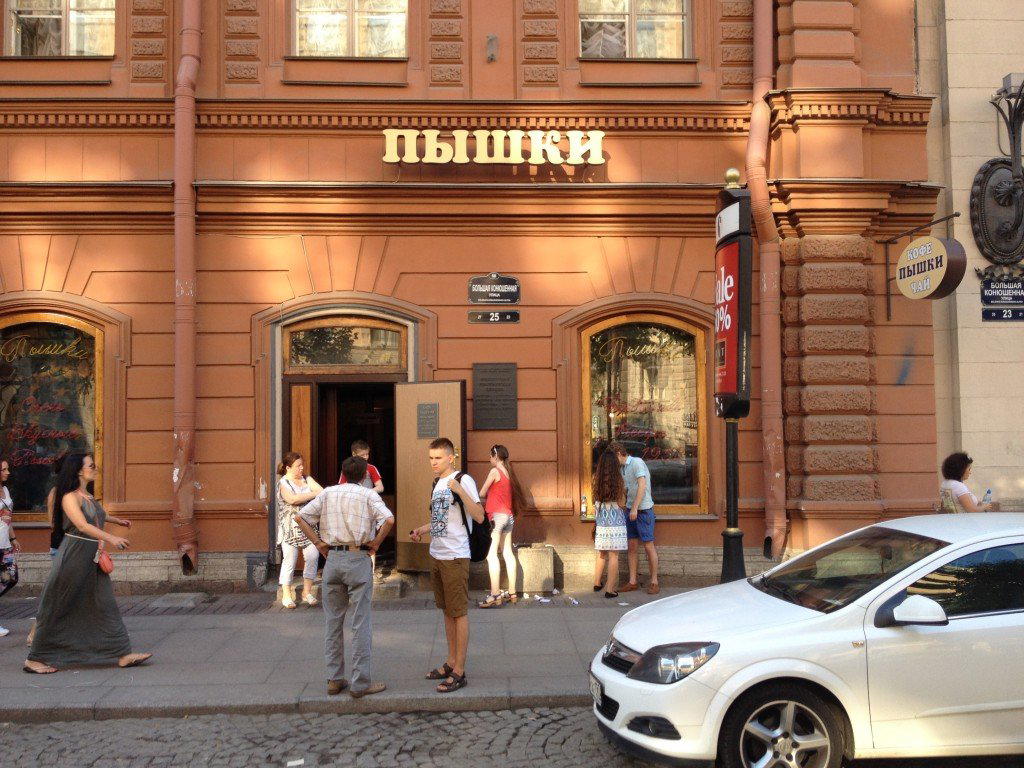
The Queue Is the Experience
Before you reach the counter at Pyshechnaya, you will almost certainly stand in a line. Not because the operation is slow, but because this particular spot on Bolshaya Konyushennaya Street has occupied the same function in Saint Petersburg's daily life for decades: a place where the city pauses, briefly, for fried dough and something hot to drink. The interior, tiled walls, aluminium trays, the smell of oil and powdered sugar, belongs to a category of Soviet-era public canteen that has nearly vanished from Russian cities. Most were converted into something more profitable or more photogenic. This one was not.
That survival is not accidental. The regulars here did not choose Pyshechnaya despite its austerity. They chose it because of it. There is a particular kind of loyalty that accrues to places that do not try to be anything other than what they are, and Pyshechnaya has accumulated that loyalty across multiple generations of Saint Petersburg residents.
What the Regulars Actually Come For
The product is simple and specific: pyshki, the ring-shaped fried doughnuts that are St. Petersburg's answer to a pastry course, served warm and dusted with powdered sugar. Unlike the filled, Americanised doughnuts that have spread through Russian café culture, pyshki are hollow, slightly chewy, and meant to be eaten quickly while still warm from the fryer. The regulars know this, which is why most of them eat standing at the small counters rather than searching for a table. Coffee, served in the Soviet canteen style, completes the transaction.
The unwritten menu at a place like this is understood rather than communicated. First-timers sometimes hesitate at the counter, scanning for options that do not exist. Regulars do not hesitate. They order by number, pyshki, coffee, done, pay a sum that remains among the lowest charged at any food establishment in the city centre, and move to a spot at the counter. The efficiency is its own form of hospitality.
This format places Pyshechnaya in a specific and shrinking category within Russian urban food culture: the stolovaya-adjacent institution that maintained its Soviet-era function without transformation into a nostalgia concept. The distinction matters. Several Moscow establishments have packaged Soviet canteen aesthetics as a design statement for a younger demographic, Twins Garden in Moscow operates at the opposite end of the spectrum, where ingredient sourcing and tasting formats define the experience. Pyshechnaya's continued relevance does not come from repackaging; it comes from continuity.
Saint Petersburg's Relationship with Cheap, Honest Food
Saint Petersburg's dining scene has developed in two distinct directions over the past fifteen years. On one side, restaurants like 1913, Bellevue, and Astoria Cafe serve a clientele looking for formal dining, wine lists, and the kind of room that signals occasion. On the other, a parallel culture of affordable, high-frequency eating has persisted, and in some cases, thrived, precisely because the city's population of students, office workers, and local commuters needs somewhere to eat well without the calculus of a full restaurant experience.
Pyshechnaya sits at an extreme point within that second category. It is not a casual bistro or a budget lunch spot in the conventional sense. It is a single-product institution that has held its price point and format against every wave of café culture that has passed through the city. BeefZavod and Blok represent the direction that affordable eating in St. Petersburg has largely moved: towards concept-led, Instagram-adjacent formats. Pyshechnaya represents what pre-exists that shift and what, for many locals, still makes more practical sense on a Tuesday morning.
Across Russia's cities, a few analogous institutions survive in various states. Kukhterin in Tomsk and Grisha in Omsk occupy different positions within their local food cultures, but each reflects a similar principle: that regional cities sustain particular eating formats rooted in local habit rather than imported trend. Saint Petersburg's pyshki tradition is specific to the city in the way that certain formats are, recognisable to visitors, but oriented towards the people who eat there every week.
The Tourist Problem (and How Regulars Navigate It)
Pyshechnaya's location near the city centre means it has become part of the tourist circuit, which introduces a friction familiar to any long-standing neighbourhood institution. Visitors who arrive with phone cameras and curiosity about Soviet-era food culture are not unwelcome, the counter serves everyone in the order they arrive, but they do change the tempo of the queue. Regulars who have been coming for years have adjusted accordingly, timing visits for early morning or mid-afternoon, when the flow returns to its local rhythm.
This is not a distinctive dynamic in a city that draws significant international visitor numbers. Made in China in St. Petersburg and Lev I Ptichka both occupy positions where local reputation and tourist interest coexist with varying degrees of tension. What distinguishes Pyshechnaya is that its format, counter service, limited options, standing room, self-regulates. There is no reservation system to game and no table to linger at. The experience moves at the same pace regardless of who is in the queue.
For visitors approaching Saint Petersburg's food culture for the first time, the broader restaurant landscape offers considerably more range: from Georgian kitchens like Alanskaya Kukhnya in Krasnodar to the kind of high-format dining that puts Russian cities on international radar. Pyshechnaya is not a representative sample of that range. It is, instead, a specific and legible data point about what a city eats when it is not performing for anyone.
Planning a Visit: What You Actually Need to Know
Pyshechnaya requires no reservation, no dress consideration, and no particular planning beyond showing up. It operates during daytime hours in a central location that most visitors to St. Petersburg will pass through during a standard itinerary. Payment is cash-forward at the counter. The transaction takes under two minutes for experienced visitors. Arriving hungry and without firm expectations about the experience is the correct approach. Those looking for the kind of high-production food culture or technical ambition found elsewhere will not find it here. What they will find is a counter that has been frying the same dough, in the same building, for longer than most of the city's celebrated restaurants have existed.
What It’s Closest To
Comparable venues nearby, for context on price, style, and recognition.
| Venue | Cuisine | Price | Notes |
|---|---|---|---|
| PyshechnayaThis venue — the venue you are viewing | Russian Pyshechnaya (Donut Cafe) | $ | Not listed |
| Little Sicily | Authentic Sicilian Italian Pizzeria | $$ | City Center |
| Деда Хинкали на Финлядском | Traditional Georgian Khinkali House | $$ | Выборгский район |
| Social Club | Young Kitchen: Israeli Street Food & Franco-Italian Fusion | $$ | Rubinshtein Street |
| Taleon | Modern European Fine Dining | $$$$ | Admiralteisky |
| Terrassa | Global Fusion Rooftop | $$$$ | Nevskiy |
Continue exploring
More in Saint Petersburg
Restaurants in Saint Petersburg
Browse all →
Bars in Saint Petersburg
Browse all →

At a Glance
- Well Known
- Classic
- Cozy
- Solo
- Family
- Casual Hangout
- Historic Building
- Standalone
Nostalgic and retro with a preserved Soviet feel; tiny, packed, and bustling with a quick snack-shop atmosphere.