Our verdict
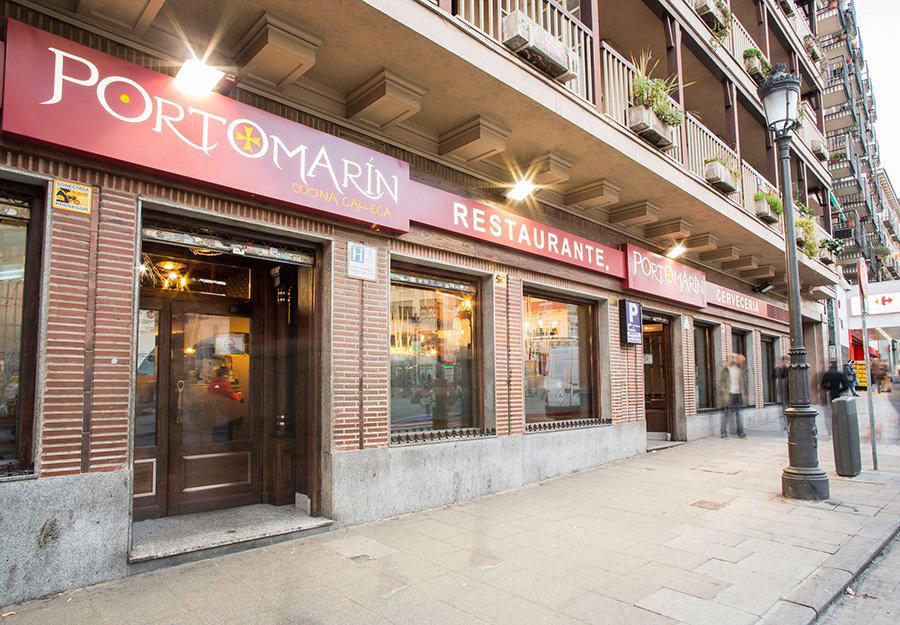
On Calle de Valencia in Madrid's Centro district, Portomarín sits at the intersection where Galician culinary tradition meets the technical precision that defines the capital's contemporary dining scene. The address places it within reach of the city's most serious restaurant corridor, where locally sourced Atlantic ingredients are worked through methods that owe as much to modern European technique as to the north-western Spanish coast.

Pearl is the En Primeur Club membership app — saves, bookings, and concierge access live there. Same editors, same standards.
- Address
- C. de Valencia, 4, Centro, 28012 Madrid, Spain
- Phone
- +34915285686
- Hours
- Daily 8 AM–12 AM
- Website
- restauranteportomarin.es
- Directions
- Get directions
- Booking
- Book on CoverManager
The menu
What to order
- Pulpo a feira
- Croquetas de lacón con grelos
Where Calle de Valencia Meets the Atlantic
Madrid's Centro district does not announce itself as a food destination the way Salamanca or Chueca might, yet the streets around Calle de Valencia have quietly accumulated a tier of restaurants that take their produce seriously. The neighbourhood draws a mixed crowd: residents who eat out several nights a week, visitors who have done their research, and the occasional table of industry professionals cross-checking notes. It is the kind of street where a restaurant can build a following without the distraction of tourist foot traffic or the pressure of a high-profile postcode.
Portomarín occupies that address at C. de Valencia, 4, and the name signals its orientation immediately. Portomarín is a municipality in Lugo, Galicia, and the choice of that reference over a Madrid landmark or an abstract concept tells you something about the kitchen's priorities: the ingredient origin matters, and the north-western coast of Spain, with its cold-water seafood, its empanadas, its octopus traditions, and its green interior, is the point of departure for what arrives on the plate.
Galician Produce, Madrid Technical Register
Spain's fine dining conversation has long played out across a tension between regional specificity and international technique. The restaurants that have attracted the most serious attention, from El Celler de Can Roca in Girona to Arzak in San Sebastián, have succeeded precisely because they grounded formal technical ambition in a specific territorial identity. The Basque Country built a template for this in the 1970s and 1980s. Galicia, with its extraordinary marine pantry, has been slower to export that model to Madrid, which makes restaurants that carry the north-west's produce into the capital's dining culture a distinct and credible niche.
The editorial angle worth examining here is what happens when Galician raw material, octopus from Carril, percebes from the Costa da Morte, Padrón peppers, Albariño-friendly shellfish, meets the technique register of a Madrid kitchen that has grown up alongside some of the more technically demanding addresses in the city. Madrid's top tier, including DiverXO with its three Michelin stars and its progressive Asian-creative vocabulary, Coque with its Spanish creative format at the €€€€ tier, and DSTAgE with its modern Spanish creative positioning, has set a high baseline for what the city expects in terms of kitchen precision. Restaurants in the mid-to-upper tiers absorb those expectations even when their culinary reference is regional rather than avant-garde.
This intersection of imported method and indigenous product is not unique to Madrid or to Galician cooking. The same dynamic runs through what Aponiente in El Puerto de Santa María has done with Andalusian marine ingredients, or what Ricard Camarena in València has built around Valencian produce. The question for any Galician-referenced kitchen operating in Madrid is whether it can hold that tension productively, keeping the ingredient at the centre while allowing technique to serve rather than overwhelm it.
The Madrid Context: Positioning Within the Capital's Tiers
Madrid's restaurant market has stratified more sharply in recent years. The €€€€ tier, where Deessa and Paco Roncero both operate with creative Spanish formats, has consolidated around a set of expectations: tasting menu formats or structured à la carte, serious wine lists with Spanish regional depth, and service calibrated for guests who are not treating a restaurant dinner as a special occasion but as a routine calibration of where Madrid sits on the European dining map.
Below that tier, but above casual neighbourhood dining, sits a category that Centro does well: kitchens with a specific regional identity, a shorter menu that changes with supply rather than season marketing, and a clientele that values the ingredient story over the theatrical presentation. Portomarín's Calle de Valencia address places it in this middle register, where the competition is not DiverXO or Coque but the dozen or so well-regarded regional specialists that Madrid has accumulated across its central barrios.
For comparison, Spain's broader fine dining map shows how productive regional specificity can be as a platform. Martin Berasategui in Lasarte-Oria holds three Michelin stars built on Basque product worked through classical and contemporary technique. Azurmendi in Larrabetzu has three stars and a strong sustainability framework. Quique Dacosta in Dénia operates at three stars with a Mediterranean product focus. The pattern is consistent: ingredient provenance, treated with rigour, is a credible path to serious recognition.
For readers deciding how Portomarín fits into a Madrid itinerary, the comparison below places it against the city's most prominent creative addresses and a regional specialist benchmark.
| Venue | Price Tier | Format | Cuisine Reference |
|---|---|---|---|
| Portomarín | Not confirmed | Not confirmed | Galician / regional Spanish |
| DiverXO | €€€€ | Tasting menu | Progressive Asian-Creative |
| Coque | €€€€ | Tasting menu | Spanish Creative |
| Deessa | €€€€ | Tasting menu | Modern Spanish Creative |
| DSTAgE | €€€€ | Tasting menu | Modern Spanish Creative |
Verify directly with the restaurant before planning. For broader context on how Madrid's dining tiers sit relative to each other, see our full Madrid restaurants guide.
The Wider Spanish Frame
Galician cooking in Madrid sits within a national conversation about how Spain's distinct regional food cultures travel. The most instructive comparison points are not always within the capital. Cocina Hermanos Torres in Barcelona and Mugaritz in Errenteria both demonstrate how a kitchen can hold a specific cultural and geographical identity while operating at the technical level the contemporary European dining circuit expects. Atrio in Cáceres does the same for Extremaduran product. The common thread is that regional specificity, when applied with discipline, generates more critical attention than generic contemporary Spanish cooking.
For readers who want a wider international calibration, the technique-over-territory approach finds its clearest expression in places like Le Bernardin in New York City, where classical French seafood technique has been maintained as a consistent identity over decades, or Atomix in New York City, where Korean culinary reference is worked through a format borrowed from fine dining's most exacting tier. The comparison is not direct, but the underlying logic, that a specific cultural anchor handled with precision outperforms genericism, applies equally to a Galician kitchen operating in Madrid.
Planning Your Visit
Portomarín is at C. de Valencia, 4, in Madrid's Centro district. Guests planning a visit should confirm availability and format directly with the restaurant. For a structured view of how Portomarín sits within Madrid's broader dining options, the EP Club Madrid guide maps the city's key addresses by price tier and cuisine type.
Frequently asked questions
How would you describe the vibe at Portomarín?
What is the dish most worth ordering at Portomarín?
What is the ideal way to book a table at Portomarín?
What makes Portomarín distinct within Madrid's regional restaurant scene?
How does Portomarín compare to Madrid's leading creative restaurants?
The Short List
Comparable venues nearby, for context on price, style, and recognition.
| Venue | Cuisine | Price | Awards | Notes |
|---|---|---|---|---|
| PortomarínThis venue — the venue you are viewing | Galician Spanish | $20–30 | Not listed | Not listed |
| Fismuler | Modern Mediterranean Fusion | $30–50 | Michelin Plate · Guía Repsol 1 Sol | Almagro, Modern Spanish with Nordic influences |
| Restaurante El Ducado | Traditional Spanish Tapas | $10–20 | Not listed | Palacio, Traditional Spanish Tapas |
| Café Comercial | Traditional Madrid Cuisine with Contemporary Touches | $30–50 | Macarfi 6.8 Food Rating | Trafalgar, Traditional Madrid Cuisine with Contemporary Touches |
| La Flaca | Traditional Spanish Tapas | $20–30 | Not listed | Castellana, Traditional Spanish Tapas |
| ROSA & ESPIGAS | Modern Spanish Vanguardista | $20–30 | Not listed | Goya, Modern Spanish Vanguardista |
Continue exploring
More in Madrid
Restaurants in Madrid
Browse all →
Bars in Madrid
Browse all →
Hotels in Madrid
Browse all →


Details
- Rustic
- Classic
- Group Dining
- Casual Hangout
- Historic Building
- Beer Program
- A La Carte
- Small Plates
Current opening hours
- Monday
- 8 AM–12 AM
- Tuesday
- 8 AM–12 AM
- Wednesday
- 8 AM–12 AM
- Thursday
- 8 AM–12 AM
- Friday
- 8 AM–12 AM
- Saturday
- 8 AM–12 AM
- Sunday
- 8 AM–12 AM
Hours can change for holidays and private events. Last verified .
Spacious dining room with a casual, traditional Galician atmosphere.