Our verdict
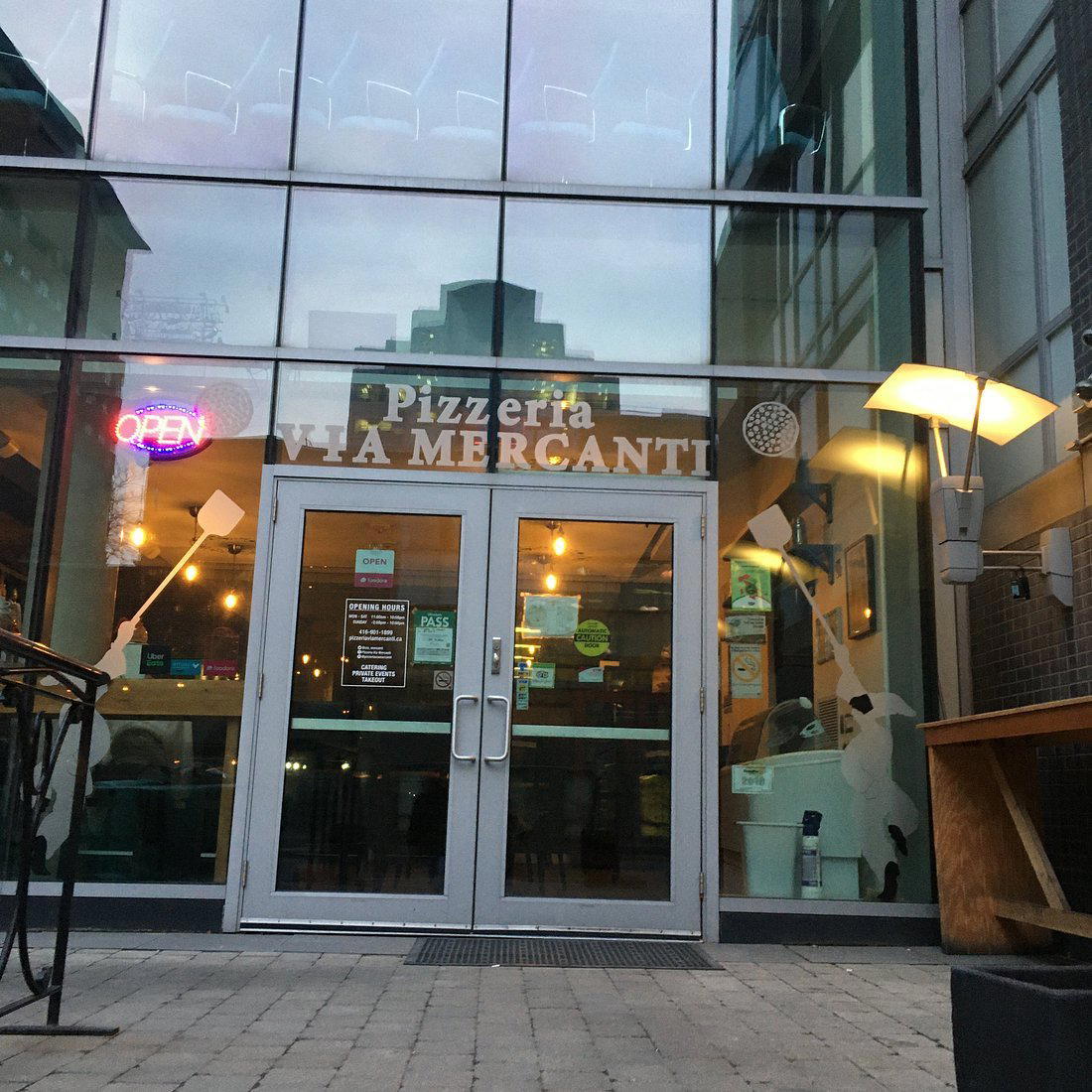
On Augusta Avenue in Kensington Market, Pizzeria Via Mercanti occupies a specific position in Toronto's pizza conversation: a Neapolitan-leaning counter that has evolved alongside the neighbourhood's shifting identity while holding to wood-fired fundamentals. For those tracking where the city's casual Italian scene has moved over the past decade, this address functions as a useful reference point.

Pearl is the En Primeur Club membership app, where members save venues, book tables and use the concierge.
The menu
What to order
- Margherita
- Via Mercanti Pizza
- Ciambella Ripiena
- Patate e Salsiccia
- Quattro Stagioni
Augusta Avenue and the Pizza Counter That Moved With the Market
Kensington Market has never been a stable neighbourhood in the way that Yorkville or Rosedale are stable. It absorbs successive waves of immigration, shifts its retail character every decade or so, and tends to reward the venues that evolve with it rather than those that plant a flag and refuse to move. Pizzeria Via Mercanti, at 188 Augusta Avenue, has been part of that rhythm long enough to be read as a document of how the area's relationship with casual Italian dining has changed.
The Neapolitan pizza format itself has undergone its own revision across Toronto's restaurant culture during that time. What arrived in the mid-2000s as a specialist proposition, tied to imported flour certifications and Vera Pizza Napoletana credentials, has since broadened into a more contested category. The conversation has shifted from authenticity gatekeeping toward a more pragmatic question: what does a wood-fired pizza in this city actually taste like now, and who is making it well? Via Mercanti sits inside that evolved conversation rather than outside it.
The Kensington Context
Placed on Augusta Avenue rather than on one of Toronto's better-trafficked dining corridors, Via Mercanti operates within Kensington Market's particular commercial logic. The neighbourhood draws a mix of long-term residents, students, weekend market visitors, and a younger dining crowd that crosses the city specifically for the strip's density of independent operators. That audience tends to be price-sensitive in ways that Yorkville or King West crowds are not, and casual format pizza has historically performed well there as a result.
The address sits within walking distance of the broader Chinatown boundary and the College Street corridor, two zones with their own distinct dining registers. Via Mercanti's positioning between those gravitational pulls has allowed it to function as a neighbourhood anchor rather than a destination-only draw. That distinction matters when tracking how the venue has evolved: it has not chased the tasting-menu tier occupied by places like Alo or the precision formats associated with Sushi Masaki Saito and Aburi Hana. It has, instead, deepened its grip on a specific casual register.
How the Format Has Shifted
The evolution of pizza as a dining category in Toronto mirrors patterns visible in other North American cities. The first wave of Neapolitan specialists arrived with a missionary zeal for imported San Marzano tomatoes, 00 flour, and 60-to-90-second bake times in wood-burning ovens calibrated to 450 degrees Celsius. The second wave, which is where Via Mercanti's current iteration sits most comfortably, absorbed those technical standards and began treating them as baseline rather than as marketing. The result is a format that can speak to both the pizza traditionalist and the casual lunch crowd without alienating either.
This parallels what has happened to Italian dining more broadly across the city. The formal end of that market has grown more concentrated, with the contemporary Italian tier now occupied by venues like DaNico and Don Alfonso 1890 drawing a different audience and a different price expectation. The casual end, where Via Mercanti operates, has become more competitive as the number of wood-fired operators in Toronto has grown. That competitive pressure has pushed operators to sharpen their product or lose ground, and the venues that have survived in Kensington specifically have generally done so by becoming more legible to their immediate neighbourhood rather than broader.
Where Via Mercanti Sits in the Canadian Casual Dining Picture
Mapping Via Mercanti against the wider Canadian restaurant conversation places it in an interesting position. The country's most-discussed restaurant destinations tend toward either remote destination dining, as with Eigensinn Farm in Singhampton or the Fogo Island Inn Dining Room, or metropolitan fine dining with clear international reference points. The mid-register casual operator in a major city neighbourhood tends to receive less editorial attention but frequently absorbs more of the day-to-day dining culture of a city than its higher-profile counterparts.
That pattern repeats across the country. In Quebec City, Tanière³ commands the tasting-menu conversation; in Vancouver, AnnaLena anchors a particular neighbourhood dining ethos; in Montreal, Jérôme Ferrer's Europea holds a formal city-centre position. The neighbourhood pizza counter filling seats on a Tuesday night in a market district operates at a different register entirely, and its longevity is measured by different metrics: repeat visit frequency, walk-in conversion, neighbourhood embeddedness.
For a broader survey of where Toronto's restaurants sit across these registers, the full Toronto restaurants guide maps the city's dining tiers in more detail. Readers interested in regional comparisons might also find reference points in Restaurant Pearl Morissette in Lincoln, The Pine in Creemore, or further afield at Narval in Rimouski. Internationally, the casual-to-serious Italian tension is visible in different form at Le Bernardin in New York and at format-driven operations like Lazy Bear in San Francisco, where the commitment to a specific dining register defines the operation as clearly as the food itself. For Canadian comparisons outside the fine dining tier, Busters Barbeque in Kenora and Cafe Brio in Victoria offer useful reference points for how regional operators build longevity outside major-city dining circuits.
Know Before You Go
- Address: 188 Augusta Ave, Toronto, ON M5T 2L4
- Neighbourhood: Kensington Market, Toronto
- Getting there: Accessible from Spadina Station (Line 2) or by streetcar along Spadina Avenue; Augusta Avenue is a short walk south from College Street
- Format: Casual counter-service pizza with Neapolitan-leaning wood-fired format
- Booking: Confirm current reservation policy directly with the venue before visiting
- Leading timing: Weekday visits typically yield shorter waits than weekend market-day traffic on Augusta Avenue
Frequently asked questions
Where is Pizzeria Via Mercanti located?
Pizzeria Via Mercanti is located at 188 Augusta Ave, Toronto, ON M5T 2L4, Canada, Toronto.
How does Via Mercanti compare to other Neapolitan pizza spots in Toronto?
Toronto's Neapolitan pizza scene has matured through at least two distinct waves, early specialists who introduced VPN-adjacent standards, followed by a broader casual tier that normalised the format across neighbourhoods. Via Mercanti at Augusta Ave occupies the Kensington Market node of that conversation, where the setting is deliberately low-key rather than destination-driven. That positioning keeps it distinct from the more polished Italian restaurant clusters in neighbourhoods like Little Italy on College or the downtown core.
What do regulars order at Pizzeria Via Mercanti?
Via Mercanti built its following on Neapolitan-style pies, and that remains the reason most regulars return. The Augusta Avenue location draws a Kensington Market crowd that treats the menu as a familiar rotation rather than an occasion, meaning the pizza, not the full Italian spread, is the point of the visit.
Do I need a reservation for Pizzeria Via Mercanti?
Reservation policy details are not published for the Augusta Avenue location. For a counter-oriented pizza spot in a market neighbourhood like Kensington, walk-in timing matters: arriving before the lunch or early dinner rush on weekdays tends to be the practical approach. Confirming directly via the venue before a weekend visit is advisable.
What's the standout thing about Pizzeria Via Mercanti?
The address tells part of the story: 188 Augusta Ave puts Via Mercanti inside Kensington Market, a neighbourhood that absorbs and outlasts dining trends rather than chasing them. What distinguishes Via Mercanti within Toronto's crowded Neapolitan pizza conversation is consistency of format in a location that resists the kind of polish that comes with a higher-traffic corridor.
In Context: Similar Options
| Venue | Cuisine | Price | Awards | Notes |
|---|---|---|---|---|
| Pizzeria Via MercantiThis venue (the venue you are viewing) | Authentic Neapolitan Pizza | $20–30 | Not listed | Not listed |
| Alo | Modern French Fine Dining with Asian Influences | $200–300 | 1 Michelin Star · La Liste Top Restaurants | Contemporary |
| Sushi Masaki Saito | Edomae-Style Omakase | $500+ | 1 Michelin Star · La Liste Top Restaurants | Sushi, Japanese |
| Aburi Hana | Modern Japanese Kyō-Kaiseki | $300–500 | 1 Michelin Star · The Best Chef One Knife | Kaiseki, Japanese |
| Don Alfonso 1890 | Modern Italian Fine Dining | $200–300 | 1 Michelin Star · La Liste Top Restaurants | Contemporary Italian, Italian |
| Edulis | Mediterranean Seafood Tasting Menu | $150–200 | 1 Michelin Star · World's 50 Best #25 | Canadian, Mediterranean Cuisine |