
Tabelog Bronze #38
Our verdict
One of only a handful of French restaurants in Aomori to earn Tabelog Award recognition, Petit Restaurant Bouquet de France operates from a residential house in the Nijigaoka district, serving twelve guests at a time. Open since 2002, it holds a Tabelog score of 3.95 and features in Tabelog's French EAST "100" selection for 2023 and 2025, placing it firmly in the prefecture's most consistent fine-dining tier.

Pearl is the En Primeur Club membership app, where members save venues, book tables and use the concierge.
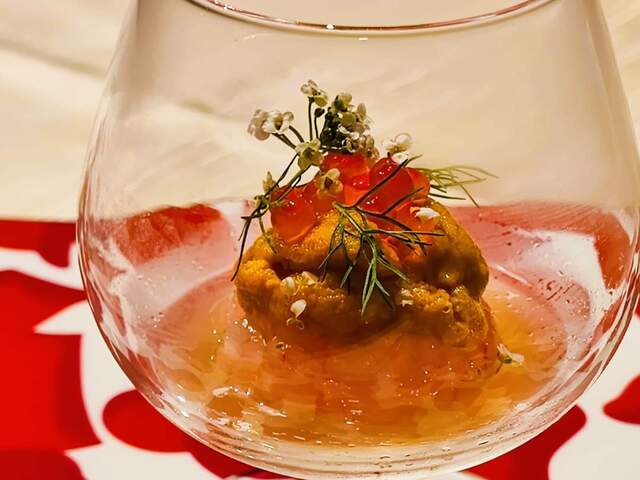
A House in Nijigaoka, and What It Represents
In most Japanese provincial cities, serious French cooking exists in a single register: a formal restaurant in a commercial district, with white tablecloths, a printed wine list, and a room designed to communicate ceremony. Aomori has that template, but it also has something rarer: a twelve-seat house restaurant in a residential neighbourhood, operating quietly since July 2002, that now ranks among the most decorated French tables in the entire Tohoku region. The dining room at Petit Restaurant Bouquet de France holds no more guests than a generous dinner party. The location, a converted house in Nijigaoka, sits roughly fifteen minutes on foot from Higashi-Aomori Station on the Aoi Mori Railway, or about thirty seconds from the Nijigaoka 1-chome bus stop. Getting there requires a degree of intention. That intentionality is part of the point.
France's house-restaurant tradition, the table d'hôte model where a small, fixed-format kitchen operates in a domestic setting, has found an unusually sympathetic host in Japan, where precision, restraint, and intimacy are already embedded dining values. Petit Restaurant Bouquet de France sits within that cross-cultural lineage: it is neither a French bistro transplanted wholesale nor a fusion exercise, but a format where French cooking discipline meets the ingredient priorities of northern Honshu. The kitchen declares a specific focus on fish, which makes geographic sense. Aomori Prefecture faces the Tsugaru Strait to the north and Mutsu Bay to the northeast, both of which supply cold-water species that French classical technique handles with particular elegance.
Tabelog's scoring model aggregates reviewer ratings into a single decimal figure, where anything above 3.5 already represents a meaningful threshold and scores above 3.8 signal consistent performance across a large review sample. Petit Restaurant Bouquet de France carries a Tabelog score of 3.95. The restaurant has won the Tabelog Award Bronze in both 2023 and 2026, and has been selected for Tabelog's French EAST "Tabelog 100" list in 2023 and again in 2025. That latter selection, covering the leading French restaurants across eastern Japan, means the kitchen is being evaluated not against Aomori's modest French scene in isolation, but against well-resourced French operations in Sendai, Sapporo, and the broader Tohoku and Hokkaido regions.
For context on what that competitive set looks like nationally: Japan's French restaurant culture runs from neighbourhood bistros through to three-starred formal operations like HAJIME in Osaka and technically rigorous contemporary tables like Sézanne in Tokyo. The mid-tier of that spectrum, where serious cooking meets intimate formats, increasingly defines itself by sourcing specificity and house personality rather than by size or formality. Bouquet de France's repeated selection for the EAST 100 confirms it occupies that mid-to-upper register with consistency. Among Aomori's own dining options, the French category is thin: Italian-leaning addresses like OSTERIA ENOTECA DA SASINO and European-inflected spots like Casa del cibo occupy adjacent but distinct categories, which makes this restaurant's position as the prefecture's leading French address less surprising.
The Drinks Programme: Wine, Sake, and the BYO Provision
French restaurants in Japan face a structural choice when building a drinks programme: lean into a French-dominant cellar that reflects the cuisine's classical roots, or acknowledge that the guest base may come with different reference points entirely. The available drinks at Bouquet de France include wine, sake, and cocktails, a selection that covers both the classical wine-with-French-food pairing logic and the increasingly common preference among Japanese diners for nihonshu alongside European-style cooking. That pairing, sake with French cuisine, is no longer the novelty it once was: the umami alignment between aged Junmai sake and butter-enriched preparations, or between a mineral Junmai Daiginjo and delicate fish cookery, has become a recognised pairing framework in serious Japanese restaurants across multiple cuisines.
The BYO provision is the more significant logistical note for the dedicated wine traveller. Guests may bring their own bottles, which opens the meal to a range of possibilities unavailable through any house list: a grower Champagne purchased in Tokyo, a mature Burgundy sourced at auction, or a bottle from one of Japan's own emerging wine regions. For guests arriving from Aomori's broader travel circuit, it is worth noting that the prefecture's winemaking activity remains limited but developing. Those wanting to understand the regional picture can find current information in our full Aomori wineries guide.
House wine programmes at restaurants of this size and format typically reflect a curator's sensibility rather than a distributor's volume: the list is small, chosen personally, and oriented toward what pairs well with the kitchen's current direction. Given the fish focus, expect white Burgundy, Loire Muscadet, and Alsatian whites to operate as the logical classical pairing tier, with the sake option providing an equally rigorous alternative path. Comparable small French tables in Japan, from akordu in Nara to Goh in Fukuoka, have demonstrated that a well-considered BYO policy at a serious table functions less as a concession and more as an invitation to a different kind of guest participation.
Format, Timing, and the Practical Shape of an Evening
The restaurant seats twelve. Monday is closed. Tuesday operates dinner service only (18:00 to 22:00, with last orders at 20:30). Wednesday through Sunday runs both lunch (12:00 to 14:00) and dinner (18:00 to 22:00, last orders 20:30). The kitchen operates on a reservation-required basis, which at twelve seats is functionally non-negotiable: walk-ins are not a viable option. Reservations can be made by phone at +81-17-772-7967, and Tabelog indicates online reservation availability.
The dinner price range runs from JPY 15,000 to JPY 19,999 per person, with lunch coming in at JPY 10,000 to JPY 14,999. At the dinner price point, this sits in the same financial register as comparable small French tables at the serious end of Japan's regional dining circuit, including those in secondary cities like Yokohama (see 1000 in Yokohama) or further afield (Abon in Ashiya). The format accommodates parties of up to 2.5 hours as standard, and the restaurant is available for private use for groups of up to twenty people. Credit cards are accepted; electronic money and QR code payments are not. Parking is available on site.
Aomori city itself is accessible by Shinkansen from Tokyo in approximately three hours via the Hayabusa service, making the restaurant a feasible evening destination on a longer northern Japan itinerary. Those building a wider Aomori trip can reference our full Aomori restaurants guide, our full Aomori hotels guide, our full Aomori bars guide, and our full Aomori experiences guide for broader itinerary context.
Where Bouquet de France Fits in Japan's Wider French Scene
Japan's French restaurant tradition is now old enough to have developed genuine regional character. Tokyo dominates by volume, with addresses like Sézanne setting a reference point for contemporary French-Japanese crossover. Kyoto and Osaka have their own serious French representations, including the multi-starred work at HAJIME and the kaiseki-adjacent precision at Gion Sasaki in Kyoto. For internationally trained comparison, the formal French tradition at Hotel de Ville Crissier in Crissier represents the European benchmark against which Japan's French kitchens calibrate.
Within that architecture, Bouquet de France occupies the tier that most rewards the knowledgeable, self-directed traveller: too small to appear on mass tourism itineraries, consistently recognised by peer reviewers over more than two decades of operation, and positioned in a city where the surrounding ingredient environment, particularly the seafood supply from Mutsu Bay and the Tsugaru Strait, gives the kitchen a raw material advantage that a Tokyo address cannot replicate. That combination, awards credibility, sourcing specificity, and genuine intimacy at twelve seats, makes it a different kind of argument for dining seriously outside Japan's major cities. Comparable addresses in Aomori, including Kashu, cover adjacent territory but not the same French-specific ground.
Frequently asked questions
What's the address for Petit Restaurant Bouquet de France?
Petit Restaurant Bouquet de France is located at Japan, 〒030-0948 Aomori, Nijigaoka, 1 Chome−10−7, Aomori.
What's the price range at Petit Restaurant Bouquet de France?
Pricing at Petit Restaurant Bouquet de France is listed as JPY 15,000 - JPY 19,999 JPY 10,000 - JPY 14,999.
Has Petit Restaurant Bouquet de France won any awards?
Petit Restaurant Bouquet de France has received recognition including:
What dish is Petit Restaurant Bouquet de France famous for?
The kitchen has a stated focus on fish, which makes geographic sense: Aomori sits between Mutsu Bay and the Tsugaru Strait, giving the restaurant access to cold-water species not readily available to French kitchens further south.95.
Do I need a reservation for Petit Restaurant Bouquet de France?
Reservations are required, not optional. The dining room holds twelve seats, and the restaurant operates on a reservation-only basis across all services. Given its Tabelog Award Bronze recognition and selection for the Tabelog French EAST Top 100 in both 2023 and 2025, booking ahead is advisable. Call +81-17-772-7967 to reserve.
The Short List
| Venue | Cuisine | Price | Awards |
|---|---|---|---|
| Petit Restaurant Bouquet de FranceThis venue (the venue you are viewing) | French with Local Aomori Ingredients | $100–150 | Tabelog Bronze #38 |
| Casa del cibo | Italian with Aomori Local Ingredients | $100–150 | Tabelog Bronze #42 |
| Kashu | Modern French Omakase with Aomori Ingredients | $200–300 | Tabelog Bronze #169 |
Recognition history
Dated appearances from independent guides and award organizations, with the underlying list record or original source where available.
Tabelog Bronze #38
Tabelog
Full recognition history (2 entries)
Tabelog 100 #39 · No. 39
Tabelog · Tabelog 100 - French - EAST - 2025
Continue exploring
More in Aomori
Restaurants in Aomori
All restaurants in Aomori →
Bars in Aomori
Browse all →
Details
- Cozy
- Elegant
- Intimate
- Romantic
- Sophisticated
- Date Night
- Special Occasion
- Open Kitchen
- Sake Program
- Local Sourcing
- Farm To Table
- Prix Fixe
Current opening hours
- Monday
- Closed
- Tuesday
- 6–10 PM
- Wednesday
- 12–2 PM, 6–10 PM
- Thursday
- 12–2 PM, 6–10 PM
- Friday
- 12–2 PM, 6–10 PM
- Saturday
- 6–10 PM
- Sunday
- 12–2 PM, 6–10 PM
Hours can change for holidays and private events. Last verified .
Charming chalet-like house in a residential area with stylish, relaxing space, ornate floral presentations, and sophisticated yet intimate atmosphere.