
Petit A La Campagne sits in Tokyo’s European-style curry tradition rather than the city’s louder spice-curry wave, with Tabelog Curry TOKYO 100 selection in 2024 and roots dating to 1981. The Hanzomon address, modest JPY 1,000–1,999 range, 36-seat scale and wine-minded listing place it in a practical, old-Tokyo category: serious curry without ceremony.
Pearl is the En Primeur Club membership app — saves, bookings, and concierge access live there. Same editors, same standards.
- Address
- 東京都千代田区一番町8-13 日興ロイヤルパレス一番町 1F
- Phone
- +81332344416
- Website
- tabelog.com
 Saves & bookings on Pearl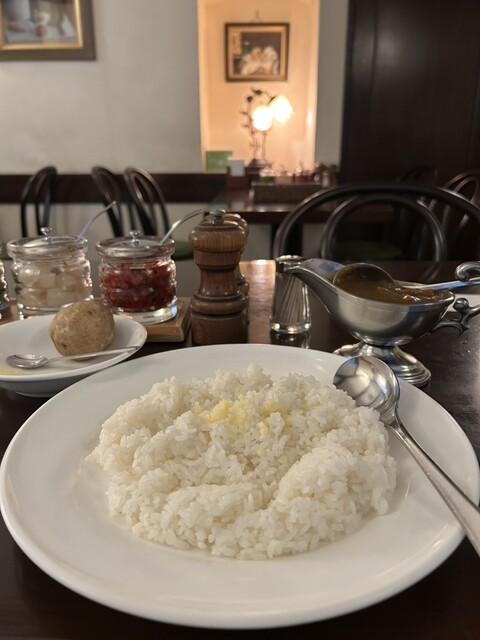
Hanzomon does not perform for diners. Government offices, embassies, schools and apartment blocks set a measured rhythm, and its restaurants often match it: compact rooms, regulars, reliable lunch traffic over spectacle. In that setting, Petit A La Campagne belongs to an older Tokyo curry lineage shaped by European sauces, rice plates, wine lists and everyday pricing, not limited drops, maximal spice or social-media grammar.
That matters because Tokyo curry is not one category. The city runs from station-counter katsu curry to South Asian regional rooms, soup curry imports and Western-style yoshoku kitchens. The European subset has its own history: less heat as headline, more roux, stock, texture and repeatable plates. Petit A La Campagne, listed under Curry and European, fits that branch. Its Tabelog Curry TOKYO 100 recognition in 2024 signals sustained local relevance in a field where diners debate details as intensely as sushi rice or ramen broth.
European curry in a city that keeps rewriting curry rules
Tokyo’s curry culture has changed sharply over the past decade. Specialist spice-curry shops have multiplied, often drawing on Osaka-style layering, South Asian technique or Japanese interpretations of both. Long-running European curry rooms have become a quieter counterpoint: less trend-led, more continuity-dependent. Petit A La Campagne opened in 1981, before the current boom and in a different restaurant economy, when yoshoku-adjacent curry houses served office workers, neighbourhood regulars and destination diners without a viral format.
The 2024 Tabelog Curry TOKYO 100 selection is useful not as a trophy line, but as a sorting mechanism. In a city with hundreds of credible curry addresses, inclusion in a curry-specific list separates it from convenience and places it among specialists. Its Tabelog score of 3.74 reinforces that position: not luxury signalling, but enough Japanese-diner consensus to sit above ordinary lunch-spot churn.
The comparison set around Kojimachi and Hanzomon clarifies the niche. Le Grenier à Pan Koujimachi ten sits in a lower price lane, Ichigenya is also listed below JPY 1,000, while SOLEIL occupies a similar JPY 1,000–1,999 bracket. The restaurant competes less through scale or novelty than through the durability of an old-format curry restaurant in a central neighbourhood where many addresses serve weekday demand first. For readers mapping Tokyo’s broader dining spread, Our full Tokyo restaurants guide gives wider context, from quick specialist rooms to formal counters.
The appeal is continuity, not performance
Practical facts describe the experience clearly: 36 seats, no private rooms, no private hire and a non-smoking policy. Children are welcome, placing the room closer to neighbourhood dining than hushed destination formality. The listed budget, JPY 1,000–1,999 for both lunch and dinner, is important in Tokyo: recognition has not pushed the meal into luxury territory.
That pricing changes the decision. This is not a booking that asks a traveller to sacrifice an evening reserved for kaiseki, sushi or a tasting menu. It fits a different slot: central Tokyo curry before or after palace-side errands, museum plans, hotel transfers or a day around the Chiyoda and Akasaka axis. Hanzomon Station is nearest, with the address in Ichibancho, so it suits itineraries that do not require crossing the city for dinner.
The wine note is small but telling. Many Tokyo curry shops are beer-and-water affairs, and plenty of counter specialists keep beverages secondary. A European curry address particular about wine points back to yoshoku and bistro habits, where curry is treated less as fast food and more as a composed restaurant plate. No named bottle or pairing should be assumed, but the category detail defines the room’s identity.
Tokyo travellers often overcorrect toward high ceremony, then miss the middle layer residents use constantly. Places like this earn their keep there. It is not competing with yakitori rooms such as 124. KAGURAZAKA (Yakitori), seafood izakaya formats such as . 鮪と炭火焼き うお炭 秋葉原店, or highly styled cafés such as 2D Cafe. It occupies the quieter lane between everyday convenience and specialist pilgrimage.
How to place it in a Tokyo itinerary
The strongest use case is category-specific. If the goal is to understand Tokyo curry beyond katsu curry and contemporary spice shops, the restaurant gives that older European register a concrete address. Pair it intellectually with another curry stop such as 3 Chome no Curry Ya San, or compare it with regional curry references outside Tokyo, including [Curry Senmon Ten] Maruyama Kyoju. in Sapporo. The point is not to crown a winner, but to see how Japanese curry changes by city, service model and local habit.
Reservations are available and sensible for diners who care about timing, given the compact 36-seat room and awards-led visibility. The listed business pattern runs Monday through Saturday, with Sunday and public holiday closure, so weekend planning needs attention. Credit cards are accepted; electronic money and QR code payments are not listed as accepted. Parking is unavailable, making rail access the natural choice in central Tokyo.
For a broader itinerary, this is a useful counterweight to Tokyo’s formal dining calendar. A traveller might spend one night in a higher-stakes Shinjuku or Ginza room, then use Hanzomon for a lower-friction meal with category credibility. Nearby planning can sit alongside citywide research in Our full Tokyo hotels guide, Our full Tokyo bars guide, Our full Tokyo wineries guide and Our full Tokyo experiences guide.
Tokyo’s dining map rewards contrast. For Japanese comfort formats beyond curry, compare the city’s casual specificity with 12/10 Shinjuku ten, then look outside the capital to -Grilled beef Sukiyaki- KAMAKURA TANUKIAN 鎌倉 たぬき庵 in Kamakura.cafe in Osaka.know in Kumamoto, (Shoku) Vietnam in Kawasaki and [ki:] in Kyoto. Even overseas Japanese-adjacent addresses such as Jōdo Saké Bar in Los Angeles and Onigiri Time in Pasadena show how familiar formats shift when they leave Japan.
The editorial case is simple: this is a long-running, category-recognised Tokyo curry room with everyday pricing and a central address. Its value lies in continuity. In a city obsessed with the next opening, that can be the sharper signal.
Booking and Cost Snapshot
Comparable venues for context, by category and price tier.
| Venue | Cuisine | Price | Notes |
|---|---|---|---|
| Petit A La CampagneThis venue — the venue you are viewing | Chiyoda, European-style curry | $ | Not listed |
| CACAO SAMPAKA Marunouchi honten | Chiyoda, Artisanal Chocolate & Sweets | $ | Not listed |
| BONNET D'ANE | Not listed | $ | Setagaya, French-style bakery & sandwich shop |
| THE LIVING | Not listed | $ | Ōta, Cafe / Dessert Cafe |
| Blondir | Nerima, French pastries | $ | Not listed |
| L'Atelier du pain | Not listed | $ | Minato, Artisanal Japanese-French bakery & café |
Recognition history
Dated appearances from independent guides and award organizations, with the underlying list record or original source where available.
Tabelog 100 #73 · No. 73
Tabelog · Tabelog 100 - Curry - TOKYO - 2024









At a Glance
- Classic
- Cozy
- Solo
- Family
- After Work
- Casual Hangout
- Standalone
- Extensive Wine List
A relaxed, classic curry house atmosphere with a simple, comfortable dining room suited to families and office workers, often with a line at opening but an unpretentious, cozy feel inside.