Our verdict
On the main square of Polignano a Mare, Pescaria has become a reference point for Adriatic seafood served fast, without ceremony, and directly from the day's catch. The format sits closer to refined fish bar than formal dining room, making it one of the more honest expressions of how this stretch of the Apulian coast actually eats. Worth understanding before you arrive.

Pearl is the En Primeur Club membership app, where members save venues, book tables and use the concierge.
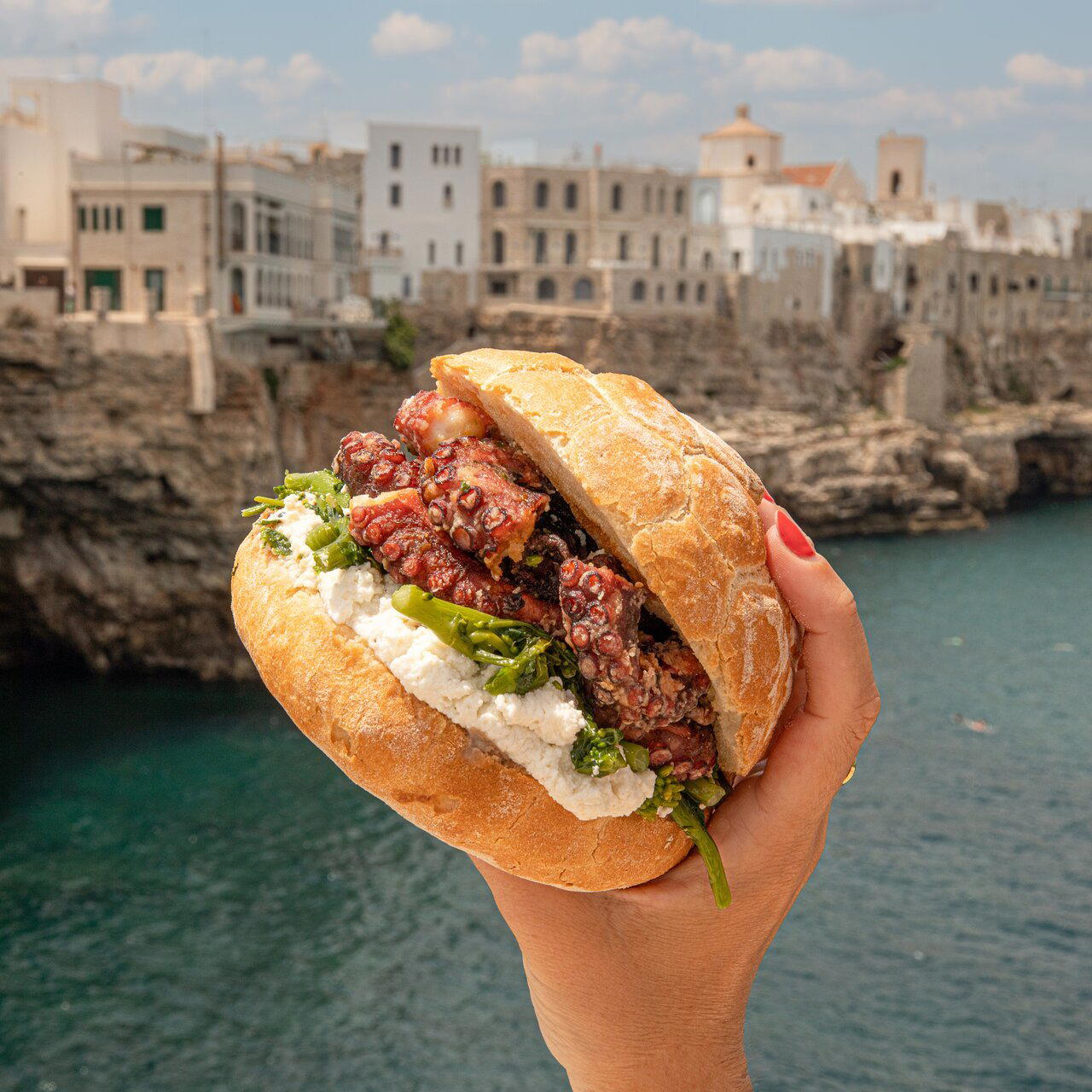
Where the Adriatic Comes to the Counter
Polignano a Mare sits on a limestone shelf above the Adriatic, and the relationship between the town and the sea is not decorative. It is structural. The fishing boats that work the water below the old town cliffs do not supply restaurants as an afterthought, the catch shapes what gets served, and on which days. Pescaria, positioned on Piazza Aldo Moro in the centro storico, operates inside that logic rather than around it. The format here is counter-service seafood: you order at the front, the kitchen works fast, and the fish on your plate arrived from local waters, not a distribution warehouse.
That distinction matters more in Puglia than in many other Italian regions. The Adriatic off this coast yields a specific roster of species, ricci di mare (sea urchin), polpo (octopus), cozze (mussels), and a rotating cast of whole fish and crustaceans, that define the local diet in ways that go back centuries. The leading fish restaurants in this part of southern Italy do not work from fixed menus so much as from what arrived that morning, and Pescaria follows that discipline. What you find on the menu in July will not be identical to what appears in October, because the sea changes and the kitchen follows.
The Case for Sourcing Over Ceremony
Italy's premium seafood dining operates across a wide register. At the formal end, you have places like Uliassi in Senigallia, where creative technique and Adriatic ingredients combine at a level that has earned sustained Michelin recognition, or Quattro Passi in Marina del Cantone, where Mediterranean seafood arrives inside a full tasting architecture. At the other end sits the tradition of the fish counter, the friggitoria, the seafood kiosk, formats that strip out the dining room entirely and let the ingredient carry the experience on its own.
Pescaria sits somewhere between those poles, but it leans hard toward the second category. The appeal is not in plating refinement or in a chef's interpretation of what the sea means. It is in the directness of the transaction: fresh fish, minimal intervention, eaten on or near the square. For Italy's coastal towns, this format is historically normal. What has changed in recent years is the profile of who seeks it out. Polignano has become a destination for Italian and international visitors alike, which means the fish counter on the piazza now operates in a more self-conscious context than it did a generation ago. The food is still honest; the audience has grown more attentive.
That shift in audience does not affect the underlying logic of the sourcing. The Adriatic supplies what it supplies, and a kitchen working with that reality has less room for theatrical consistency than a restaurant in a capital city ordering from multiple national suppliers. This is a feature, not a limitation. It is the same argument that animates the approach at Da Tuccino, the more formally structured seafood address in Polignano, which has operated on a similar philosophy of Adriatic-first sourcing for decades.
Polignano as a Frame
Understanding Pescaria requires understanding the town it occupies. Polignano a Mare is not a large city. The historic centre is compact, built on karst rock above sea caves that the Adriatic has carved out over millennia. Piazza Aldo Moro functions as the social hub of that centre, which means Pescaria operates in full public view of the town's daily life rather than in a side-street dining room. The experience of eating here is partly an experience of being in that piazza, watching the light change over the limestone facades, and hearing the background noise of a southern Italian town going about its business.
That setting gives the meal a context that no interior dining room could replicate. Italian coastal eating has always been connected to place in a way that the format of the grand tasting menu, by design, partially abstracts away. When Dal Pescatore in Runate or Reale in Castel di Sangro earn recognition for their cooking, the recognition comes partly from how they have transformed local ingredients into something architecturally complex. Pescaria represents the other end of that argument: the ingredient is enough, and the place makes the meal.
For visitors planning a wider circuit of southern Italian dining, Pescaria fits into the Polignano stop as the informal counterweight to a more structured meal. The town's dining scene, covered in depth in our full Polignano restaurants guide, is small enough that two or three well-chosen meals cover most of what matters. Pescaria is the kind of address you visit at lunch, standing, eating fried fish with paper napkins, before spending the afternoon on the cliffs.
Italy's Seafood Dining in Wider Context
The appetite for high-commitment seafood dining in Italy has produced a recognizable tier of destination restaurants: Uliassi, with its three-star program on the Adriatic coast; Atelier Moessmer Norbert Niederkofler in Brunico, applying alpine-sourcing logic to a different set of ingredients; the broader ecosystem of Italian fine dining that includes Osteria Francescana, Piazza Duomo in Alba, and Enoteca Pinchiorri in Florence. Those addresses share a commitment to sourcing integrity, but they express it through technical complexity and formal dining architecture.
Pescaria expresses the same underlying commitment through the opposite method: reduce the format until the only thing left is the fish and the place. Internationally, the closest parallel is the raw bar or fish shack tradition that operates at the edge of fishing communities from Brittany to coastal Japan, the idea that the shortest distance between the ocean and the plate is itself a form of quality. Venues like Le Bernardin in New York City have built formal dining programs on the philosophical premise that fish should not be obscured. The counter-service format takes that premise to its logical endpoint.
Planning Your Visit
Pescaria operates on Piazza Aldo Moro in the historic centre of Polignano a Mare, which is reachable by train from Bari (approximately 35 minutes on the Adriatic coast line) or by car along the SS16. The piazza is walkable from both the main train station and the clifftop viewpoints that draw visitors to the town. Given the format and the location, queues are common during summer months, particularly around midday, and the pace of service is faster than a sit-down restaurant. This is a meal you plan around the market availability of the day, not a fixed menu you preview online in advance. Visitors combining Polignano with a broader Adriatic itinerary will find the town manageable as a half-day stop, with Pescaria functioning as the anchor meal before continuing along the coast.
Frequently asked questions
Is Pescaria a family-friendly restaurant?
Pescaria sits on Piazza Aldo Moro in Polignano a Mare's historic centre, a public square that draws a broad cross-section of visitors and locals. The counter-style format and seafood focus suit adults and older children comfortable with fish-forward menus. Families with younger children will find the open piazza setting accommodating in terms of space, though the specific seating configuration is not documented in available detail.
What kind of setting is Pescaria?
Pescaria occupies Piazza Aldo Moro at the heart of Polignano a Mare's compact limestone old town, perched above the Adriatic. The setting is a working Italian piazza rather than a formal dining room: the town's geography and the sea are the backdrop. It sits closer to the sourcing-first, no-ceremony end of Italy's seafood dining register than to the white-tablecloth tradition.
Is Pescaria worth visiting as a day trip from Bari?
Polignano a Mare is approximately 35 minutes from Bari by regional train, making Pescaria on Piazza Aldo Moro a realistic lunch destination without an overnight stay. The town's compact historic centre means the restaurant is within walking distance of the station. For visitors using Bari as a base to cover Puglia's Adriatic coast, Polignano and Pescaria sit on the same logical itinerary as the cliff town's other draws.
What should I order at Pescaria?
Pescaria's identity is built around proximity to the Adriatic catch rather than a fixed tasting architecture, so the menu follows what the sea delivers. The strongest orders at a counter like this are typically whatever reflects that day's landing rather than composed dishes assembled from distant supply chains.
Comparable Spots, Quickly
| Venue | Cuisine | Price | Awards | Notes |
|---|---|---|---|---|
| PescariaThis venue (the venue you are viewing) | Italian Seafood Fast Food | $20–30 | Not listed | Not listed |
| Atelier Moessmer Norbert Niederkofler | Modern Alpine Fine Dining | $300–500 | 3 Michelin Stars · World's 50 Best #20 | Italian, Creative |
| Dal Pescatore | Classic Italian Fine Dining | $200–300 | 3 Michelin Stars · World's 50 Best #38 | Italian, Italian Contemporary |
| Quattro Passi | Modern Mediterranean Fine Dining | $300–500 | 3 Michelin Stars · World's 50 Best #38 | Italian, Mediterranean Cuisine |
| Reale | Modern Italian Fine Dining | $200–300 | 3 Michelin Stars · World's 50 Best #18 | Progressive Italian, Modern Cuisine |
| Uliassi | Modern Adriatic Italian Fine Dining | $300–500 | 3 Michelin Stars · World's 50 Best #43 | Italian Seafood - Marche, Creative |
Continue exploring
More in Polignano
Restaurants in Polignano
All restaurants in Polignano →
Bars in Polignano
All bars in Polignano →

Details
- Lively
- Trendy
- Casual
- Casual Hangout
- Open Kitchen
- A La Carte
- Small Plates
- Vegetarian Friendly
- Vegan Options
- Gluten Free Options
Current opening hours
- Monday
- 11:30 AM–10:30 PM
- Tuesday
- 11:30 AM–10:30 PM
- Wednesday
- 11:30 AM–10:30 PM
- Thursday
- 11:30 AM–10:30 PM
- Friday
- 11:30 AM–11:30 PM
- Saturday
- 11:30 AM–11:30 PM
- Sunday
- 11:30 AM–10:30 PM
Hours can change for holidays and private events. Last verified .
Informal fast-casual atmosphere with a focus on fresh seafood in a bustling, no-frills setting.