Papermoon Diner
Our verdict
Papermoon Diner sits on West 29th Street in Baltimore's Remington neighbourhood, occupying a category that American dining rarely sustains well: the genuinely idiosyncratic diner that operates on its own terms. The room, the ritual, and the regulars form a self-contained world that rewards those who arrive without expectations shaped by the usual diner playbook.

Pearl is the En Primeur Club membership app, where members save venues, book tables and use the concierge.
The menu
What to order
- French Toast
- Crab Cakes
- Bacon Milkshake
The Room Before the Menu
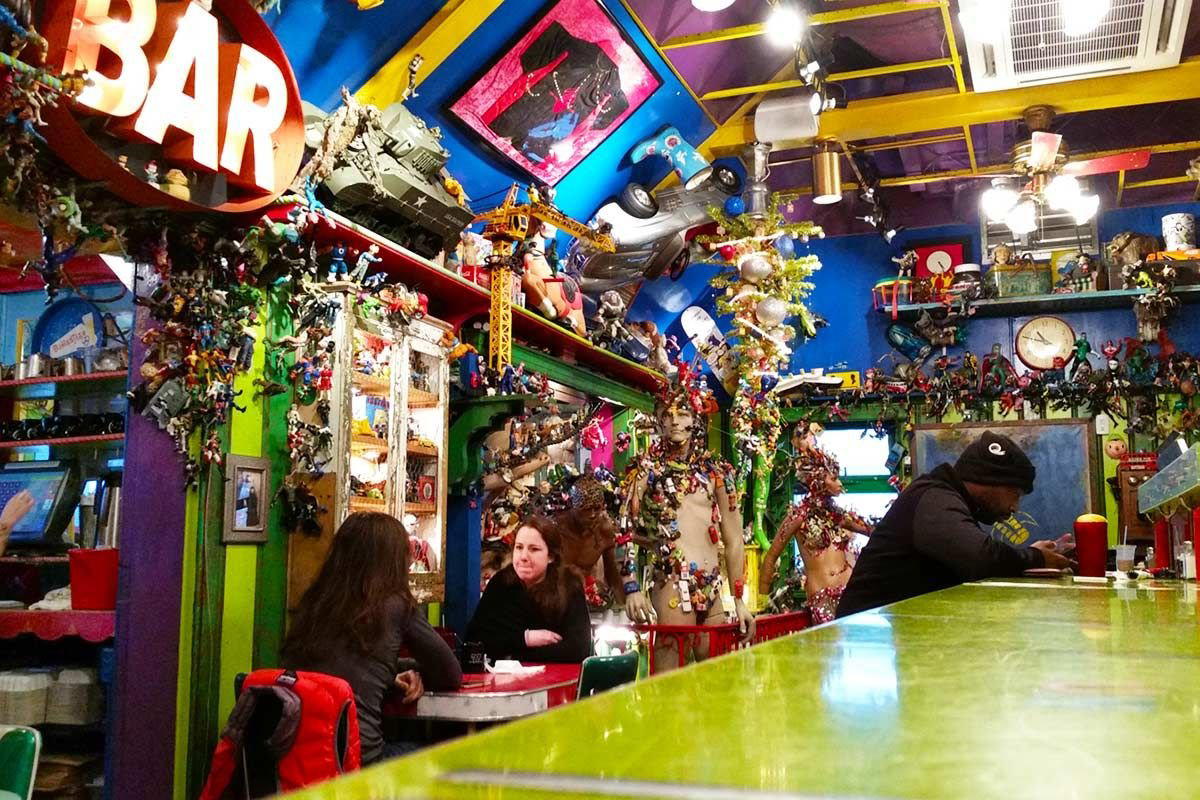
There is a particular kind of American diner that resists easy categorisation. Papermoon Diner, at 227 West 29th Street in Baltimore's Remington district, belongs to this rarer type. The physical environment announces its intentions before you sit down. The interior operates as an accumulated visual record, with dolls, toys, and found objects covering surfaces in a way that reads less as decoration and less as art installation and more as an ongoing domestic argument about what gets to stay. It is, in the most literal sense, a room that has been lived in.
Baltimore's diner culture has always occupied a different register than the city's better-documented steakhouse and seafood traditions. Where the Inner Harbour draws visitors toward crab houses and waterfront dining, the neighbourhoods north of the city centre sustain a parallel ecosystem of longer-running, less photographed establishments. Remington, which has seen incremental gentrification without wholesale transformation, remains one of the better addresses for that kind of continuity. Papermoon sits in that context: a place where the surrounding blocks still have the texture of a working neighbourhood rather than a dining district.
How the Meal Is Meant to Go
The dining ritual at an American diner carries its own set of conventions, and understanding them matters more than the menu itself. You arrive, you are seated, a server appears quickly, coffee comes without ceremony. The expectation is that you will linger if you want to, or turn the table in forty minutes if that is all you need. There is no tasting menu logic here, no pacing dictated by a kitchen, no progression from amuse to pre-dessert. The meal is yours to structure, and that freedom is part of the point.
What distinguishes Papermoon from the functional diner format is not a departure from that ritual but a deepening of it. The regulars, and there are many, have a relationship with the space that functions more like a standing appointment than a dining choice. This is a pattern visible in the long-running diners of cities like New York and Chicago, where certain tables at certain hours become semi-permanent fixtures of specific people's weeks. The diner in that model is less a restaurant than a recurring social infrastructure, and Papermoon appears to function in exactly that way for a portion of its clientele.
For first-time visitors, the practical advice is to treat the visit as a morning or midday affair rather than an evening destination. The diner format rewards daylight hours, when the pace of service and the tempo of conversation align with the ambient light and the relative quiet. Remington is accessible by car, and West 29th Street offers street parking in a way that most Baltimore dining districts do not, which is a meaningful logistical advantage for those arriving from outside the neighbourhood.
Papermoon in Baltimore's Broader Dining Scene
Baltimore's restaurant scene has developed considerably in the past decade, with Turkish-influenced cooking at dede (Turkish) representing one direction of the city's expanding ambition, while established neighbourhood spots like Angeli's Pizzeria hold a different kind of loyalty. At the more formal end, Cindy Wolf's Charleston has defined what fine dining looks like in the city for years. 16 On The Park and Akbar fill out distinct corners of the dining spectrum. Papermoon does not compete with any of these; it operates in a category those venues do not address.
The comparison that matters is not between Papermoon and Baltimore's fine dining tier, but between Papermoon and the category of diner that has survived long enough to develop genuine institutional character. Across American cities, this type of establishment has become less common as real estate pressure and changing neighbourhood demographics have eliminated many long-running independents. That makes the ones that persist worth taking seriously, not as nostalgia objects but as evidence that a particular dining format still has real demand when executed with conviction.
The contrast with destination dining at the national level is instructive. Restaurants like Alinea in Chicago, The French Laundry in Napa, or Le Bernardin in New York City ask diners to surrender entirely to the kitchen's structure, pacing, and logic. The diner format inverts that entirely. The contrast is also visible in experiential dining formats like Lazy Bear in San Francisco or Blue Hill at Stone Barns in Tarrytown, where the meal is a curated sequence. At Papermoon, the sequence is yours. Other acclaimed American tables, including Emeril's in New Orleans, Providence in Los Angeles, Addison in San Diego, Single Thread Farm in Healdsburg, Atomix in New York City, The Inn at Little Washington, and 8 1/2 Otto e Mezzo Bombana in Hong Kong, represent the opposite pole of the spectrum: high-formality, high-cost, high-structure. Papermoon's value lies precisely in what it refuses to do.
For a wider orientation to dining in the city, our full Baltimore restaurants guide maps the range across neighbourhoods and price tiers.
Planning the Visit
West 29th Street in Remington is a direct drive from central Baltimore, and the address at number 227 is easy to locate. The neighbourhood character rewards a short walk before or after the meal: the surrounding blocks have an unforced quality that contrasts with more deliberately curated dining districts. No booking infrastructure is publicly documented for Papermoon, which places it in walk-in territory for most visits, though arriving early during peak weekend morning hours will avoid a wait.
Frequently asked questions
What do regulars order at Papermoon Diner?
The diner format at Papermoon runs on a broad menu covering the standard American breakfast and lunch range, which means eggs, pancakes, sandwiches, and comfort-oriented plates form the backbone of what most tables order. Regulars at this type of long-running neighbourhood diner tend to establish personal routines around specific items, often ordering the same dish on each visit.
Can I walk in to Papermoon Diner?
Papermoon operates in a format and price tier consistent with walk-in dining rather than advance booking. If you are visiting during a weekend morning, the most competitive window in the diner category across most American cities, arriving before the mid-morning rush reduces wait time. Baltimore's diner culture generally supports the walk-in model, and Papermoon appears to follow that convention.
What is Papermoon Diner known for?
Papermoon is known within Baltimore for its distinctive interior environment, a densely layered accumulation of dolls, toys, and collected objects that gives the room a character unlike the standard diner aesthetic. That visual identity, combined with its longevity in Remington, has made it a reference point in the city's independent restaurant history. It functions as a neighbourhood institution in the specific sense that the regulars define the atmosphere as much as the physical space does.
Is Papermoon Diner a good option for visitors who want to experience Baltimore neighbourhood dining rather than the Inner Harbour restaurant circuit?
For visitors whose interest is in Baltimore as a city of distinct neighbourhoods rather than a waterfront dining destination, Remington and Papermoon represent a more grounded entry point. The diner sits in a part of the city that has maintained its residential character through the same period that saw other Baltimore neighbourhoods transform more dramatically. Arriving on foot or by car from the central city takes under fifteen minutes, and the visit pairs naturally with exploration of Remington's surrounding blocks, which carry the texture of a working Baltimore neighbourhood in a way that the Inner Harbour's dining district does not.
Fast Comparison
Comparable venues nearby, for context on price, style, and recognition.
| Venue | Cuisine | Price | Notes |
|---|---|---|---|
| Papermoon DinerThis venue (the venue you are viewing) | Whimsical American Diner | $20–30 | Not listed |
| The 1920 | Contemporary American with French influences | $30–50 | Downtown |
| Big Bad Wolf's House of Barbeque | American Barbecue | $20–30 | Hamilton |
| Annabel Lee Tavern | American Gastropub | $20–30 | Canton |
| Soup's On | Gourmet Soups & Sandwiches | $10–20 | midtown |
| 16 On The Park | Modern American Gastropub | $20–30 | Eager Park |
Continue exploring
More in Baltimore
Restaurants in Baltimore
All restaurants in Baltimore →

Details
- Whimsical
- Cozy
- Well Known
- Trendy
- Brunch
- Casual Hangout
- Family
- Historic Building
- Craft Cocktails
- A La Carte
- Milkshakes
- Vegetarian Friendly
- Vegan Options
- Gluten Free Options
Current opening hours
- Monday
- Closed
- Tuesday
- Closed
- Wednesday
- 8 AM–4 PM
- Thursday
- 8 AM–4 PM
- Friday
- 8 AM–6 PM
- Saturday
- 8 AM–6 PM
- Sunday
- 8 AM–6 PM
Hours can change for holidays and private events. Hours as of .
Lively, colorful, and whimsically cluttered with vintage toys, embellished mannequins, and eclectic art covering walls and ceilings, offering a fun, nostalgic, and visually stimulating environment.