Orchestria Palm Court
Orchestria Palm Court occupies a historic address at 27 E William St in downtown San Jose, placing it among a small tier of venues where architectural character and deliberate programming intersect. Compared to the neighborhood's louder, higher-volume options, it operates at a quieter register, the kind of space where the room itself carries meaning before the first course arrives.
 Discover on Pearl
Pearl is the En Primeur Club membership app — saves, bookings, and concierge access live there. Same editors, same standards.
- Address
- 27 E William St, San Jose, CA 95112
- Phone
- +14082885606
- Website
- orchestriapalmcourt.com
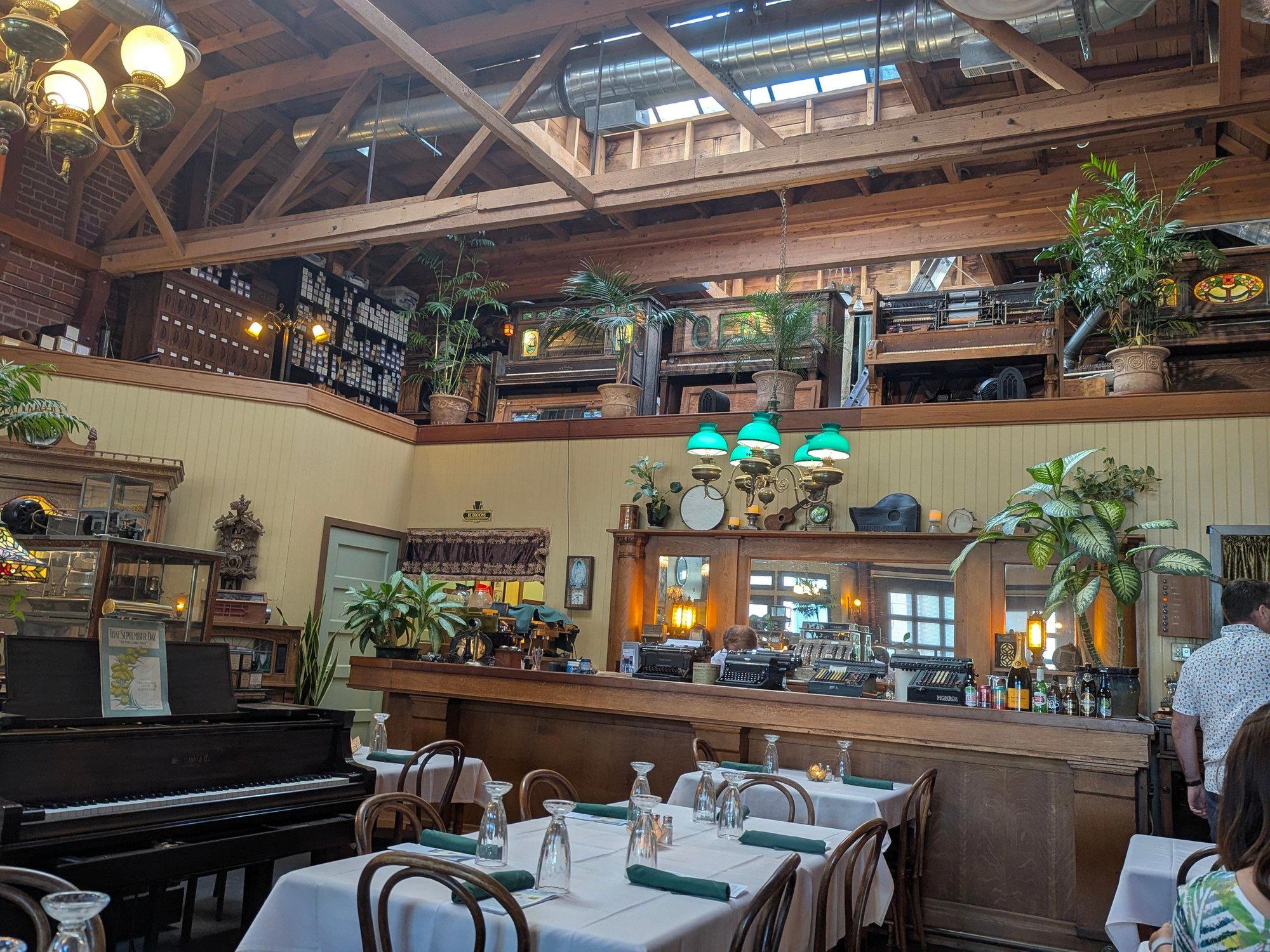
A Room That Predates the Noise
Downtown San Jose has spent two decades cycling through redevelopment phases, with SoFA and the surrounding streets absorbing successive waves of hospitality concepts, many of them optimized for volume and turnover. Against that backdrop, the Palm Court format, historically a covered atrium or garden room designed for lingering, often within older civic or hotel architecture, reads as a deliberate counterstatement. Orchestria Palm Court, at 27 E William St, occupies a building that anchors a city block. The experience of arriving here begins before you enter.
What a palm court format offers, architecturally, is a particular relationship between enclosure and openness. These rooms were designed to feel simultaneously sheltered and spacious, with natural light filtered through glass or lattice above, and a social geometry that encourages conversation across tables rather than isolating each party in its own acoustic bubble. In that sense, the format is inherently communal, a design tradition inherited from late-Victorian hotels and civic dining rooms that understood the room itself as part of the hospitality offer. San Jose has very few venues operating in this register, which positions Orchestria Palm Court within a narrow comparable set defined less by cuisine category and more by spatial ambition.
Where Orchestria Palm Court Sits in the San Jose Dining Picture
San Jose's restaurant scene is more internally varied than its national profile suggests. The city supports a credible Portuguese fine-dining tier, anchored by Adega (Portuguese) at the top of the price bracket, alongside mid-range operators like Alma de Amón and Antipastos by DeRose that serve distinct neighborhood functions. There is also genuine breadth in the informal sector: Back A Yard Caribbean Grill and Augustine represent the kind of independent operators that give a city its texture at the street level.
Orchestria Palm Court does not fit cleanly into any of these existing tiers. The venue's name points toward a specific cultural programming tradition, the orchestria was a mechanical instrument capable of replicating orchestral sound, and palm courts in the early twentieth century were among the primary venues for live and mechanical music as part of the dining experience. If that lineage is still operative here, it places the venue in a category that predates the modern restaurant as we understand it, closer to the European grand café or the American hotel rotunda than to any contemporary dining concept. That is a relatively rare positioning in a city where most venues anchor their identity to a cuisine category or a price-point signal.
Sustainability as Architecture, Not Afterthought
Across American fine dining, the sustainability conversation has split into two distinct approaches. The first is supply-chain certification: sourcing from named farms, displaying provenance on menus, and using local and seasonal language as a marketing layer. The second is structural: designing the format itself around low-waste principles, including portion architecture, fermentation and preservation programs, and the elimination of disposables at the service level. The most rigorous practitioners of the second approach, venues like Single Thread Farm in Healdsburg and Blue Hill at Stone Barns in Tarrytown, treat ecological accountability as a condition of the cooking rather than a communication strategy. At Lazy Bear in San Francisco, the communal format itself reduces per-cover waste by design.
The palm court format, if operated with attention to its original logic, aligns more naturally with the structural approach than the supply-chain-certification approach. A room designed for extended stays, shared service, and ambient programming creates conditions where slower dining, lower food waste, and reduced energy throughput are practical outcomes of the format rather than imposed constraints. Historic buildings of the type that typically house palm court venues also carry a sustainability argument in themselves: adaptive reuse of existing structures avoids the embodied carbon cost of new construction, a calculation that newer purpose-built restaurant spaces rarely have to make. In that sense, the physical fact of occupying 27 E William St carries its own environmental logic before a single sourcing decision is made.
For context on how American venues are approaching this structurally, the programs at The French Laundry in Napa, Providence in Los Angeles, and Addison in San Diego offer a useful comparative frame. Each has moved beyond menu-level sustainability signaling toward operational programs with measurable outputs. The question for any venue operating in the palm court tradition is whether that slowness and communality can be formalized into a coherent environmental practice rather than left as an incidental benefit.
The Broader Conversation: Format as Cultural Sustainability
There is a version of the sustainability argument that extends beyond food systems into cultural preservation. Venues like Le Bernardin in New York City, Emeril's in New Orleans, and The Inn at Little Washington in Washington each maintain formats and traditions that would disappear if the venues closed, forms of hospitality that took generations to develop and cannot be easily replicated. The orchestria palm court format sits in this category. The combination of mechanical or live musical programming with a specific architectural typology and a communal dining tradition is not something that regenerates spontaneously. Venues that sustain it are doing preservation work.
Internationally, the grand café and palm court traditions persist most durably in cities that have a strong sense of their own pre-modern hospitality history. Venues like 8 1/2 Otto e Mezzo Bombana (Hong Kong) in Hong Kong operate within a luxury tier that can financially sustain formal European service traditions. In the American context, the challenge for any venue working in a historic format is that the economic model has to be constructed around the format rather than imported from the standard restaurant playbook. Venues like Alinea in Chicago and Atomix in New York City have shown that format-first thinking can produce financially durable operations when the audience is correctly identified.
Planning a Visit
Orchestria Palm Court is located at 27 E William St in central San Jose, within walking distance of the downtown core and accessible via the VTA light rail network, which reduces the practical argument for driving into a congested urban center. Orchestria Palm Court is open Friday and Saturday from 5:30 to 9 PM, and reservations are recommended. The surrounding downtown blocks offer enough supplementary dining and cultural options that a visit can be planned around it. For a broader view of what the San Jose dining scene offers across price tiers and cuisine categories, the EP Club San Jose guide provides the necessary context.
A Tight Comparison
Comparable venues nearby, for context on price, style, and recognition.
| Venue | Cuisine | Price | Notes |
|---|---|---|---|
| Orchestria Palm CourtThis venue — the venue you are viewing | South Campus, Continental European | $$$ | |
| Black Sheep Brasserie | $$$ | Willow Glen, Contemporary French Brasserie | |
| Grand View | Mount Hamilton, Farm-to-Table American | $$$ | |
| The Pressroom | $$ | San Pedro Square, Elevated California Cuisine | |
| Giorgio's Italian Food and Pizzeria | $$ | Willow Glen South, Classic Italian Pizza and Pasta | |
| Oveja Negra | Santana Row, Modern Spanish Tapas | $$ |
Continue exploring
More in San Jose
Restaurants in San Jose
Browse all →
Bars in San Jose
Browse all →
Hotels in San Jose
Browse all →

At a Glance
- Classic
- Elegant
- Intimate
- Historic
- Whimsical
- Date Night
- Special Occasion
- Live Music
- Historic Building
- Craft Cocktails
- Beer Program
- Organic
- Local Sourcing
Charming nostalgic atmosphere with vintage decor, player pianos, and self-playing instruments evoking the early 1900s, enhanced by skylights and rustic elements.