Michelin Plate
Our verdict
Positioned a short walk from the Uffizi in the heart of Florence's historic centre, Ora d'Aria holds a Michelin Plate and an Opinionated About Dining Classical Europe ranking, placing it in the tier just below the city's starred rooms. Chef Marco Stabile runs two tasting menus, one meat, one fish, with creative Italian cooking that draws selectively on Tuscan ingredients without being constrained by regional tradition.

Pearl is the En Primeur Club membership app, where members save venues, book tables and use the concierge.
A Room Behind the Uffizi
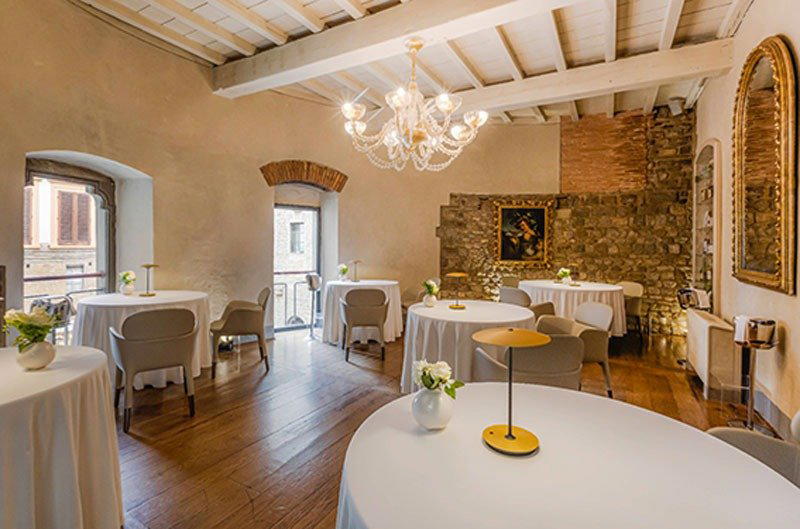
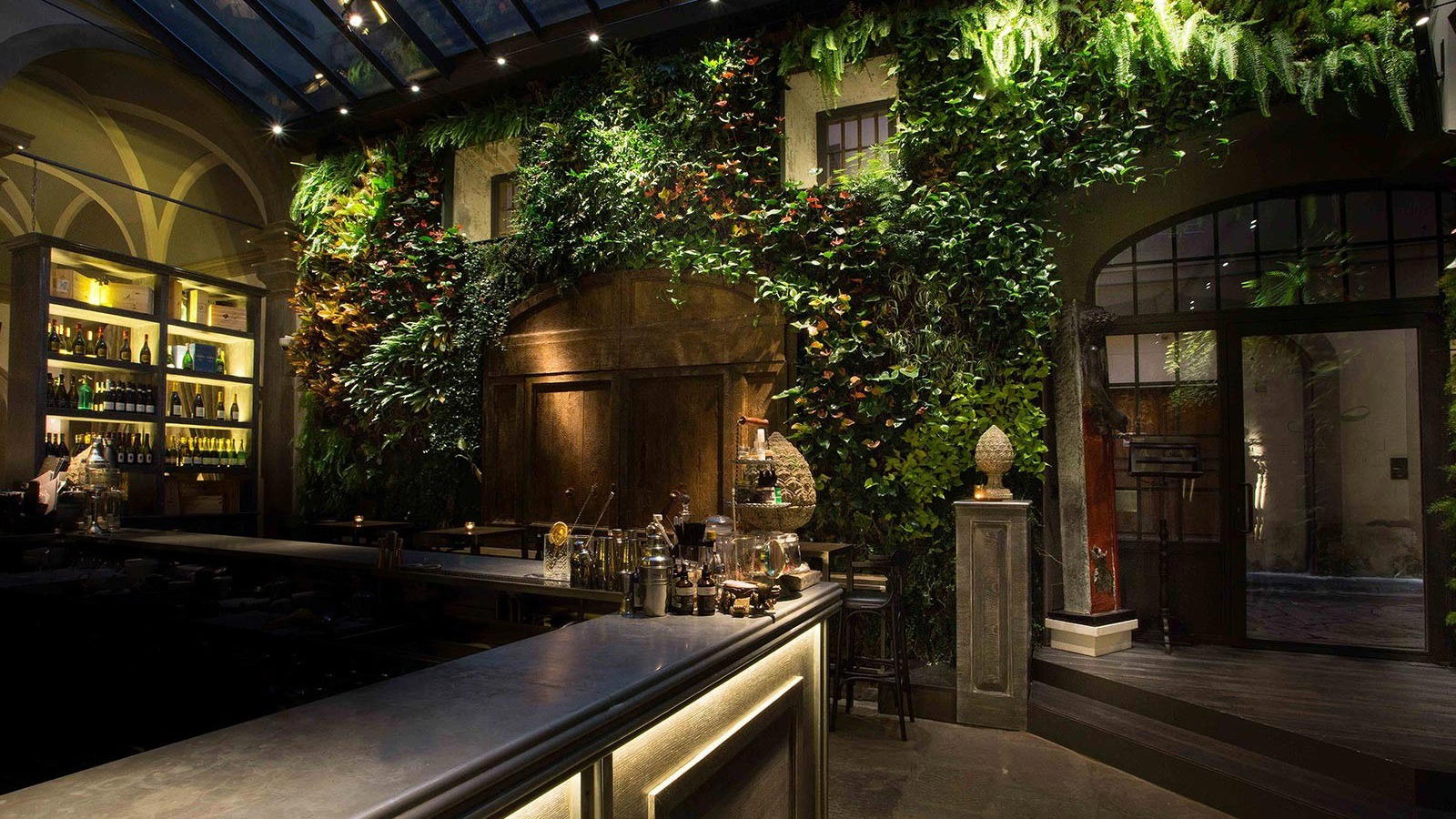
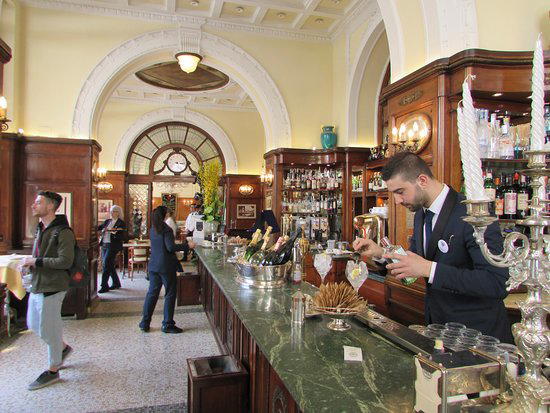
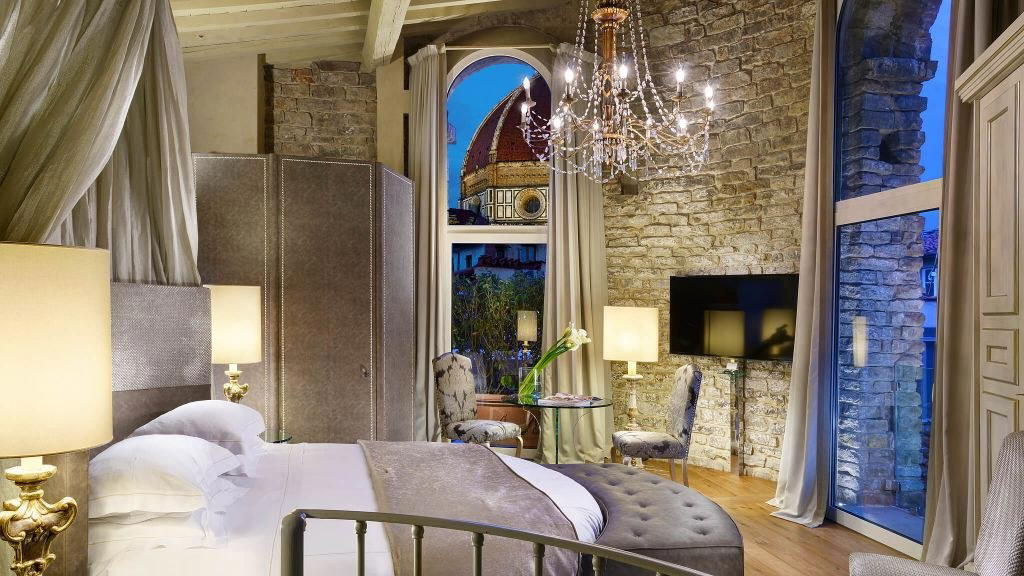
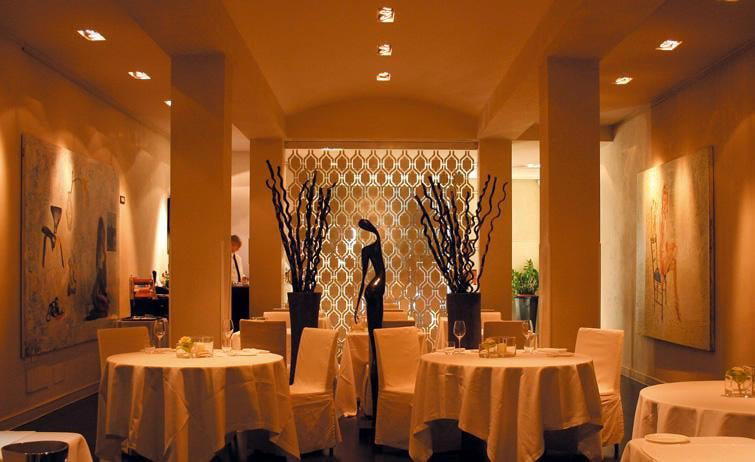
The streets that fan out from the Uffizi's south side are among the most footfall-heavy in Florence, yet Via dei Georgofili operates at a different register: narrower, quieter, emptied of the tour-group rhythm that defines Piazza della Signoria two minutes away. Arriving at Ora d'Aria in the early evening, before the gallery crowds have fully dispersed, the contrast between outside and inside is immediate. The dining room has a gold-leaf frescoed ceiling, a reference to the building's age rather than a decorative flourish, and an open kitchen that makes the brigade visible from the moment you sit down. The room reads as intimate without being cramped, composed without feeling staged.
The name is Florentine in origin. It refers to the brief daily outdoor hour granted to prisoners at the old Le Murate jail nearby, a sliver of sky and open air within a contained day. That etymology carries a structural idea into the restaurant: the meal is framed as a deliberate pause, a period of unhurried attention in a city that moves fast around cultural landmarks. Whether that framing lands depends on the pace at which service chooses to move it forward.
Where Ora d'Aria Sits in Florence's Dining Tier
Florence's premium restaurant market divides more sharply than most Italian cities. At the upper end, Enoteca Pinchiorri occupies a category of its own, with three Michelin stars and a cellar that functions as a destination independent of the food. One tier below, a group of €€€€ rooms, Santa Elisabetta, Atto di Vito Mollica, Borgo San Jacopo, and Gucci Osteria da Massimo Bottura, compete in a band where hotel addresses, Michelin stars, and brand associations do a lot of the positioning work.
Ora d'Aria sits at €€€, which is a meaningful distinction. It carries a Michelin Plate in 2025, a recognition that signals quality technique without the formal star, and it ranked 202nd in the Opinionated About Dining Classical Europe list in 2024, having been Highly Recommended in 2023. For the European dining-circuit reader, OAD placement at that level among classical restaurants is a specific signal: the food is taken seriously by the kind of frequenter who eats across the continent systematically. The price point makes it accessible to a broader range than the starred tier, which matters in a city where high-end dining is increasingly tied to hotel infrastructure and the spending assumptions that come with it.
The Structure of the Meal
Contemporary Italian tasting menus have developed a fairly consistent grammar over the past decade: an opening sequence of small technical pieces, a mid-menu turn toward heavier protein or pasta, then a measured descent into dessert. What varies between rooms at this level is the degree to which regional identity anchors that grammar, or whether the kitchen treats region as a material rather than a mandate.
At Ora d'Aria, Chef Marco Stabile works with two parallel tasting menus, one built around meat, one around fish, and both draw selectively on Tuscan ingredients without committing to a strictly regional brief. The open kitchen is not incidental to this: it is part of how the meal is experienced. Guests can observe the pacing of the kitchen, see the sequence of courses being assembled, and develop a sense of the meal's architecture before each plate arrives. In rooms where the kitchen is hidden, tasting menus can feel like a series of surprises; here, the transparency creates something closer to a dialogue, which maps to the restaurant's stated intent. The guest is not a passive recipient.
The format runs Monday through Saturday, dinner only, with service from 7 to 10 pm. The restaurant is closed on Sundays. For anyone planning around Florence's broader week, that Sunday closure is worth noting: the city's better rooms cluster toward Thursday-Saturday peaks, and weekend availability at this address should be treated as a lead-time consideration rather than a walk-in prospect.
The Dining Ritual at This Address
In cities where tasting menus have become the default format at the premium tier, the ritual of how a meal progresses has become as meaningful as what is served. Florence, as a city, has been slower than Milan or Rome to fully detach from the trattoria rhythm of à la carte eating, which means that a structured tasting menu here still carries a degree of deliberateness, you are choosing a format rather than defaulting to it.
At Ora d'Aria, the ritual is shaped by the room's physical arrangement. The open kitchen sets a tempo: the kitchen is visibly at work throughout the meal, which keeps the pacing transparent and creates an ambient awareness of what is coming. The gold-leaf ceiling, the compact scale of the room, the address between the Uffizi and the Arno, these are the conditions in which the meal unfolds, and they are not neutral. Eating this attentively in this part of Florence produces a specific quality of evening, one that is harder to find at the larger, louder rooms in the city's upper tier.
Italy's contemporary restaurant scene at this level is well represented elsewhere on the peninsula: Osteria Francescana in Modena and Uliassi in Senigallia define the starred end of creative Italian cooking, while Enrico Bartolini in Milan and Quattro Passi in Marina del Cantone each represent distinct regional expressions at high price points. Atelier Moessmer Norbert Niederkofler in Brunico and Dal Pescatore in Runate occupy the more formal, classical end. For comparison, Le Bernardin in New York and Atomix represent how the same tasting-menu ritual plays out in a different cultural register entirely.
Planning a Visit
Ora d'Aria is at Via dei Georgofili, 11R, directly behind the Uffizi. The location is central enough to reach on foot from most of Florence's historic-centre hotels; for logistics around where to stay, the full Florence hotels guide maps the main options by area. Dinner service runs 7 to 10 pm, Tuesday through Saturday (Monday also listed as open evenings); the restaurant does not operate on Sundays. Given the address and the OAD recognition, table availability at peak periods should be treated as finite. The full Florence restaurants guide provides broader context for how this room sits within the city's wider dining offer, and the Florence bars guide, wineries guide, and experiences guide are useful for building the surrounding days.
Frequently asked questions
How much does it cost to eat at Ora d'Aria?
Pricing at Ora d'Aria is listed as €€€.
What time does Ora d'Aria open and close?
Hours at Ora d'Aria: Hours: Monday 7–10 pm Tuesday 7–10 pm Wednesday 7–10 pm Thursday 7–10 pm Friday 7–10 pm Saturday 7–10 pm Sunday Closed.
Is Ora d'Aria Michelin-listed?
Ora d'Aria has received recognition including: Situated behind the Uffizi, this restaurant boasts a large open-view kitchen and an original approach that focuses on creating meaningful dialogue between guests and the chefs in the kitchen. The restaurant owes its name to the old Florenti….
What's the signature dish at Ora d'Aria?
Ora d'Aria structures its menu around two distinct tasting courses rather than a single signature plate: one dedicated to meat, one to fish, both built on Tuscan ingredients interpreted through a contemporary lens by chef Marco Stabile. The Michelin Plate recognition in both 2024 and 2025 reflects consistent kitchen execution across the full menu rather than a single standout dish.
The Essentials
| Venue | Cuisine | Price | Awards | Notes |
|---|---|---|---|---|
| Ora d'AriaThis venue (the venue you are viewing) | Modern Tuscan Fine Dining | Not listed | Michelin Plate | Not listed |
| Enoteca Pinchiorri | Contemporary Italian Fine Dining | $200–300 | 3 Michelin Stars · World's 50 Best #32 | Italian - French, Italian Contemporary |
| Santa Elisabetta | Modern Italian Fine Dining with Seafood Focus | $200–300 | 2 Michelin Stars · La Liste Top Restaurants | Italian, Creative |
| Borgo San Jacopo | Michelin-starred Modern Tuscan & Italian Fine Dining | $150–200 | 1 Michelin Star · Falstaff Restaurant - 94 Falstaff Points | Italian, Modern Cuisine |
| Gucci Osteria da Massimo Bottura | Contemporary Italian with Japanese and Mexican Influences | $200–300 | 1 Michelin Star · Wine Spectator Best of Award of Excellence | Modern Italian, Italian Contemporary |
| Il Palagio | Modern Tuscan Fine Dining | $100–150 | 1 Michelin Star · Star Wine List | Italian Contemporary |
Recognition history
Dated appearances from independent guides and award organizations, with the underlying list record or original source where available.
Michelin Plate
Michelin
Opinionated About Dining Classical in Europe Ranked #202
Opinionated About Dining
Full recognition history (5 entries)
Michelin Plate
Michelin
Michelin Plate
Michelin
Opinionated About Dining Classical in Europe Highly Recommended
Opinionated About Dining