Old Jerusalem Restaurant
Old Jerusalem Restaurant on Mission Street has anchored San Francisco's Middle Eastern dining scene for decades, representing the kind of neighborhood institution that exists outside the city's fine-dining circuit. Situated in the Mission District at 2966 Mission St, it draws regulars for its unfussy, direct approach to Palestinian and broader Levantine cooking in a part of the city where rent pressures have thinned the independent-restaurant count considerably.
Pearl is the En Primeur Club membership app — saves, bookings, and concierge access live there. Same editors, same standards.
- Address
- 2966 Mission St, San Francisco, CA 94110
- Phone
- +14156425958
- Website
- oldjerusalem.co
- Directions
- Get directions
 Saves & bookings on Pearl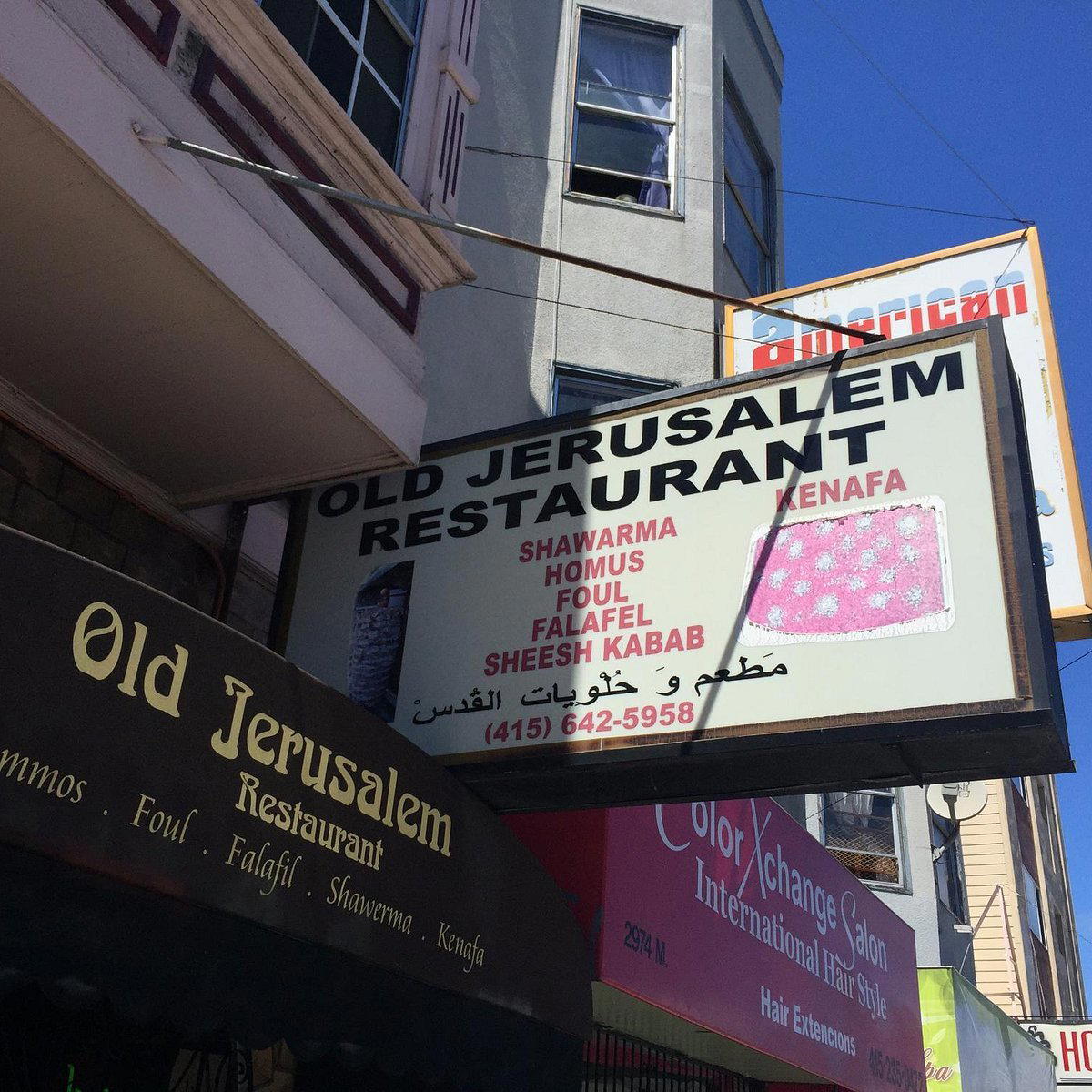
Mission Street and the Long Arc of Middle Eastern Cooking in San Francisco
San Francisco's dining conversation tends to orbit a tight cluster of tasting-menu destinations: the hyper-local progressivism of Lazy Bear, the poetic modernism of Atelier Crenn, the Franco-Korean precision of Benu. These are the restaurants that draw attention and command $300-plus covers. But a parallel city exists on Mission Street, where a different kind of institutional weight operates. Old Jerusalem Restaurant, at 2966 Mission St, belongs to that second city, the one built on neighborhood loyalty, consistent execution, and the slow accumulation of trust that no award cycle accelerates or reverses.
The Mission District has changed substantially over the decades Old Jerusalem has operated here. Tech-economy displacement raised rents across the corridor, reducing the density of independent operators who once made the stretch between 24th and 30th Street among the more culinarily diverse in California. The restaurants that survived that pressure did so through one of two routes: either they became destination draws with enough tourist traffic to absorb higher costs, or they maintained a core local clientele whose repeat visits provided baseline stability. Old Jerusalem took the second path.
The Levantine Tradition This Restaurant Inhabits
Palestinian and broader Levantine cooking in American cities has undergone a significant reappraisal over the past fifteen years. What was once filed under generic "Middle Eastern" in the American dining imagination has gradually been parsed into its regional and cultural specifics, the difference between Syrian mezze traditions and Lebanese grill culture, between Yemeni bread culture and Palestinian whole-roasted preparations. San Francisco, with its historically diverse immigrant population, was ahead of most American cities in making those distinctions, and the Mission District was the geography where many of them played out.
Levantine cuisine at its structural core is built around sharing formats: mezze plates designed for the center of the table, flatbreads that function as both utensil and dish, braised and roasted proteins that reward slow eating. These formats translate poorly to the individual plating conventions of fine dining, which is partly why this category of cooking has historically been underrepresented in premium dining coverage, even as the ingredients and techniques involved are as technically demanding as those in any European tradition. The revival of interest in these cuisines among younger American diners has coincided with a broader shift toward ingredient-forward, vegetable-heavy eating patterns, which happen to align naturally with how Levantine cooking has always worked.
Compared to the tasting-menu tier, where Quince operates in the $300 range and Saison commands similar premiums for its fire-focused Californian work, Old Jerusalem operates in a different register entirely. Its competitive comparable set is not the Michelin tier but the mid-range neighborhood institutions that have become harder to find in San Francisco as the cost structure of the city has pressed outward toward fast-casual or upward toward fine dining, hollowing out the middle.
How the Restaurant Has Evolved
Neighborhood restaurants of this type in American cities tend to follow a recognizable arc. An initial period of establishment serves the immediate immigrant community or a diaspora cluster with limited crossover to the broader dining public. A second phase, if the restaurant survives long enough, brings gradual discovery by food-curious locals who find the cooking more complex and more interesting than the generic category label suggested. A third phase, which fewer restaurants reach, involves the place becoming genuinely embedded in the neighborhood's social fabric, not merely a restaurant people go to but a place people feel a stake in.
The Mission District's role in San Francisco's food history has drawn coverage from outlets including the San Francisco Chronicle, which has tracked the neighborhood's independent-restaurant culture through multiple economic cycles. Old Jerusalem's longevity on Mission Street places it in the company of a small number of institutions that predate the first dot-com boom, survived the subsequent bust, and then navigated the far more structurally transformative pressures of the 2010s tech economy. That survival record, in a city where restaurant turnover runs high even in stable periods, is itself a form of institutional credential.
The evolution visible in long-running neighborhood restaurants of this type is rarely dramatic. It tends to be incremental: a menu that responds to ingredient availability, a room that gets modest updates without losing its character, a staff that develops depth over time because turnover is lower than in higher-pressure kitchens. These are not the reinventions that generate press cycles, they are the quieter adjustments that allow a restaurant to remain relevant to regulars over ten, fifteen, or twenty-plus years.
For context on what this kind of durability means in an American restaurant context, consider that many of the country's most discussed establishments, from Le Bernardin in New York City to Alinea in Chicago to The French Laundry in Napa, have also navigated significant reinventions over multi-decade runs. The difference is that those reinventions were publicly documented and drove subsequent media coverage. The evolution of a neighborhood institution like Old Jerusalem happens without that apparatus, which makes it harder to track but no less real.
Where This Sits in the San Francisco Dining Map
San Francisco's dining geography has always been more neighborhood-specific than the city's relatively small footprint might suggest. The Ferry Building and Financial District axis serves a different dining public than the Mission, which operates differently again from the Richmond's Asian restaurant concentration or Hayes Valley's design-conscious mid-range. Old Jerusalem is specifically a Mission restaurant, in the sense that its character, pricing, and clientele are shaped by that neighborhood's particular combination of longtime Latino community, arriving professional population, and legacy immigrant institutions.
For visitors whose San Francisco itinerary includes the tasting-menu tier, Benu or Atelier Crenn or further afield at Single Thread Farm in Healdsburg or Providence in Los Angeles, a meal at Old Jerusalem represents the other axis of what the Bay Area does well: the durable, unfussy, community-embedded institution that the premium tier often renders invisible. Our full San Francisco restaurants guide covers both ends of that spectrum.
Visitors arriving from cities with stronger Middle Eastern dining infrastructure, say, those familiar with the depth of Levantine cooking available in parts of metropolitan Detroit or in some New York neighborhoods, will recognize the type immediately. Those whose frame of reference is primarily the tasting-menu circuit, from Addison in San Diego to Blue Hill at Stone Barns to The Inn at Little Washington, may find the register unfamiliar but the cooking no less considered.
Planning Your Visit
Old Jerusalem Restaurant is located at 2966 Mission St, San Francisco, CA 94110, in the Mission District. For current hours, booking availability, and menu details, check directly with the restaurant.
A Credentials Check
Comparable venues nearby, for context on price, style, and recognition.
| Venue | Cuisine | Price | Notes |
|---|---|---|---|
| Old Jerusalem RestaurantThis venue — the venue you are viewing | Palestinian & Mediterranean | $$ | Not listed |
| Reem’s | Arab Street Food Bakery | $$ | Mission |
| The Halal Guys | American Halal Street Food | $$ | Tenderloin |
| Agrodolce Provisions | Italian pasta lunch spot and provisions market | $$ | SoMa |
| HRD Smokin' Grill | Korean-Asian Fusion BBQ | $$ | North Beach |
| Sushirrito | Sushi Burritos - Modern Japanese with Latin Twist | $$ | Union Square |
Continue exploring
More in San Francisco
Restaurants in San Francisco
Browse all →
Bars in San Francisco
Browse all →
Hotels in San Francisco
Browse all →


At a Glance
- Well Known
- Lively
- Casual
- Casual Hangout
- Group Dining
- Solo
- Standalone
Current opening hours
- Monday
- 11 AM–10 PM
- Tuesday
- Closed
- Wednesday
- 11 AM–10 PM
- Thursday
- 11 AM–10 PM
- Friday
- 11 AM–10 PM
- Saturday
- 11 AM–10 PM
- Sunday
- 11 AM–9 PM
Hours can change for holidays and private events. Last verified .