
Mito’s eel culture rewards restaurants that treat fish sourcing and grill discipline as the main event. Nuriya Izumichou oodoori sits in that serious unagi tier, with Tabelog 100 Unagi selections in 2018, 2019, 2022, and 2024, plus a room format suited to groups rather than counter-only dining.
Pearl is the En Primeur Club membership app — saves, bookings, and concierge access live there. Same editors, same standards.
- Address
- 3 Chome-1-31 Izumicho, Mito, Ibaraki 310-0026, Japan
- Phone
- +81 29-231-4989
- Website
- tabelog.com
 Saves & bookings on Pearl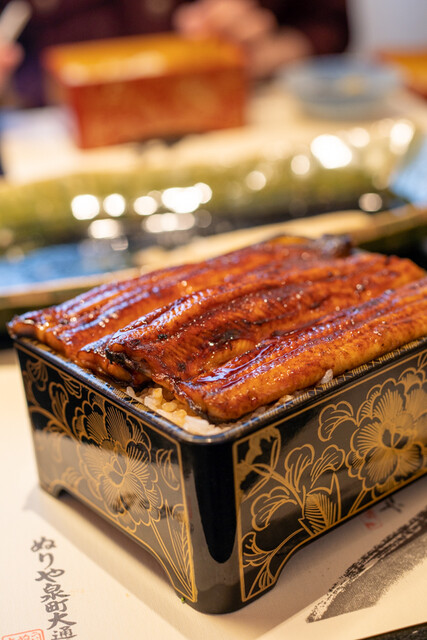
Approach Izumicho and the rhythm is not Ginza theatre or Kyoto ceremony, but the quieter confidence of a regional Japanese dining room built around one ingredient. In Mito, unagi is not a luxury import so much as the meal’s reason, and serious houses are judged by restraint: fish handling, timing over heat, tare that supports rather than masks, and rice that understands its role.
Nuriya Izumichou oodoori sits in the eel-restaurant category where sourcing language matters because the cuisine leaves little room for distraction. Its public category is direct: Unagi (Eel) and Dojo (Loach), with “particular about fish” attached to the food profile. Plain as that sounds, it carries weight here. Broader izakaya-style eel restaurants can blur the central promise; this signal is narrower, and Tabelog 100 Unagi selections in 2018, 2019, 2022, and 2024 place it in a national conversation around specialist unagi rather than general-purpose Japanese dining.
Unagi in Mito is judged by fish, fire, and restraint
Unagi is one of Japan’s great format cuisines because its technical range is deliberately compressed. Diners are not comparing dozens of courses or watching a chef build narrative through rare ingredients. The frame is smaller: procurement, preparation, grilling, sauce, rice, pacing. Recognition in a list devoted specifically to unagi therefore matters more here than a broader popularity badge; it measures the restaurant against eel specialists, not every restaurant serving a pleasant lunch.
Mito’s dining scene has a practical regional cast. It supports family meals, neighborhood regulars, and visitors using the city as an Ibaraki base, rather than behaving like a destination only for tasting-menu pilgrims. In that setting, a focused eel house occupies useful middle ground: more ceremonial than a casual curry or set-meal stop, less formal than high-spend reservation rooms built around scarcity. Compared with Shirakawa, listed at a higher spend band, this reads as a more accessible specialist choice. Compared with casual Mito addresses such as Karma or Kimura Ya Honten, the decision is less everyday convenience than committing the meal to eel.
Dojo alongside eel also matters. Loach has deep roots in Japanese cooking but appears far less often on contemporary travel itineraries than sushi, ramen, tempura, or wagyu. Its listing places the restaurant inside an older freshwater tradition, one that suits a regional city more than a menu engineered for international shorthand. The meal need not be explained to be enjoyed; its identity comes from a narrower, more local grammar than the pan-Japanese menus visitors often meet first.
A house-style dining room, not a performance counter
The format is part of the appeal. This is not the tense, seat-counted counter experience dominating much high-end Japan coverage. The room has table seating and tatami seating, with private rooms for small parties and larger groups. That changes the tempo: conversation can carry, families can eat without adopting a hushed tasting-menu script, and visitors get a regional dining appointment rather than a stage-managed chef encounter.
That distinction helps when sorting Mito restaurants. Agni, Bansen Store, Koji Koji, Our full Mito restaurants guide, Our full Mito hotels guide, Our full Mito bars guide, Our full Mito wineries guide, and Our full Mito experiences guide map a city where valuable meals are not always the loudest online. Nuriya Izumichou oodoori’s appeal is narrower: go when the meal should revolve around freshwater fish, not when a group wants maximum menu variety.
The award history is a clear trust signal, if read correctly. Tabelog’s Hyakumeiten selections are category-specific, and the 2024 Unagi selection places the restaurant among recognized eel specialists for that year. Earlier selections in 2018, 2019, and 2022 suggest sustained relevance in the same category. That is different from chasing luxury-dining spectacle. The evidence points to consistency in a craft where regularity matters: the same core ingredient, service after service, under conditions where small lapses are easy to notice.
For visitors eating widely across Japan, this stop adds regional texture. Tokyo can supply polished seafood counters; Osaka, dense urban snacking; Kyoto, codified seasonal formality. Mito’s contribution is quieter: specialist rooms with enough local utility to avoid feeling staged. Readers building a broader Japan itinerary may cross-reference formats from -Grilled beef Sukiyaki- KAMAKURA TANUKIAN 鎌倉 たぬき庵 in Kamakura to. 鮪と炭火焼き うお炭 秋葉原店 in Tokyo,.cafe in Osaka,.know in Kumamoto, (Shoku) Vietnam in Kawasaki, and [Curry Senmon Ten] Maruyama Kyoju. in Sapporo. Outside Japan, the contrast sharpens against specialist Japanese-adjacent rooms such as Jōdo Saké Bar in Los Angeles and Onigiri Time in Pasadena. The point is not equivalence, but clarity of format: this Mito address belongs to the ingredient-led side of the ledger.
How to read the meal
Approach the restaurant by treating eel as the anchor and letting the traditional structure work. Sake is part of the drink profile, private rooms broaden the use case, and take-out extends the restaurant beyond a single seated occasion. Plan for cash: cards, electronic money, and QR payments are not accepted. The location also rewards forethought, in Izumicho rather than directly inside the station cluster, with bus access from Mito Station and contracted parking nearby.
The editorial case is simple. Choose this restaurant when the meal should teach something about regional unagi culture: sourcing discipline, freshwater tradition, and a dining room designed for actual local use. Skip it when the brief is a broad menu, late-night drinking, or a chef-led performance format. In Mito, that specificity is the point.
Snapshot
Comparable venues by cuisine and price in the same metro.
| Venue | Cuisine | Price | Awards | Notes |
|---|---|---|---|---|
| Nuriya Izumichou oodooriThis venue — the venue you are viewing | Traditional Unagi (Eel) Restaurant | $$$ | , | |
| Shirakawa | Teppanyaki & Hitachi Beef Steakhouse | $$$ | , | Minami-machi |
| Karma | Indian curry house | $$ | , | Mito |
| Agni | Sichuan & Chinese Dining Bar with Japanese-Western Influences | $$ | , | Mito |
| Ogura Ya | Japanese | $ | , | Mito |
| marcador | Casual Spanish Bar & Restaurant | $$ | , | Minamimachi |
Continue exploring
More in Mito

At a Glance
- Classic
- Cozy
- Rustic
- Family
- Group Dining
- Casual Hangout
- Solo
- Special Occasion
- Private Dining
- Standalone
- Sake Program
A classic house-style unagi restaurant with tatami rooms and spacious, relaxing seating; the atmosphere is calm and comfortable, suited to families and small groups rather than formal dining.