

On Osaka's Oimatsu-dori antique strip, Naniwa Okina serves soba built on three generations of dashi tradition, using kombu-and-light-soy broth from a grandfather's recipe and noodles made with sacred water drawn from nearby Osaka Tenmangu Shrine. Two consecutive Michelin Bib Gourmand awards (2024 and 2025) confirm its place in Kita Ward's understated dining tier, where craft and locality matter more than ceremony.
Pearl is the En Primeur Club membership app — saves, bookings, and concierge access live there. Same editors, same standards.
- Address
- 4 Chome-1-18 Nishitenma, Kita Ward, Osaka, 530-0047, Japan
- Phone
- +81 6-6361-5457
- Website
- naniwa-okina.co.jp
- Directions
- Get directions
 Saves & bookings on Pearl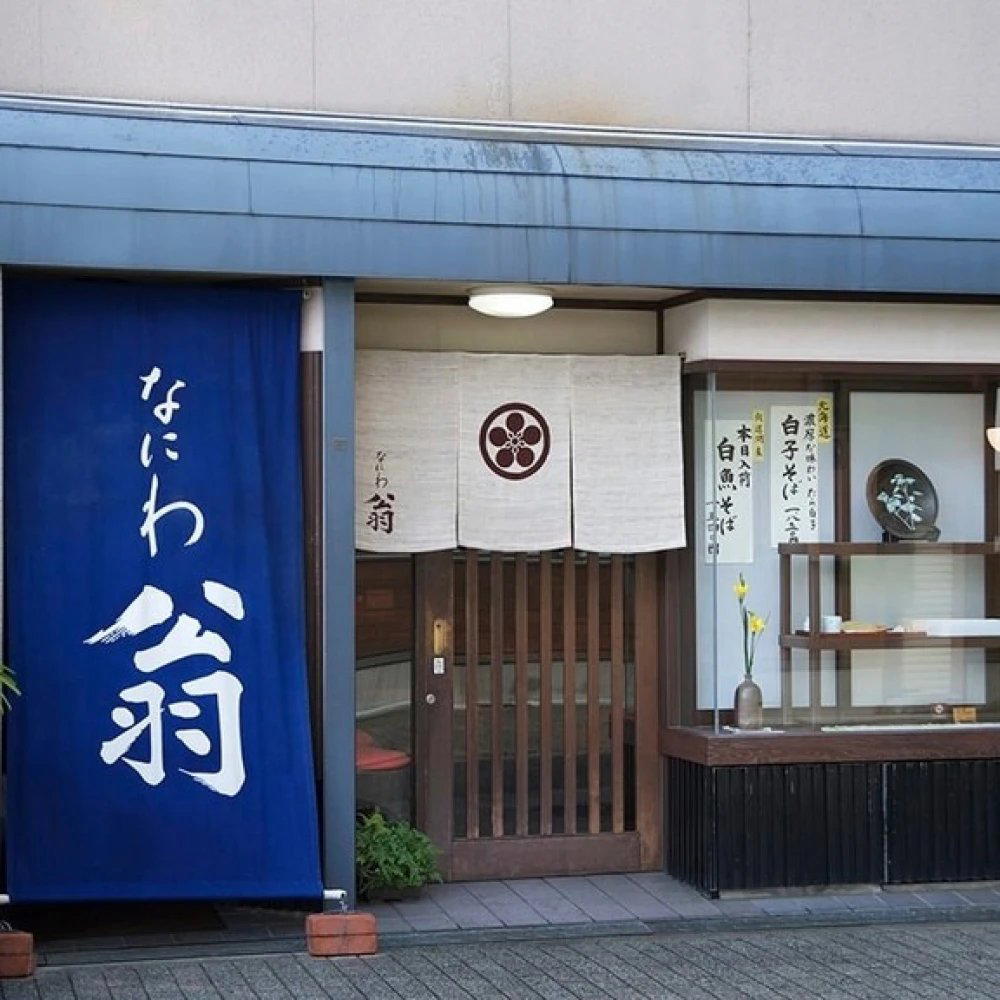
A Street With Memory, a Bowl With Lineage
Oimatsu-dori in Kita Ward is not a dining destination by default. The street built its identity around antique dealers and galleries, and its deeper past as the ceremonial approach to Osaka Tenmangu Shrine gives it a weight that most restaurant corridors lack. That context is not incidental to Naniwa Okina; it is load-bearing. The noren hanging at the entrance carries the shrine's plum-flower crest, placing the restaurant inside a chain of civic and spiritual continuity that stretches back well before the current building existed. In Osaka, where food culture is often discussed through the lens of kuidaore, eating until you drop, a soba-ya that frames itself through shrine adjacency and generational recipe custody is making a specific and considered argument about what a bowl of noodles can mean.
Within Osaka's current dining range, the price spread runs from approachable neighbourhood counters to multi-course kaiseki at ¥¥¥ and European-rooted tasting menus at ¥¥¥¥, with venues like Hajime and La Cime anchoring the upper end. Naniwa Okina operates at the ¥ tier, which in Japanese soba culture is not a compromise: it is the appropriate register for a discipline where the cost is in technique and time rather than ingredient volume.
Dashi as Cultural Argument
Osaka's food identity has always been built on dashi more than on any single ingredient or format. The city's broth tradition draws from kombu-heavy stocks that differ structurally from the bonito-forward dashi of Tokyo, and that distinction has real consequences for how flavours layer. At Naniwa Okina, the third-generation owner-chef works from his grandfather's kombu-and-light-soy recipe, a formula that preserves the city's approach to broth in a direct way. This is not fusion or interpretation; it is recipe custody across three generations, which in the context of Osaka dashi culture makes it a primary source rather than a contemporary take.
For a diner interested in how regional dashi traditions hold or erode under commercial pressure, the bowl here functions as evidence. The Kansai preference for lighter soy in broth, against the darker seasoning typical in eastern Japan, is a documented regional distinction, and a soba counter that anchors its recipe to that tradition while holding a Bib Gourmand across consecutive years is doing something worth paying attention to. Compared with Tokyo-based soba houses like Akasaka Sunaba or Azabukawakamian, where Edo-style broth conventions dominate, Naniwa Okina represents a clearly differentiated regional position.
Noodle Craft and Its Geography
What makes the technical picture at the restaurant more complex than a direct inheritance story is the split in where the craft was learned. The broth recipe comes from Osaka, from the grandfather's kitchen. The noodle-making technique, however, was acquired in Yamanashi Prefecture, a region on Honshu's central mountains with its own soba lineage, distinct from both Kansai and Edo traditions. Yamanashi is better known for houtou, its wide flat wheat noodle, but the prefecture's mountainous terrain historically supported buckwheat cultivation and produced soba artisans with particular attention to texture and hydration ratios.
This geographic split in training means the bowl at the restaurant is not a single regional document; it is a deliberate cross-pollination. The dashi speaks Osaka. The noodle-making was shaped elsewhere. The water used to make those noodles, drawn from the shrine adjacent to the restaurant, closes the loop back to the immediate neighbourhood. It is a technically coherent combination, and it explains why the restaurant's identity is harder to reduce to a single regional label than most soba-ya.
Where Sake Fits
Soba and sake have a long pairing logic in Japanese food culture, built around the idea that the clean, slightly earthy profile of buckwheat noodles calls for drinks that complement rather than overpower. The standard finishing move in a traditional soba meal, drinking the cooking water from the noodles, sobayu, mixed with the remaining dipping broth, is itself a kind of extended pairing ritual, turning the broth into a closing drink. In a restaurant built around a precisely calibrated kombu-and-light-soy dashi, that final step is an argument for the broth's quality as much as anything else.
Japan's sake geography places Osaka within easy reach of producers from Nada and Fushimi, two of the country's most significant brewing zones, and Kansai sake tends toward the slightly softer, food-friendly profiles associated with the Fushimi style. At the ¥ price tier, beverage programmes at soba-ya are typically concise rather than extensive, but the pairing principle applies regardless of list depth: the light soy and kombu base of the broth is well-suited to junmai expressions where rice character is unmasked by the distillation additions of honjozo grades. Shochu, particularly mugi (barley) varieties, also works well here, providing a cleaner finish against buckwheat than the sweetness of imo (sweet potato) types might allow.
Soba in Osaka's Broader Dining Context
Osaka's soba scene is smaller and less internationally profiled than Tokyo's, which makes the venues that have earned Michelin recognition worth tracking specifically. Alongside the restaurant, other soba counters across the city worth mapping include Soba Takama, Sobadokoro Toki, and Sobakiri Arabompu, each bringing a different emphasis to the category. For other genre anchors in the city, Ayamedo and Shitennoji Hayauchi represent further points on the map.
Across Japan's Kansai corridor, the premium dining spectrum extends well beyond soba. Gion Sasaki in Kyoto and akordu in Nara offer reference points for the region's higher-end formats. Nationally, Harutaka in Tokyo, Goh in Fukuoka, 1000 in Yokohama, and 6 in Okinawa mark out a diverse set of contemporary dining approaches across the archipelago. For planning wider Osaka trips, our full Osaka restaurants guide, hotels guide, bars guide, wineries guide, and experiences guide cover the full range.
Know Before You Go
- Address: 4 Chome-1-18 Nishitenma, Kita Ward, Osaka, 530-0047, Japan
- Cuisine: Soba
- Price range: ¥
- Awards: Michelin Bib Gourmand 2024 and 2025 4 from 623 reviews
- Chef: Kanda Takuji
- Neighbourhood context: Oimatsu-dori, Kita Ward, antique district, adjacent to Osaka Tenmangu Shrine
- Booking: Reservations are recommended.
What Should I Eat at Naniwa Okina?
The soba at the restaurant is the only sensible anchor for your order, and the choice within that is between cold and hot preparations. Cold soba, served on a bamboo tray for dipping, shows the noodle's texture most directly, which is where the Yamanashi-trained technique becomes legible. The broth is the document of the kitchen's Osaka identity: kombu-forward, light soy seasoning, the grandfather's formula intact across three generations. If a hot preparation is available seasonally, the same broth logic applies but in immersive rather than dipping form. End with sobayu if offered, the starchy cooking water poured into the remaining dipping broth is the traditional close to a soba meal, and given the quality of the dashi here, it completes the case the restaurant has been making since your first sip. The Bib Gourmand designation in two consecutive years (2024 and 2025) reflects a kitchen operating with consistency, not novelty, come for the recipe, not for seasonal reinvention.
Comparable Venues
Comparable venues nearby, for context on price, style, and recognition.
| Venue | Cuisine | Price | Awards | Notes |
|---|---|---|---|---|
| Naniwa OkinaThis venue — the venue you are viewing | Traditional Hand-Rolled Soba | $$ | Bib Gourmand | Not listed |
| Shitennoji Hayauchi | Traditional Soba | $$ | Bib Gourmand | Tennōji |
| Shokudo Akari | Seasonal Wakayama Izakaya Omakase | $$ | Bib Gourmand | Kita |
| Ramen Hayato | Authentic Japanese Ramen | $$ | Bib Gourmand | Kita |
| Kushikatsu Gojoya | Creative Fusion Kushikatsu | $$ | Bib Gourmand | Chūō |
| AKA to SHIRO | Modern Edomae-Kansai Sushi Omakase | $$$ | Bib Gourmand | Kita |
Recognition history
Dated appearances from independent guides and award organizations, with the underlying list record or original source where available.
Michelin Bib Gourmand
Michelin
Michelin Bib Gourmand
Michelin
Tabelog 100 #51 · No. 51
Tabelog · Tabelog 100 - Soba - WEST - 2025
Michelin Bib Gourmand
Michelin
Continue exploring
More in Osaka
Restaurants in Osaka
Browse all →




Bars in Osaka
Browse all →



Hotels in Osaka
Browse all →




Wineries in Osaka
Browse all →
At a Glance
- Cozy
- Classic
- Elegant
- Quiet
- Solo
- Casual Hangout
- Standalone
- Historic Building
- Sake Program
- Local Sourcing
Current opening hours
- Monday
- Closed
- Tuesday
- 11:30 AM–5 PM
- Wednesday
- 11:30 AM–5 PM
- Thursday
- 11:30 AM–5 PM
- Friday
- 11:30 AM–8 PM
- Saturday
- 11:30 AM–8 PM
- Sunday
- Closed
Hours can change for holidays and private events. Last verified .
Warm wood-paneled interior with clean, calm, and relaxing atmosphere; simple yet charming décor reflecting traditional Japanese aesthetics.