
Tabelog 100 #50
Our verdict
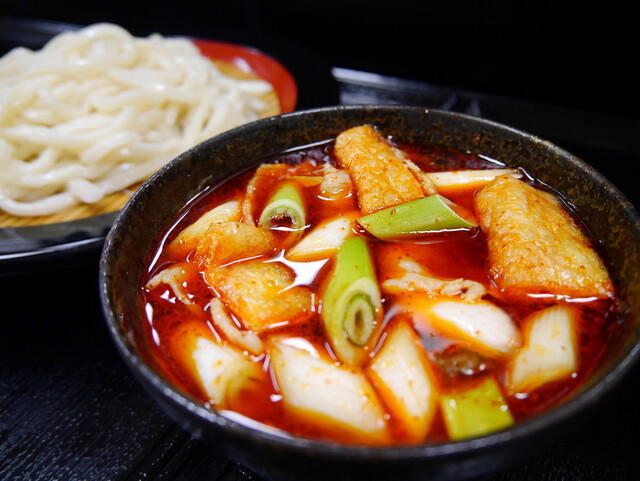
Musashino Udon Fujiwara Kitayono honten puts Saitama’s wheat-noodle culture in sharp focus: firm Musashino-style udon, a spice-forward identity, and recognition in Tabelog 100 - Udon - EAST - 2024. It is a compact, casual Saitama counter-and-table room rather than a polished destination restaurant, with value pricing and a format built around lunch rather than lingering ceremony.

Pearl is the En Primeur Club membership app, where members save venues, book tables and use the concierge.
The menu
What to order
- Spicy Musashino udon
- Jorokia Hell udon
- DEATH UDON
Approaching an udon specialist in Saitama is a different proposition from chasing sushi counters in Ginza or kaiseki rooms in Kyoto. The cues are plainer: a focused noodle meal, a casual rhythm, and the expectation that noodles, not theatre, carry the argument. Musashino Udon Fujiwara Kitayono honten belongs to that older Kanto logic, where wheat has as much regional meaning as rice, and where texture can matter as much as broth.
Musashino udon has never needed luxury codes to make its case. The style is associated with the inland belt around western Tokyo and Saitama, historically a wheat-growing region where hand-cut noodles developed a firmer, more rustic personality than the smoother, softer udon many travellers first meet elsewhere in Japan. The appeal is tactile and direct: chew, dipping broth, heat, and a meal that reads as local daily food rather than ceremony. That matters in Saitama, a city often treated as a commuter extension of Tokyo but carrying its own noodle grammar.
Spice gives Saitama's wheat-noodle tradition a sharper edge
The local significance here is not just that the kitchen serves udon; it is that Musashino Udon Fujiwara Kitayono honten is discussed as part of Saitama’s more characterful wheat-noodle culture. The strongest appeal is not luxury, but directness: firm noodles, a focused format, and a style of eating that feels grounded in daily appetite. In cultural terms, that is a useful distinction. Japan’s udon tradition is often discussed through regional broth differences, from Kansai clarity to Sanuki firmness, but Saitama’s contribution around Musashino udon is more textural and agricultural. A sharper, more assertive register gives the form a contemporary hook without detaching it from its working-lunch roots.
Recognition from Tabelog 100 - Udon - EAST - 2024 places the restaurant inside a selective udon conversation rather than a general neighbourhood ranking. Tabelog’s listed score of 3.68 also matters in the Japanese review ecosystem: for an udon specialist in this price band, that number signals sustained diner confidence rather than novelty traffic.
Compared with Saitama peers in the same casual bracket, the value proposition is tight. Ono Udon and Shokujidokoro Tarafuku sit in the same broader world of unfussy local dining, while HOP TRIP, Keitoku, and UN GRAND PAS show how varied Saitama’s restaurant map can be beyond a single noodle stop. That puts Musashino Udon Fujiwara Kitayono honten in a useful category for travellers who want a regionally specific meal without building a day around fine-dining logistics.
A focused noodle stop built around the bowl
The format explains how to read the experience. This is the everyday Japanese specialist model: narrow focus, straightforward decisions, limited ceremony, and a meal that depends on execution rather than spectacle. It is not the slow choreography of an omakase counter. It is closer to the discipline of ramen, soba, or curry shops where a clear specialty can define a local reputation through one narrow lane.
That specialist character also shapes expectations. The strongest way to approach this kind of Saitama meal is not to ask for breadth, but to understand the house’s lane: Musashino-style udon, texture as a defining feature, and a rhythm that rewards decisiveness. The point is practical food with a serious following, not a meal designed around special-occasion pacing.
The modest listed budget belongs to the same genre of operation. In Japan, many noodle specialists resist the infrastructure and rhetoric of destination dining because their value sits in repetition, not personalization. Travellers used to Tokyo’s reservation economy may find the category refreshing: the challenge is less about decoding ceremony and more about timing, appetite, and willingness to eat on the shop’s terms.
Where it fits in a Saitama food day
Saitama’s dining interest is often dispersed rather than concentrated in a single tourist district. That makes this udon shop a strong anchor for a food day built around local specialists rather than landmark dining. For a broader map of the city’s restaurants, start with Our full Saitama restaurants guide; the same city lens extends to Our full Saitama hotels guide, Our full Saitama bars guide, Our full Saitama wineries guide, and Our full Saitama experiences guide.
Within Saitama’s casual food circuit, it pairs intellectually with other focused shops rather than formal restaurants: other Saitama dining rooms for different craft-led formats, local specialist stops for another kind of everyday precision, and unnamed casual venues for a change of register. The broader Japanese casual-specialist thread continues beyond Saitama through other tightly defined noodle, curry, cafe, seafood, and grilled-meat formats. For readers tracking Japanese food culture abroad, the same lesson applies generically: tightly defined formats travel when the premise is clear.
The editorial case is simple: this is Saitama udon with a defined point of view, recognized within an East Japan udon award list, and priced like everyday food rather than destination dining. Musashino Udon Fujiwara Kitayono honten is better understood as a regional noodle argument than as a restaurant to romanticize. That is exactly why it matters.
Frequently asked questions
Does Musashino Udon Fujiwara Kitayono honten work for a family meal?
It can, provided the family is comfortable with a focused udon shop in Saitama. The listed price range is JPY 1,000 - JPY 1,999.
What kind of setting is Musashino Udon Fujiwara Kitayono honten?
It is an udon specialist in Saitama, set up around a focused noodle meal rather than a long formal sit-down.
What should I budget for a meal at Musashino Udon Fujiwara Kitayono honten?
Pricing at Musashino Udon Fujiwara Kitayono honten is listed as JPY 1,000 - JPY 1,999.
What's the address for Musashino Udon Fujiwara Kitayono honten?
Saitama.
Price and Positioning
Nearby venues at a similar price tier for orientation.
| Venue | Cuisine | Price | Awards | Notes |
|---|---|---|---|---|
| Musashino Udon Fujiwara Kitayono hontenThis venue (the venue you are viewing) | Musashino udon | $10–20 | Tabelog 100 #50 | Not listed |
| Ono Udon | Traditional Sanuki Udon | Not listed | Tabelog 100 #98 | Not listed |
| Shokujidokoro Tarafuku | Japanese Teishoku / Cafeteria | Not listed | Tabelog 100 #98 | Chuo Ward, Japanese Teishoku / Cafeteria |
| Fujidana Udon | Traditional Saitama Musashino Udon | $10–20 | Tabelog 100 #55 | Nishi-ku, Traditional Saitama Musashino Udon |
| Ramen Jiro Koshigaya ten | Jiro-style Ramen Shop | $10–20 | Tabelog 100 #27 | Koshigaya, Jiro-style Ramen Shop |
| Hibi Shushu | Creative Japanese Tachinomi & Small Plates | $20–30 | Tabelog 100 #9 | Omiya, Creative Japanese Tachinomi & Small Plates |
Recognition history
Dated appearances from independent guides and award organizations, with the underlying list record or original source where available.
Tabelog 100 #50 · No. 50
Tabelog · Tabelog 100 - Udon - EAST - 2024
Continue exploring
More in Saitama
Restaurants in Saitama
All restaurants in Saitama →




Bars in Saitama
Browse all →








Details
- Solo
- Casual Hangout
- After Work
- Standalone
- A La Carte
- Counter Dining
Current opening hours
- Monday
- Closed
- Tuesday
- Closed
- Wednesday
- 11 AM–2:30 PM
- Thursday
- 11 AM–2:30 PM
- Friday
- 11 AM–2:30 PM
- Saturday
- 11 AM–2:30 PM
- Sunday
- Closed
Hours can change for holidays and private events. Hours as of .