
Tabelog 100 #9
Our verdict
Hibi Shushu brings Saitama’s tachinomi culture into sharper focus: compact, counter-led, drink-forward, and built for fish-led snacks with sake and shochu. Its selection for Tabelog 100 Tachinomi 2025 gives the room a measurable signal in a category that is usually judged by regulars, pace, and value rather than ceremony.

Pearl is the En Primeur Club membership app, where members save venues, book tables and use the concierge.
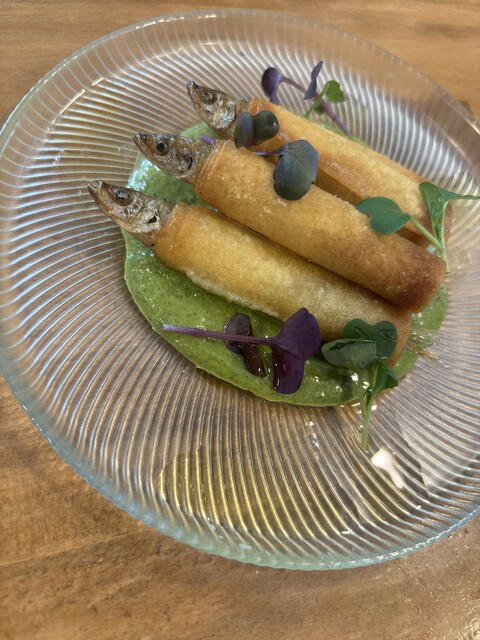
The menu
What to order
- Yellowtail with Ume Truffle Namero
- Chilled liver and chives
- Ayu sweetfish confit
Saitama’s stand-up drinking rooms work on compression: narrow counters, close conversation, quick pours, and food designed to keep pace with the glass. In that setting, Hibi Shushu reads as part of Saitama’s tachinomi landscape, less about long-form dining and more about a small-format bar experience that rewards attention without asking for a full restaurant commitment.
The format matters. Tachinomi is often misunderstood as a cheap pre-dinner stop, but the stronger modern versions operate closer to compact izakaya with stricter editing. The counter does the work that linen and ceremony do elsewhere: it puts the drink, the staff, and the next order within close range of one another. Hibi Shushu’s 2025 recognition from Tabelog’s Hyakumeiten places it in a wider conversation around stand-up bars rather than only in the local Saitama circuit.
Small-counter focus and the discipline of a stand-up bar
Saitama’s dining identity is often read through commuter convenience, but the city has its own evening grammar. Station-area dining pulls in office workers, rail travellers, and residents who treat a short session of food and drink as a complete plan. Within that rhythm, a stand-up bar makes sense: flexible, compact, and portioned for repeat ordering rather than a single centrepiece plate.
Hibi Shushu’s public profile places it in the stand-up bar category, and that says more than ornamental tasting-menu language would. Tachinomi venues need food and drink that can hold attention in small measures, invite comparison, and maintain a service rhythm that does not interrupt the room’s momentum. The appeal is not luxury theatre; it is editing, speed, and the pleasure of being close to the action.
The Tabelog score of 3.64 gives a useful Japanese context. On that platform, numbers tend to move conservatively, and a mid-3 rating in a narrow category can indicate meaningful traction, especially when paired with a Hyakumeiten selection. The award signal is particularly relevant for tachinomi because the format has fewer international markers than sushi, kaiseki, or fine dining. Recognition here tends to reward consistency, atmosphere, and category fluency rather than grand dining-room architecture.
Compared with Saitama venues built around fuller meals, the decision point is clear. Yakiniku Kushin and Sumibi Yakiniku Niku no Takumi Hiuchi sit in a higher dinner bracket, while Yakiniku New Hiuchi occupies a mid-evening meat-focused lane. Niboshi Chuka Soba Senmon Niboshi Maru answers a different need entirely: a noodle stop rather than a drink-led session. Hibi Shushu belongs to the compact-drinking category, where the measure of success is how well food, pour, and standing-room energy lock together.
Saitama's appeal is in the in-between meal
The strongest reason to pay attention is the city context. Tokyo often absorbs the conversation around Japan’s small bars, but Saitama is fertile ground for formats that do not require a long reservation arc. The city has the right ingredients: rail density, after-work traffic, and a dining culture that can support specialists without forcing them into destination-restaurant performance.
That makes Hibi Shushu useful for travellers who want to understand how contemporary casual dining works outside the central Tokyo spotlight. It is not trying to compete with high-price beef counters or formal Japanese restaurants. It is operating in a smaller, sharper register: a recognized stand-up bar, a compact format, and a room calibrated for a short evening rather than a drawn-out procession.
For a broader Saitama eating map, pair this kind of drinking-room logic with other category specialists rather than treating the city as a single dining genre. Everyday food culture stretches through other Saitama dining rooms and casual specialists, including Beach Story. The useful lens is not a ranking race, but a city of small, specific formats.
How to place it in a Saitama itinerary
Hibi Shushu works as an evening anchor for travellers who prefer a drink-led meal with a strong sense of room. The practical advantage is the tachinomi format itself: it reduces the friction of a long dinner and gives a clearer view of how local regulars eat and drink after work. For visitors building a wider plan, Our full Saitama restaurants guide is the natural companion, while category planning can extend through Our full Saitama hotels guide, Our full Saitama bars guide, Our full Saitama wineries guide, and Our full Saitama experiences guide.
Readers mapping Japanese casual dining beyond Saitama can use the same format-first approach. More formal restaurants, noodle counters, cafes, casual drinking rooms, and snack-led bars each tell different stories about how narrow concepts work across cities. The point is to compare formats carefully: Hibi Shushu is best understood not as a full-dinner destination, but as a compact stand-up bar with recognized category strength.
The editorial case for Hibi Shushu is category clarity. It gives Saitama a recognized tachinomi address, a stand-up bar identity, a listed dinner budget of JPY 3,000 - JPY 3,999, and enough award validation to separate it from the ordinary after-work bar. Go for the compressed energy of the room and the way a stand-up format can make a few orders and a few pours feel complete.
Frequently asked questions
What are the opening hours for Hibi Shushu?
Current opening hours are not provided in the available listing details. Check the venue’s official channels before going.
What's the price range at Hibi Shushu?
Pricing at Hibi Shushu is listed as JPY 3,000 - JPY 3,999.
Where do I go for Hibi Shushu?
Saitama.
What do critics highlight about Hibi Shushu?
The clearest signal is its 2025 Tabelog Hyakumeiten recognition, with a listed score of 3.64 and a category listing as a stand-up bar.
Can Hibi Shushu adjust for dietary needs?
The published details identify Hibi Shushu as a stand-up bar rather than a fixed tasting-menu venue, so adjustment depends on the day’s offer. For specifics, the venue lists a phone line, +81-48-658-9570, which is the practical way to confirm any restrictions before going.
Is Hibi Shushu child-friendly?
Published details available here do not confirm a child policy. Check the venue's official channels for the latest details.
In Context: Similar Options
Side-by-side context: comparable cuisine and price.
| Venue | Cuisine | Price | Awards | Notes |
|---|---|---|---|---|
| Hibi ShushuThis venue (the venue you are viewing) | Creative Japanese Tachinomi & Small Plates | $20–30 | Tabelog 100 #9 | Not listed |
| Jikasei Temomimen Suzunoki | Handmade Flat Noodle Ramen | $10–20 | Not listed | Sayamagaoka |
| Inakaya Irori | Traditional Japanese Izakaya with Irori Hearth | Not listed | Tabelog 100 #69 | Urawa-ku |
| Sumibi Yakiniku Niku no Takumi Hiuchi | Charcoal-Grilled Wagyu Yakiniku | $50–100 | Tabelog 100 #97 | Omiya |
| Temomi Chuka Soba Nakamura | Japanese Ramen | $10–20 | Tabelog 100 #31 | Omiya |
| Fujidana Udon | Traditional Saitama Musashino Udon | $10–20 | Tabelog 100 #55 | Nishi-ku |
Recognition history
Dated appearances from independent guides and award organizations, with the underlying list record or original source where available.
Tabelog 100 #9 · No. 9
Tabelog · Tabelog 100 - Tachinomi - 2025
Continue exploring
More in Saitama
Restaurants in Saitama
All restaurants in Saitama →


Bars in Saitama
Browse all →



Details
- Cozy
- Lively
- Trendy
- Casual Hangout
- After Work
- Group Dining
- Date Night
- Solo
- Standalone
- Design Destination
- Sake Program
- Beer Program
- Small Plates
- A La Carte
- Counter Dining
- Sake
- Beer
- Shochu
Current opening hours
- Monday
- 4–11 PM
- Tuesday
- 4–11 PM
- Wednesday
- Closed
- Thursday
- Closed
- Friday
- 4–11 PM
- Saturday
- 4–11 PM
- Sunday
- 4–11 PM
Hours can change for holidays and private events. Hours as of .
A cozy, casually lively tachinomi-style space where guests stand and enjoy thoughtfully crafted Japanese dishes and drinks in an intimate, relaxed atmosphere.