
Mumtaz Restaurant gives Shiroi a serious South Asian and Pakistani-curry address outside Tokyo’s usual dining orbit. Its repeat selection for Tabelog’s Asian cuisine and Ethnic cuisine EAST 100 in 2022, 2023, and 2024 makes it more than a suburban convenience stop: it points to how Chiba’s car-friendly outskirts support ingredient-led immigrant cooking at everyday pricing.
Pearl is the En Primeur Club membership app — saves, bookings, and concierge access live there. Same editors, same standards.
- Address
- 228-20 Kawarago, Shiroi, Chiba 270-1403, Japan
- Phone
- +81 47-404-1230
- Website
- mumtazrestaurants.com
 Saves & bookings on Pearl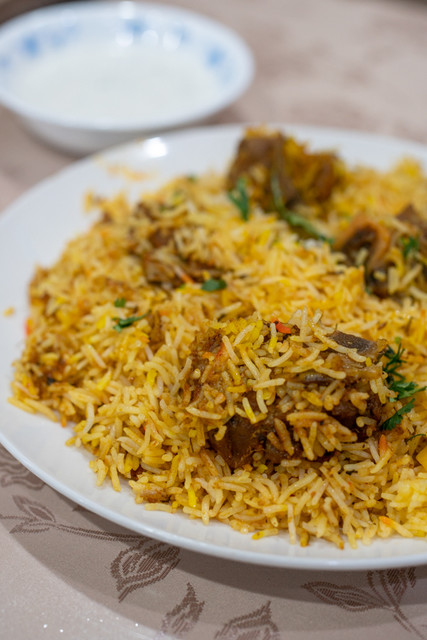
Approaching the Shiroi outskirts changes the expectations around South Asian cooking in Japan. The dining map loosens from station-front lunch sets and city-centre curry rooms into a more practical suburban pattern: larger rooms, family groups, take-out traffic, and food cultures sustained by grocery networks, religious dietary needs, and repeat local custom rather than spectacle. Mumtaz Restaurant belongs to that world, where the point is not a chef’s performance but the quiet infrastructure behind Pakistani and South Asian cooking in Chiba.
Shiroi's South Asian cooking depends on supply chains, not theatre
In Tokyo, South Asian restaurants are often judged by speed, lunch-set value, or how neatly they translate spice for office crowds. In Chiba’s commuter belt, the equation shifts. Restaurants can serve a broader community: families arriving by car, diners seeking Pakistani cooking rather than generic “Indian curry,” and customers for whom halal-oriented food culture is part of daily life rather than a novelty. That distinction matters because sourcing is the backbone of this category. Basmati rice, lentils, spice blends, breads, meat handling, and pickles are not decorative details; they define whether a kitchen feels connected to its culinary base or merely adapted to local expectation.
The public classification here is South Asian, Indian curry, and Pakistani, a useful trio because it signals range without flattening the cooking into one national shorthand. Japan’s curry culture is vast, but Pakistani cooking sits in a different register from Japanese curry rice or North Indian restaurant templates built around butter chicken and naan. The stronger editorial test is whether the kitchen appears inside a credible ethnic-dining circuit. Selection for Tabelog’s Asian cuisine and Ethnic cuisine EAST 100 in 2022, 2023, and 2024 gives Mumtaz Restaurant that external marker, placing it among recognized non-Japanese regional cooking addresses in eastern Japan.
That recognition also says something about geography. Shiroi is not a dining district built around luxury hotels, late-night bars, or tourism footfall. For a broader city read, Our full Shiroi restaurants guide is the better frame than a Tokyo comparison. The interest here is suburban durability: a restaurant with enough local gravity to register beyond its immediate catchment, in a category where consistency and ingredient access matter more than design language.
A room built for groups changes how the food is read
The setting points toward function. Sixty seats, including sofa and table seating, make this a room for families and mixed groups rather than a narrow counter built around scarcity. Children are welcomed, take-out is part of the service pattern, and the non-smoking policy keeps the dining room aligned with longer meals. Those details shape the experience as much as the cooking category. Pakistani and South Asian restaurants in suburban Japan often work as community dining rooms, not just places to sample spice; the table has to handle shared dishes, children, second orders, and the kind of unhurried meal that would be harder in a compact urban shop.
Pricing reinforces that democratic position. In the surrounding Chiba field, comparison venues such as Casa PASCALE and Unagi Ogawa Abiko ten sit in higher bands, while Takeyabu Kashiwa honten moves into a much more expensive bracket. Mumtaz Restaurant operates in a lower everyday range, which changes the reader decision: this is not a special-occasion detour measured against kaiseki or sushi, but a value-driven ethnic-cuisine address with repeated third-party recognition. That combination is rarer than it sounds, especially outside a major station cluster.
The award history should not be overread as luxury. Tabelog’s Hyakumeiten lists reward category strength and user-driven credibility, not the rituals of fine dining. Here, the signal is sharper: a suburban South Asian and Pakistani restaurant has enough traction to sit inside a regional ethnic-cuisine selection for three consecutive years. For diners tracking ingredient-led food in Japan, that is the useful clue.
How to place it in a wider Shiroi itinerary
Shiroi’s appeal is not built around a dense hospitality strip, so meals here benefit from planning around the wider area rather than expecting a walkable restaurant crawl. The venue is associated with Shiroi Station as its nearest rail point, but the suburban setting and parking context make it better suited to car-based dining than a spontaneous station-hop meal. That practical shape is part of the story: the same lower-density conditions that make access less casual also allow larger dining rooms and group-friendly formats.
Travellers building a fuller stay can map food against the city’s broader categories through Our full Shiroi hotels guide, Our full Shiroi bars guide, Our full Shiroi wineries guide, and Our full Shiroi experiences guide. For a wider Japan dining lens, compare how regional specificity appears across different formats: -Grilled beef Sukiyaki- KAMAKURA TANUKIAN 鎌倉 たぬき庵 in Kamakura, . 鮪と炭火焼き うお炭 秋葉原店 in Tokyo, .cafe in Osaka, .know in Kumamoto, (Shoku) Vietnam in Kawasaki, [Curry Senmon Ten] Maruyama Kyoju. in Sapporo, [ki:] in Kyoto, #肉といえば松田 奈良本店 in Kashihara, 1/3 HAMBURGER FACTORY in Kanazawa, 1000 in Yokohama, 1000mヒュッテ 1000m Hut in Kutchan, Jōdo Saké Bar in Los Angeles, and Onigiri Time in Pasadena.
The case for eating here is strongest for diners who care about Japan’s immigrant and regional food systems beyond the obvious urban circuits. The restaurant is not trying to mimic a luxury tasting-menu restaurant, and that is precisely why it matters: it shows how everyday pricing, family-scale seating, take-out service, and repeat category recognition can meet in a place where sourcing and community demand do the serious work.
Comparison Snapshot
Comparable venues by cuisine and price in the same metro.
| Venue | Cuisine | Price | Notes |
|---|---|---|---|
| Mumtaz RestaurantThis venue — the venue you are viewing | Halal Pakistani & Indian Curry House | $ | Not listed |
| Halal Dosa Biryani | Halal South Indian & Pakistani Curry House | $ | Aeon Mall Narita |
| ERICK SOUTH Yaesu ten | Authentic South Indian Curry & Meals | $ | Chūō |
| Curry House Chirichiri | Curry House | $ | Toda Koen |
| TOKYO BHAVAN | Authentic South Indian restaurant | $ | Chiyoda |
| Casa PASCALE | Sri Lankan curry restaurant | $ | Sakasai |
Recognition history
Dated appearances from independent guides and award organizations, with the underlying list record or original source where available.
Tabelog 100 #78 · No. 78
Tabelog · Tabelog 100 - Asian cuisine / Ethnic cuisine - EAST - 2024







At a Glance
- Cozy
- Family
- Casual Hangout
- Group Dining
- Solo
- Standalone
Current opening hours
- Monday
- 11:30 AM–11 PM
- Tuesday
- 11 AM–11 PM
- Wednesday
- 11 AM–11 PM
- Thursday
- 11 AM–11 PM
- Friday
- 11 AM–11 PM
- Saturday
- 11 AM–11 PM
- Sunday
- 11 AM–11 PM
Hours can change for holidays and private events. Last verified .
Casual, family-friendly atmosphere in a house-like space with sofa and table seating, giving a cozy "hideout" feel rather than a formal restaurant environment.