Memelas Dona Vale

Our verdict
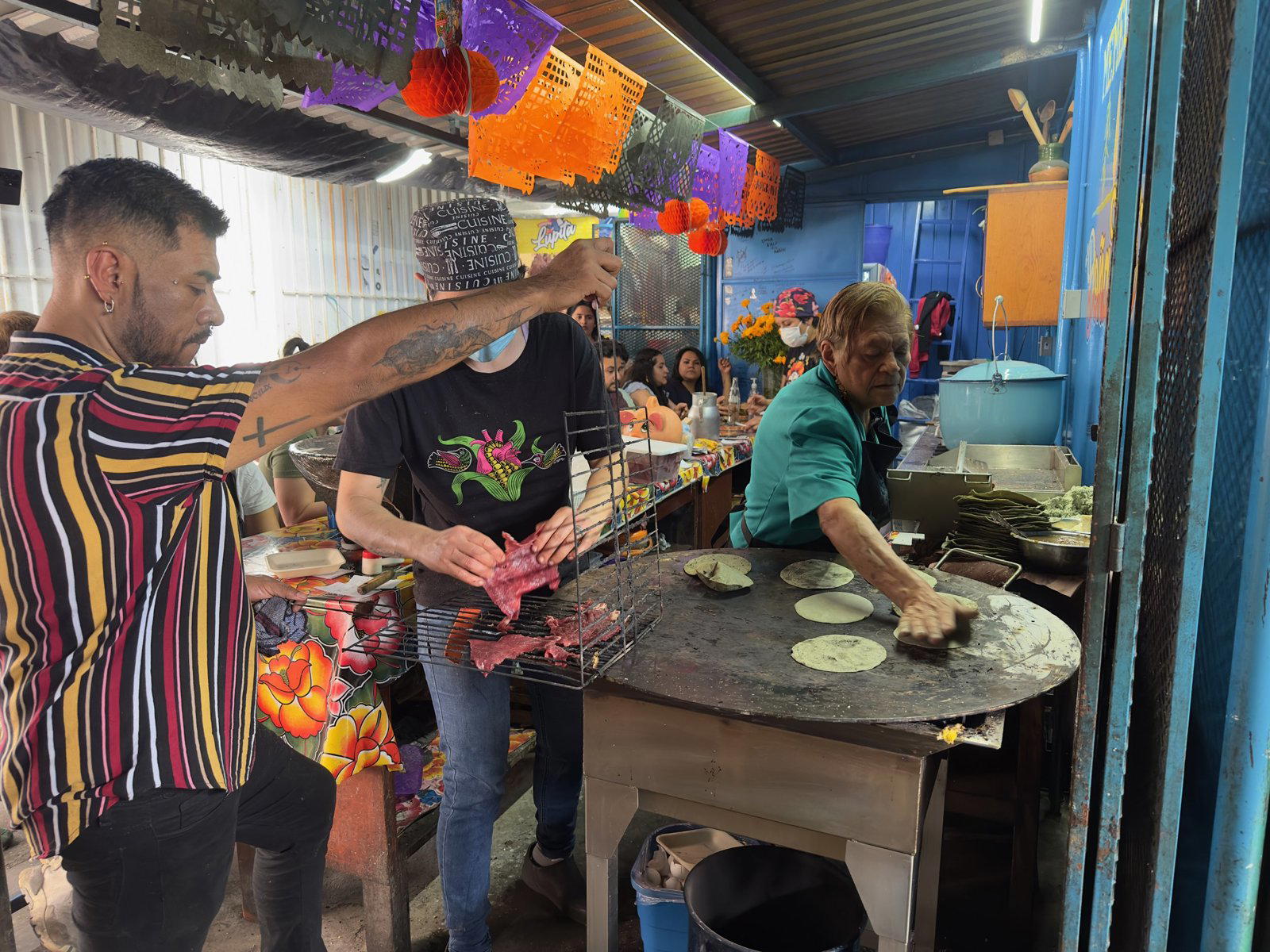
A market-side counter in Oaxaca's Central de Abasto district, Memelas Doña Vale serves one of the region's most grounded expressions of masa cookery. The memela — a thick, oval corn cake dressed with beans, salsa, and local cheese — is the format that defines the menu and the tradition. This is where the ingredient chain from milpa to comal plays out in its most direct form.

Pearl is the En Primeur Club membership app — saves, bookings, and concierge access live there. Same editors, same standards.
- Address
- Cosijoeza, Central de Abasto, 68090 Oaxaca de Juárez, Oax., Mexico
- Phone
- +52 222 792 3002
- Hours
- Mon–Sat 7 AM–12 PMSun Closed
- Website
- traveltooaxaca.com
- Directions
- Get directions
The menu
What to order
- Memelas
- Memelas with salsa morita
- Memelas with tasajo
- Memelas with eggs
Corn, Comal, and the Central de Abasto
The Central de Abasto in Oaxaca de Juárez operates on a different clock from the city's colonial centro. By early morning, the market's interior corridors are already dense with produce vendors, dried chili merchants, and the kind of food stalls that exist to feed people who have been working since before dawn. It is inside this environment that Memelas Doña Vale sits — not as a destination layered onto the market's character, but as an expression of it. The physical approach involves the same sensory sequence familiar across Mexico's great mercado kitchens: woodsmoke, lime-soaked masa, chili heat carried on warm air. The comal is the organizing object, and everything on the menu answers to it.
Oaxaca's position in Mexican culinary culture is well-documented, and the city's international reputation for mole, tlayudas, and mezcal is now firmly established. What receives less attention is the category sitting beneath those headline exports: masa-based antojitos cooked to feed the city's own population rather than its visitors. The memela belongs to this tier. It is a format common across southern Mexico but with regional variation sharp enough that a Oaxacan memela — thicker, often dressed with black bean paste and Oaxacan-style fresh cheese, finished with salsa roja or verde, reads as something distinct from its Pueblan or Mexico City cousins.
What a Memela Actually Is
The memela is worth understanding on its own terms before the venue comes into focus. Nixtamalized corn masa is shaped into an oval or elongated round, thicker than a tortilla but without the height of a gordita. It is cooked directly on the comal until the exterior firms and acquires some color, then dressed while still hot. The toppings are not garnishes, they are structural: black beans provide fat and depth, fresh cheese adds salinity and some textural contrast, and the salsa determines the dish's character more than any other element. In Oaxacan market kitchens, the salsa is often made to order or kept at a rolling simmer, never refrigerated down to dullness.
This is a format that requires very little to work and everything to go wrong if the masa quality drops. The corn variety, the nixtamalization time, the hydration of the dough, and the comal temperature all carry direct consequences with no sauce complexity to absorb errors. Market kitchens that have operated long enough to build a neighborhood following are, by definition, getting these fundamentals right on a consistent basis. Memelas Doña Vale's presence inside the Central de Abasto, a market that serves a working-class and commercial clientele rather than a tourist circuit, is its own form of editorial endorsement.
Oaxaca's Two Dining Tracks
The city's restaurant scene has split progressively over the past decade into two tracks that rarely overlap. The first is the internationally visible tier: tasting-menu formats, contemporary Mexican technique, and menus that engage the region's ingredients through a more composed, often higher-price register. Pitiona and Los Pacos - Alta Cocina Oaxaqueña both operate within this tier, with menus that position Oaxacan ingredients inside a broader fine-dining framework. The second track is the mercado kitchen, the tlayuda stand, the comal operation, venues where price, format, and clientele have not changed much in decades and where the cuisine's continuity is maintained not through innovation but through repetition performed well.
Memelas Doña Vale belongs definitively to the second track. This is not a criticism; the two tracks are not in competition. A city that can produce both Levadura de Olla Restaurante and a market corner serving masa cooked the same way it was served a generation ago is a city whose food culture has real depth. Across Mexico, the same structural pattern appears in different cities: Pujol in Mexico City and Alcalde in Guadalajara have become internationally cited reference points, but the market kitchens operating in their cities' outer neighborhoods are feeding far larger numbers of people, far more regularly, with food that is rooted in the same ingredient traditions those fine-dining kitchens are drawing from.
Internationally, the same dynamic is visible at the leading end. Venues like Le Bernardin in New York City or Atomix in New York City operate at the documented summit of their respective categories, but the food cultures that make those cities interesting to eat in exist at every price tier simultaneously. Oaxaca's culinary depth works the same way.
The Market Kitchen in Context
Mexico's mercado kitchen tradition is arguably its most important culinary institution, and Oaxaca's markets are considered among the most intact examples of that tradition in the country. The Central de Abasto differs from the more tourist-trafficked Mercado Benito Juárez in the city center: it functions primarily as a wholesale and distribution hub for Oaxaca's food supply, which means its food stalls exist to serve vendors, drivers, and market workers rather than visitors navigating between craft stalls. This gives the eating there a different quality, menus are shorter, formats are more fixed, and the clientele is less forgiving of inconsistency because they eat there regularly.
This is the competitive set within which Memelas Doña Vale operates. The comparison that matters is not with Taquería Chefinita or other street-food formats in the city's centro, but with the other comal-driven operations within the market itself, where a returning clientele sets the quality standard. Across Mexico's other regional food capitals, the cochinita pibil counters of Mérida's markets, the birria operations in Guadalajara's Mercado San Juan de Dios, the pozole stalls of Guerrero's coastal markets, the same principle applies: regulars are the quality filter, and longevity inside a working market is a more reliable signal than press coverage.
Planning Your Visit
The Central de Abasto sits on Cosijoeza street in the 68090 postal district of Oaxaca de Juárez, outside the immediate historic center. Getting there requires either a short taxi ride from the centro or local transit; it is not within comfortable walking distance of the main tourist areas. Market kitchens of this type typically operate from early morning through midday, with supply running out as the primary closing mechanism rather than a fixed hour. Arriving before noon is advisable, and earlier is better if you want the full range of preparations available. No reservation infrastructure applies here; this is a walk-in format by nature, and the queue, if there is one, moves quickly. Dress is entirely informal, and cash is the practical standard at this price tier and format. For readers building a fuller picture of Oaxaca's food scene at every level, the full Oaxaca de Juárez restaurants guide covers the range from market kitchens to the city's most composed tasting menus.
Frequently asked questions
Where is Memelas Doña Vale in Oaxaca De Juarez?
Memelas Doña Vale is located at Cosijoeza, Central de Abasto, 68090 Oaxaca de Juárez, Oax. Mexico, Oaxaca De Juarez.
How does eating at Memelas Doña Vale differ from dining at Oaxaca's better-known restaurants?
Memelas Doña Vale is located in the Central de Abasto on Cosijoeza — outside the historic centro where internationally reviewed restaurants cluster — which puts it squarely on the market-kitchen track rather than the chef-driven one. There are no tasting menus, no wine lists, and no reservation systems. What you get instead is masa cooked to order on a comal within a working market that serves Oaxaca de Juárez's residents first and visiting diners second.
What's the best thing to order at Memelas Doña Vale?
The memela is the only logical starting point — an oval of nixtamalized corn masa cooked directly on a comal, typically topped with black beans, Oaxacan cheese, or salsa. At a market stall like this in the Central de Abasto, the output changes with what's available that morning, so ordering whatever is coming off the comal fresh is the practical approach. This is not a menu-browsing situation.
Do they take walk-ins at Memelas Doña Vale?
Yes — Memelas Doña Vale operates inside the Central de Abasto on Cosijoeza in Oaxaca de Juárez, which functions as a working market stall, not a reservation-driven restaurant. Walk-in is the only mode. Arriving early in the morning aligns with when the market runs at full pace and when masa is freshest off the comal.
What's the defining dish or idea at Memelas Doña Vale?
The defining idea is the memela itself — a form of masa cookery that predates the taco in Mesoamerican food history and remains less exported than tortilla-based formats. Doña Vale's version, made in the Central de Abasto market in Oaxaca de Juárez, sits inside a broader mercado kitchen tradition that food scholars consider among Mexico's most intact. The comal is the only equipment that matters here.
Budget Reality Check
| Venue | Cuisine | Price | Awards |
|---|---|---|---|
| Memelas Doña ValeThis venue — the venue you are viewing | Oaxacan Memelas / Street Food | Not listed | Not listed |
| Pitiona | Modern Oaxacan Cocina de Autor | $30–50 | La Liste Top Restaurants |
| Los Pacos -Alta Cocina Oaxaqueña- | Alta Cocina Oaxaqueña | Not listed | Not listed |
| Taquería Chefinita | Oaxacan Taqueria | $10–20 | Not listed |
Recognition history
Dated appearances from independent guides and award organizations, with the underlying list record or original source where available.
Opinionated About Dining Cheap Eats in North America Ranked #130
Opinionated About Dining
Continue exploring
More in Oaxaca De Juarez
Restaurants in Oaxaca De Juarez
Browse all →
Bars in Oaxaca De Juarez
Browse all →
Hotels in Oaxaca De Juarez
Browse all →
Details
- Lively
- Well Known
- Rustic
- Cozy
- Brunch
- Casual Hangout
- Solo
- Family
- Standalone
- Local Sourcing
- Street Scene
- Counter Dining
- A La Carte
- Vegetarian Friendly
Current opening hours
- Monday
- 7 AM–12 PM
- Tuesday
- 7 AM–12 PM
- Wednesday
- 7 AM–12 PM
- Thursday
- 7 AM–12 PM
- Friday
- 7 AM–12 PM
- Saturday
- 7 AM–12 PM
- Sunday
- Closed
Hours can change for holidays and private events. Last verified .
Bustling, energetic market-stall atmosphere with long queues, comal heat, and an authentic everyday Oaxacan feel.