Michelin Bib Gourmand
Our verdict
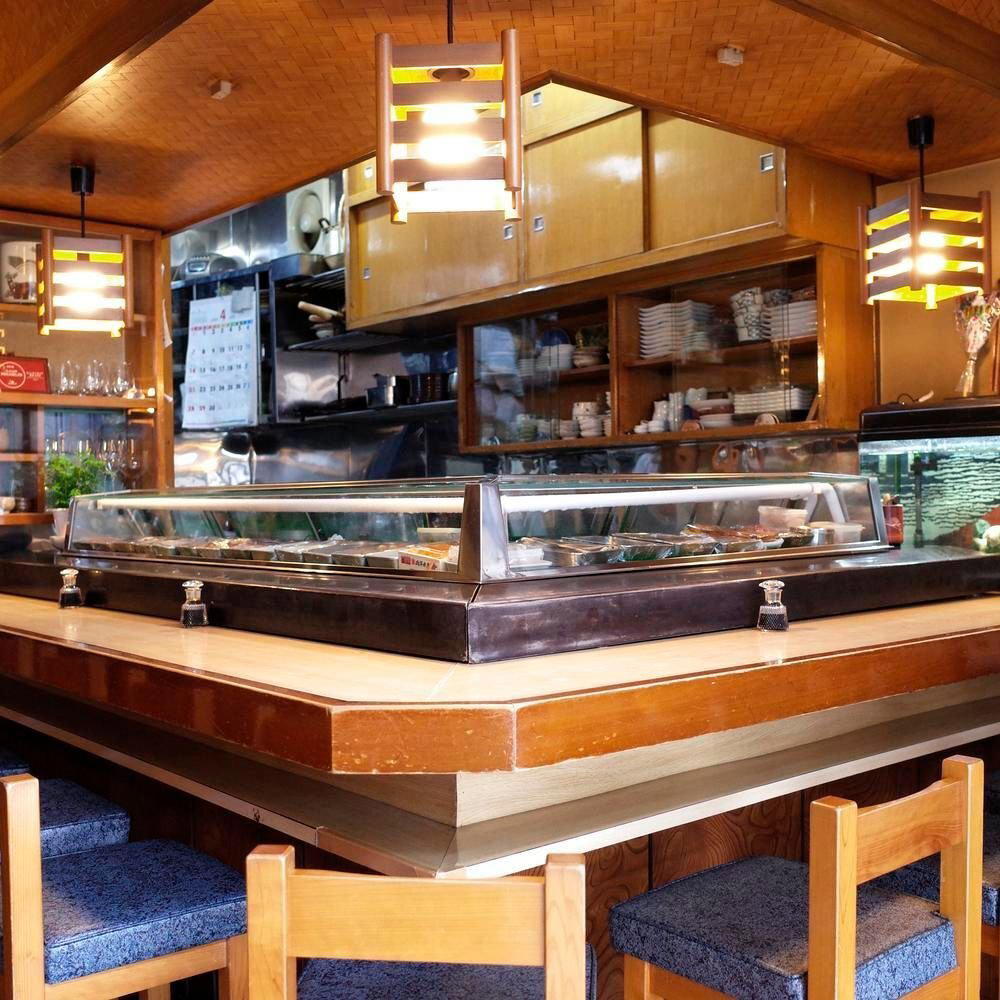
A Michelin Bib Gourmand sushiya in Shinagawa's Minamioi neighbourhood, Matsunozushi operates with the tempo and aesthetic of old-school Edo sushi. Chef Yoshinori Tezuka cuts and serves personally, offering both omakase sets and à la carte, with tuna marinated in soy sauce and egg presented in the traditional kurakake style. The glass display case, the Showa-era atmosphere, and the mid-range pricing place it in a category that Tokyo is steadily losing.

Pearl is the En Primeur Club membership app, where members save venues, book tables and use the concierge.
A Showa-Era Counter in a City That Has Largely Moved On
Edo-style sushi in Tokyo occupies two very different price brackets today. At the leading end, counters affiliated with lineages like Sushi Kanesaka or Harutaka command omakase prices that routinely exceed ¥30,000 per person. At the bottom, conveyor-belt chains and standing sushi bars have industrialised the form. What has quietly contracted is the middle register: the neighbourhood sushiya where the chef works alone behind a glass display case, the fish is prepared according to decades-old Edo technique, and the prices remain within reach of the local customer. Matsunozushi, on a residential street in Shinagawa's Minamioi district, occupies that contracting tier, and the 2024 Michelin Bib Gourmand is a formal acknowledgement that it is doing so with consistent skill.
The Atmosphere the Display Case Tells You Everything
The Showa period in Japan roughly spans 1926 to 1989, and the aesthetic shorthand it carries in contemporary Tokyo dining is specific: a certain quality of light, a certain pace of service, and the presence of a glass-fronted display case holding the day's fish. At Matsunozushi, that display case is not decorative nostalgia. It is the functional centrepiece of the operation, and it signals to anyone who grew up eating sushi in Japan exactly what kind of house this is. The fish selection visible through the glass, the handwritten price boards, the single chef working the counter without a brigade, these are the architectural grammar of a sushiya that has not recalibrated itself for the current era of destination dining.
This matters for occasion dining in a way that is easy to underestimate. Not every significant meal is a celebration requiring a months-long waitlist and a ¥¥¥¥ budget. Some of the more meaningful sushi meals in Tokyo happen at counters where the chef knows the neighbourhood, the rhythm is unhurried, and the selection of fish is selected by one person who cares about the craft. For a birthday dinner that does not require spectacle, a local anniversary, or a first proper introduction to Edo-style sushi for someone visiting Japan, Matsunozushi offers a format that is increasingly rare to find at the ¥¥ tier.
What Edo Technique Actually Means at the Plate
Edomae sushi as a tradition developed in nineteenth-century Tokyo, originally as fast food sold from street stalls. The techniques that distinguished it from other regional sushi styles were preservation methods applied directly to the fish: marinating in soy sauce, simmering in sweet sauce, pressing, ageing. These were practical solutions to the absence of refrigeration, but they also created a flavour depth and textural complexity that cold-stored fish alone cannot produce.
At Matsunozushi, three preparations named in the Michelin record illustrate this approach directly. Tuna is marinated in soy sauce, a preparation known as zuke, which draws out moisture and concentrates flavour in a way that raw tuna does not achieve. Conger eel is coated in a thick, sweet eel sauce, a far more demanding preparation than the light brushing common at contemporary omakase counters. And the tamago, the egg, is served kurakake, or saddle-style: layered into a cake and then split over a bite-sized mound of vinegared rice. This is a technically exacting preparation that takes most sushi chefs considerable time to master, and its presence here is a signal about what the chef values. These are not modern interpretations of Edo technique; they are the technique itself, maintained without simplification.
Chef Yoshinori Tezuka cuts and serves personally, which is itself a structural statement about how the kitchen operates. There is no separation between the person who selects and prepares the fish and the person who hands it to you. That continuity is part of what the Bib Gourmand is recognising: quality sustained at a price point where the economics of single-chef operations are genuinely difficult.
Where Matsunozushi Sits in Tokyo's Sushi Hierarchy
Tokyo's sushi scene is wide enough that it is worth placing Matsunozushi clearly relative to its peers. It does not compete with the three-Michelin-star counters that Tokyo's Ginza and Azabu neighbourhoods concentrate, nor with newer high-concept expressions of edomae like Edomae Sushi Hanabusa or the refined kaiseki-adjacent work happening at places like Hiroo Ishizaka. The ¥¥ price designation puts it in a separate category from Sukiyabashi Jiro Roppongiten, where the same Edo inheritance is expressed at a very different price point and under a very different level of global scrutiny.
What Matsunozushi shares with those counters is the foundational discipline: vinegared rice prepared with attention, fish selected and treated according to established Edo method, and a chef who has built a body of work coherent enough to earn repeated Michelin recognition. The Bib Gourmand category exists specifically to identify this: cooking at a standard that would merit attention at any price, offered at a cost that most diners can actually sustain.
Shinagawa and the Logic of the Location
Minamioi sits within Shinagawa City, a ward that functions largely as a transit hub and residential zone rather than a dining destination. Most visitors to Tokyo do not come to Shinagawa looking for a sushiya; they go to Ginza, Shibuya, or Shinjuku. That geographic reality is part of what sustains the economics of a counter like Matsunozushi. Its customers are largely local, its reputation built over time through return visits rather than tourist traffic, and its pricing calibrated to a neighbourhood rather than an international expense account. For the traveller willing to make the trip south on the Keikyu or Tokaido line from central Tokyo, the location functions as a filter: the diners who arrive tend to know what they are coming for.
If Matsunozushi is one destination on a longer Japanese trip, the broader context is worth noting. The country's serious dining culture extends well beyond Tokyo's postcode. Gion Sasaki in Kyoto represents kaiseki at the highest level of that tradition, while HAJIME in Osaka and Goh in Fukuoka sit at the innovative end of their respective regional scenes. Closer to Tokyo, 1000 in Yokohama is worth factoring into any extended Kanto itinerary. For sushi specifically, the tradition travels internationally too: Sushi Shikon in Hong Kong and Shoukouwa in Singapore carry the edomae lineage into Southeast Asian markets, and akordu in Nara and 6 in Okinawa extend the range of serious Japanese dining across the archipelago.
Planning a Visit
Matsunozushi is located at 3 Chome-31-14 Minamioi, Shinagawa City, Tokyo 140-0013. The ¥¥ price designation makes it among the more accessible Michelin-recognised sushi counters in the city. The format accommodates both omakase set menus and à la carte ordering, which gives first-time visitors the option to let the chef direct the meal, while regulars can return and work through the à la carte selection at their own pace. For a broader orientation to what Tokyo offers across restaurants, hotels, bars, and experiences, see our full Tokyo restaurants guide, our full Tokyo hotels guide, our full Tokyo bars guide, our full Tokyo wineries guide, and our full Tokyo experiences guide.
Frequently asked questions
What part of town is Matsunozushi in?
Matsunozushi is located at 3 Chome-31-14 Minamioi, Shinagawa City, Tokyo 140-0013, Japan, Tokyo.
What distinctions does Matsunozushi have?
Matsunozushi has received recognition including: Sushi items lined up inside a glass display case ooze Showa-era ambience. A sushi shop of the old school, and that’s how the chef likes it. Cutting and serving the sushi himself, the chef offers everything from omakase set menus to à la car….
What should I eat at Matsunozushi?
The three preparations that most directly define Chef Yoshinori Tezuka's Edo technique are the zuke tuna, marinated in soy sauce; the conger eel, finished in a thick sweet eel sauce; and the kurakake egg, layered into a cake and draped over vinegared rice in the traditional saddle style. These are not modern flourishes, they are nineteenth-century Edomae methods, and the reason the kitchen earned its Michelin Bib Gourmand in 2024. Both omakase set menus and à la carte are available, so ordering à la carte around those three dishes is a practical way to focus on what the counter does best.
How would you describe the cuisine at Matsunozushi?
Is Matsunozushi more mid-range or high-end?
Pricing at Matsunozushi is listed as ¥¥.
Who's behind the kitchen at Matsunozushi?
The chef associated with Matsunozushi is Yoshinori Tezuka.
What It’s Closest To
| Venue | Cuisine | Price | Awards | Notes |
|---|---|---|---|---|
| MatsunozushiThis venue (the venue you are viewing) | Traditional Japanese Omakase | $200–300 | Michelin Bib Gourmand | Not listed |
| Harutaka | Edo-Style Omakase Sushi | $200–300 | 3 Michelin Stars · World's 50 Best #76 | Sushi |
| RyuGin | Modern Kaiseki | $500+ | 3 Michelin Stars · World's 50 Best #41 | Kaiseki, Japanese |
| L'Effervescence | Modern French with Japanese Influences | $200–300 | 3 Michelin Stars · World's 50 Best #69 | French |
| HOMMAGE | Modern French with Japanese Influences | $150–200 | 2 Michelin Stars · World's 50 Best #78 | Innovtive French, French |
| MAZ | Innovative Peruvian-Japanese Fusion | $150–200 | 2 Michelin Stars · World's 50 Best #28 | Innovative |
Recognition history
Dated appearances from independent guides and award organizations, with the underlying list record or original source where available.
Michelin Bib Gourmand
Michelin
Full recognition history (2 entries)
Michelin Bib Gourmand
Michelin