Masalchi by Atul Kochhar
Our verdict
Atul Kochhar's Wembley Park restaurant brings a considered approach to Indian cooking to one of London's most transformed postcodes. Masalchi sits within the wider regeneration of the HA9 area, where the dining offer has grown markedly since the stadium development reshaped the neighbourhood. The cooking draws on spice-led traditions with the kind of technical discipline Kochhar has applied across his career.

Pearl is the En Primeur Club membership app — saves, bookings, and concierge access live there. Same editors, same standards.
- Address
- 2 Wembley Park Blvd, Wembley Park, Wembley HA9 0HP, United Kingdom
- Phone
- +442036679990
- Hours
- Mon–Thu 11 AM–10 PMFri–Sat 11 AM–10:30 PMSun 11:30 AM–9:30 PM
- Website
- masalchi.co.uk
- Directions
- Get directions
- Booking
- Book on OpenTable
The menu
What to order
- Machhi Masala
- Punjabi Samosas
- Miyaji Sheekwale
Wembley Park and the New Appetite for Serious Indian Cooking
The postcode around Wembley Park Boulevard did not, until relatively recently, draw food writers. Wembley was a destination for events, not dinner. That has changed as the broader regeneration of the HA9 area brought residential density, retail, and eventually restaurants capable of holding attention beyond match days. Masalchi by Atul Kochhar arrived into that shift, occupying a position in the development that reflects a wider pattern: as London's outer zones densify, the dining offer follows with more ambition than the area's historical baseline would have suggested. For context on the fuller Wembley dining picture, see our full Wembley restaurants guide.
Kochhar's name carries weight in this context. That biographical fact matters less as personal story and more as a market signal: Masalchi is not a casual curry house filling a retail unit. It is a restaurant where the sourcing decisions, spice logic, and cooking technique carry the expectation that comes with that track record.
Ingredient Sourcing as Editorial Statement
Across serious Indian cooking in Britain, the sourcing question has become a defining fault line. One cohort of restaurants imports spices and aromatics in bulk, treating provenance as a logistics problem. A smaller cohort treats ingredient origin as part of the argument the food is making. The latter approach tends to produce cooking where the heat is more considered, the layering more apparent, and the aftertaste cleaner. Masalchi's positioning within the Kochhar portfolio suggests it operates closer to that second register.
The spice traditions that underpin North and coastal Indian cooking are, by nature, ingredient-intensive in ways that European fine dining is not. A curry base can involve a dozen distinct aromatics at different stages; a marinade for a tandoor dish might be built across two or three preparation phases. When those ingredients are sourced with attention, the results arrive differently at the table: turmeric that still carries its bitterness, cardamom pods with resinous leading notes, dried chillies with heat that builds rather than front-loads. These distinctions are difficult to manufacture with commodity sourcing and relatively easy to read in the finished dish.
This matters for Masalchi specifically because the Wembley Park location sits outside the traditional London Indian restaurant corridors. Brick Lane, Southall, and the concentration around Drummond Street each carry their own sourcing ecosystems. Kochhar's restaurant operates somewhat apart from those networks, which implies a more deliberate supply relationship rather than proximity to established wholesale markets.
Where Masalchi Sits in the Broader British Fine Dining Conversation
British fine dining in 2024 remains dominated, at its upper tier, by European-rooted formats. Restaurants like CORE by Clare Smyth in London, Waterside Inn in Bray, Le Manoir aux Quat'Saisons in Oxford, and L'Enclume in Cartmel occupy the highest critical brackets, alongside newer entrants such as Moor Hall in Aughton, Gidleigh Park in Chagford, Hand and Flowers in Marlow, hide and fox in Saltwood, Midsummer House in Cambridge, Restaurant Andrew Fairlie in Auchterarder, Restaurant Sat Bains in Nottingham, The Glenturret Lalique in Crieff, and Ynyshir Hall in Machynlleth. The Indian fine dining cohort in the UK is narrower but has grown more visible. Opheem in Birmingham and Kochhar's own earlier work at Benares demonstrated that Michelin-level recognition for Indian cooking in Britain was achievable and, to some extent, reproducible.
Masalchi does not appear to be positioned as a tasting-menu destination in the mould of those multi-starred rooms. Its Wembley Park address and the development context suggest a format that serves the neighbourhood's new residential population alongside the event-day footfall that the stadium still generates. That positioning, casual-leaning but chef-driven, is its own meaningful niche. It shares more DNA, in format terms, with the mid-tier Indian restaurants of West London than with the per-cover fine dining model, but the Kochhar credential distinguishes it within that tier.
For comparison at the international level, the question of how chef-branded diaspora cooking translates to a non-heritage audience is one that restaurants like Atomix in New York City have answered for Korean cooking and that establishments like Le Bernardin in New York City demonstrated decades ago for French seafood: the answer almost always involves sourcing discipline and technique rigour applied to a cuisine the local audience does not yet read with full fluency.
The Wembley Park Dining Neighbourhood
The development around Wembley Park Boulevard now includes enough restaurants to constitute a genuine dining strip rather than a collection of isolated units. Monsterella Pizza represents the more casual end of the offer on the same boulevard. Masalchi occupies a different register in that lineup: it carries a named chef, a tradition of technical Indian cooking, and the kind of spice-led ambition that positions it as the area's anchor for that cuisine category.
The timing consideration for visiting is worth noting. Wembley Park is measurably busier on event days, when Wembley Stadium and the SSE Arena draw crowds that change the character of the area significantly. Tables at restaurants in the development fill differently on those dates. For a dinner focused on the food rather than the atmosphere of a pre-match crowd, midweek visits or non-event weekends give the kitchen room to operate at its intended pace.
Planning Your Visit
Masalchi by Atul Kochhar is located at 2 Wembley Park Boulevard, Wembley Park, HA9 0HP, a short walk from Wembley Park Underground station on the Metropolitan and Jubilee lines. The station makes this one of the more accessible outer-London dining destinations by public transport from central London, with journey times from Baker Street running under fifteen minutes on a fast Metropolitan line service. Given the stadium proximity, checking the event calendar before booking is practical: the neighbourhood dynamic shifts considerably when 90,000 people are arriving or departing within the same two-hour window. Booking in advance is advisable regardless of event day, given the limited number of comparable Indian restaurants in the immediate area.
Frequently asked questions
Can I bring kids to Masalchi by Atul Kochhar?
Masalchi by Atul Kochhar sits on Wembley Park Boulevard, a development that draws a broad mix of visitors including families attending events at the nearby arena. The restaurant's format — rooted in considered Indian cooking rather than casual-order dining — lends itself better to older children and teenagers who are comfortable at a table-service restaurant. Younger children are not explicitly excluded, but the experience is calibrated for adult appetites and pacing.
What's the overall feel of Masalchi by Atul Kochhar?
Masalchi occupies a position between neighbourhood restaurant and destination dining: more relaxed than a central London fine dining room, but more deliberate than a standard curry house. The Wembley Park setting, steps from the Underground station, means the room sees a mix of pre-event diners and those making a specific trip for the food. Atul Kochhar's involvement — he earned the first Michelin star for an Indian restaurant in the UK at Benares — gives the kitchen a credential that shapes expectations on both sides of the pass.
Is Masalchi by Atul Kochhar connected to a Michelin-starred chef, and does that affect the cooking style?
Atul Kochhar is the chef behind Masalchi, and his credential is specific: in 2001 he became the first Indian-born chef to receive a Michelin star in the UK, awarded for his work at Benares in Mayfair. That background informs Masalchi's approach to Indian cuisine in Wembley, where the emphasis falls on sourcing and culinary precision rather than the volume-driven model common to many suburban Indian restaurants. The result is a restaurant whose reference point is London's serious dining scene, relocated to a Wembley Park address.
What's the signature dish at Masalchi by Atul Kochhar?
What the restaurant's positioning signals, consistent with Atul Kochhar's wider body of work, is Indian cooking that foregrounds spice sourcing and technique over volume or novelty. Checking directly with the restaurant at 2 Wembley Park Boulevard will give you the current menu and any chef's selection dishes.
In Context: Similar Options
Comparable venues nearby, for context on price, style, and recognition.
| Venue | Cuisine | Price | Notes |
|---|---|---|---|
| Masalchi by Atul KochharThis venue — the venue you are viewing | Modern Indian Street Food | $30–50 | Not listed |
| Postbox | Modern Indian with Goan influences | Not listed | Castelnau |
| Raunka Punjab Diyan | Authentic Punjabi | $10–20 | Northolt |
| Namaaste Kitchen | Modern Indian Bar and Grill | $20–30 | Camden Town |
| Dishoom Carnaby | Bombay Comfort Food | $20–30 | Soho |
| Punjab | Traditional North Indian Punjabi | $20–30 | St Giles |
Continue exploring
More in Wembley
Restaurants in Wembley
Browse all →
Bars in Wembley
Browse all →
Hotels in Wembley
Browse all →



Details
- Lively
- Casual
- Warm
- Relaxed
- Group Dining
- Casual Hangout
- Special Occasion
- Open Kitchen
- Craft Cocktails
- Small Plates
- A La Carte
- Vegetarian Friendly
- Vegan Options
Current opening hours
- Monday
- 11 AM–10 PM
- Tuesday
- 11 AM–10 PM
- Wednesday
- 11 AM–10 PM
- Thursday
- 11 AM–10 PM
- Friday
- 11 AM–10:30 PM
- Saturday
- 11 AM–10:30 PM
- Sunday
- 11:30 AM–9:30 PM
Hours can change for holidays and private events. Last verified .
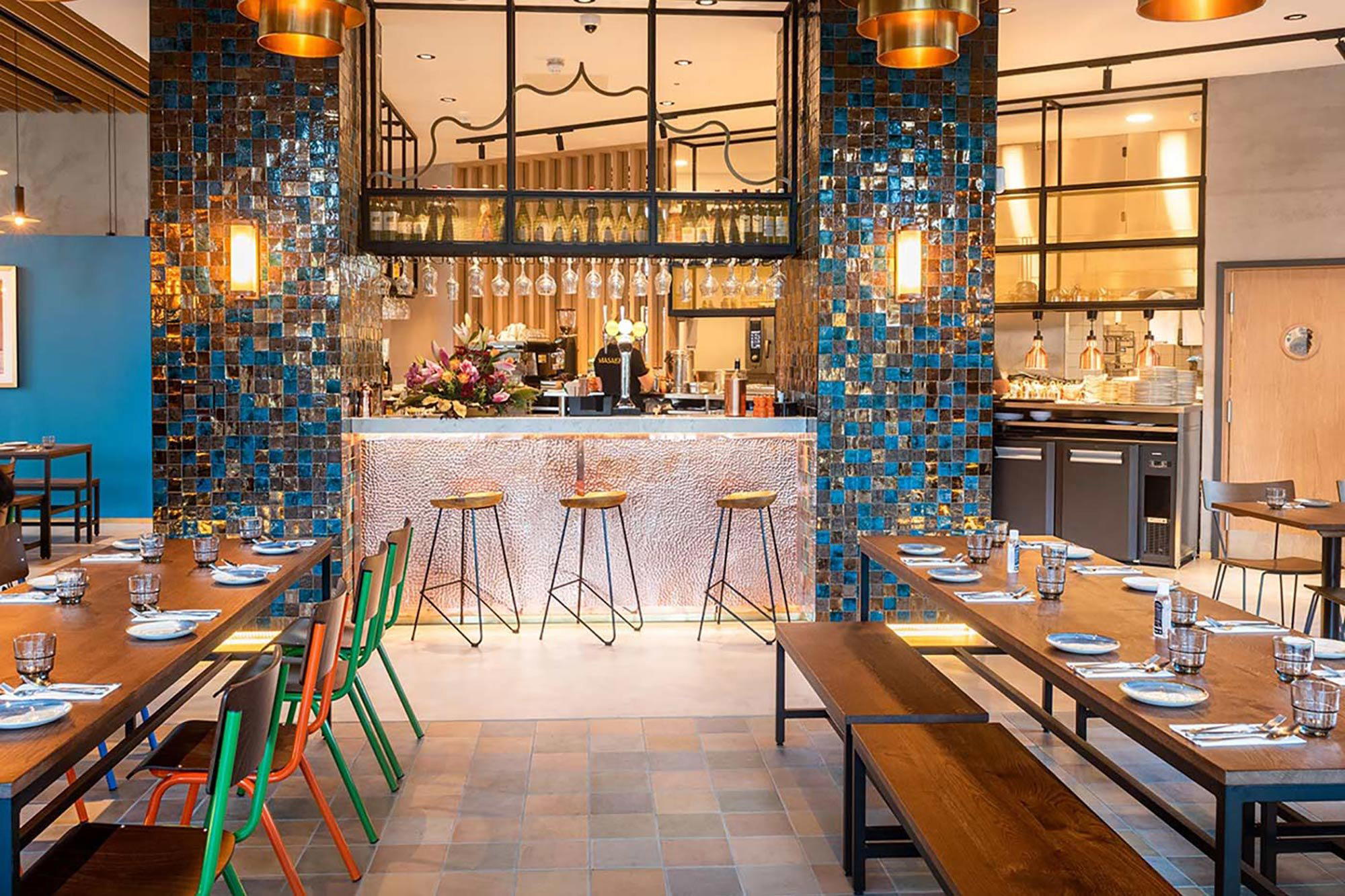
Bright and airy with glass frontage, mosaic-tiled pillars, retro travel posters, well-spaced tables, bar, and open kitchen creating a warm, relaxed, and lively atmosphere.