Mariscos San Pedro

James Beard Award Semi Finalist
Our verdict
Mariscos San Pedro anchors the 18th Street corridor in Pilsen, Chicago's most concentrated stretch of Mexican culinary tradition. The address puts it squarely in a neighbourhood where seafood preparation follows Pacific-coast and Gulf influences rather than landlocked Tex-Mex conventions. For anyone tracing Chicago's Mexican dining scene beyond the downtown restaurant circuit, this address is a meaningful reference point.

Pearl is the En Primeur Club membership app, where members save venues, book tables and use the concierge.
The menu
What to order
- Hokkaido Scallop Aguachile
- Soft Shell Crab Taco
- Tuna Tostada
Pilsen and the Architecture of Everyday Mexican Dining
Chicago's Mexican restaurant geography divides roughly into two registers. One sits inside the critical spotlight, drawing comparisons to the tasting-menu circuit populated by places like Alinea, Smyth, and Oriole. The other operates below that threshold, sustained by neighbourhood loyalty, word of mouth, and a clientele that measures quality by consistency rather than critical attention. Mariscos San Pedro, at 1227 W 18th St in Pilsen, belongs firmly to the second category, which is precisely what gives it weight as an address worth understanding.
Pilsen's 18th Street is one of the most concentrated corridors of Mexican commercial life in the Midwest. The neighbourhood's character is built on murals, panaderías, taquerías, and a residential density that has kept chain displacement slower here than in other parts of the city. Within that context, a mariscos operation, one specialising in seafood prepared in the Pacific-coast and Gulf traditions that define Mexican coastal cooking, occupies a specific and somewhat specialist niche. Inland cities do not default to seafood-forward menus, which means establishments like this one are answering a particular demand: the craving for aguachile, ceviche, and shellfish preparations that trace back to Sinaloa, Nayarit, and Jalisco rather than to Chicago's own food geography.
The Physical Container: Reading a Neighbourhood Seafood Space
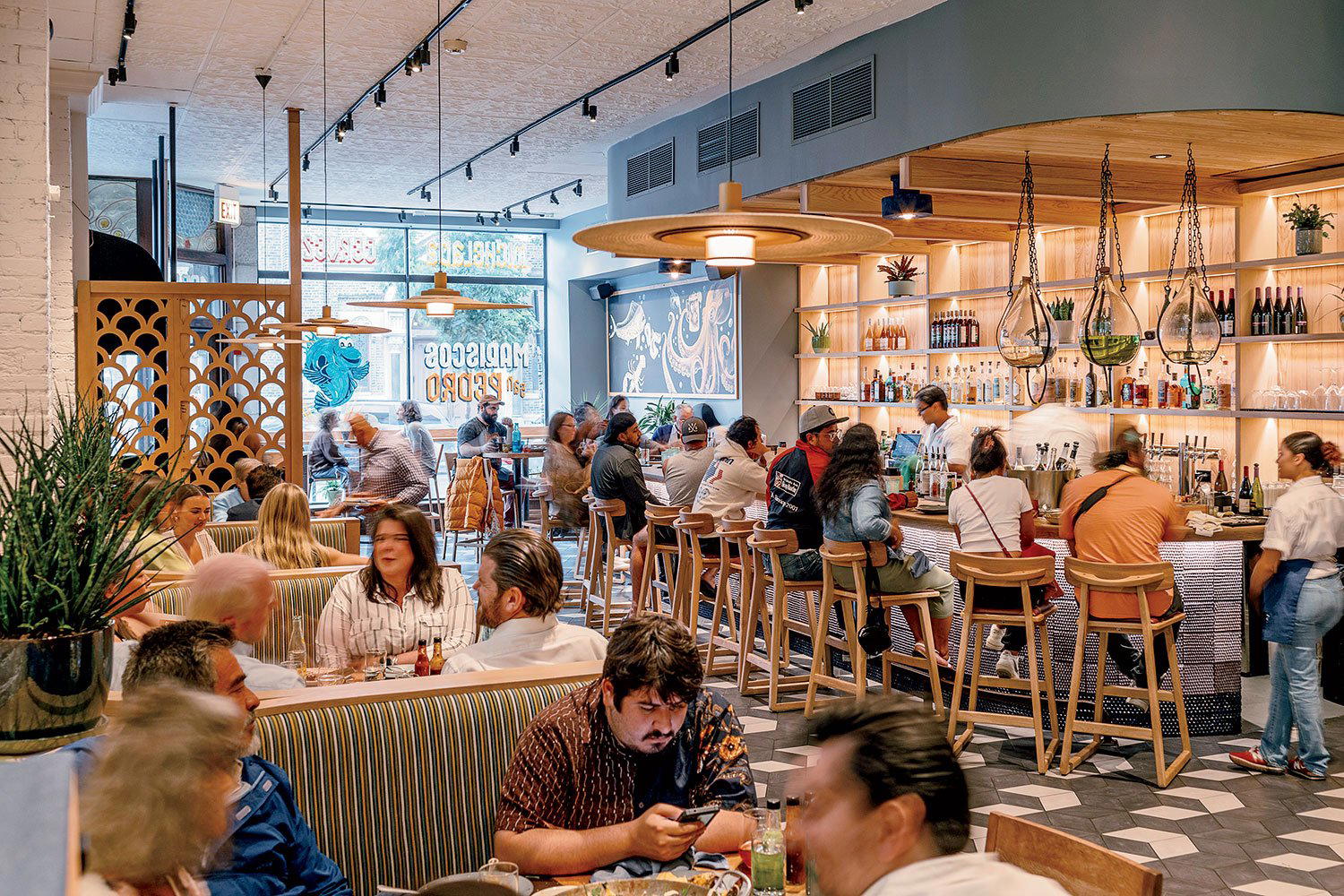
The built environment of 18th Street tends toward storefront operations with modest frontage, interiors that prioritise function over atmosphere, and signage that communicates to the immediate community rather than to passing visitors. Mariscos restaurants in this tradition occupy spaces that have evolved from their surroundings rather than been designed against them. The physical container at a place like Mariscos San Pedro typically reflects the economics of neighbourhood dining: tight seating arrangements, surfaces that prioritise easy cleaning over material warmth, and walls that carry whatever accumulated presence the years have layered onto them, family photos, seafood illustrations, regional imagery from the Pacific coast.
That kind of space rewards a different mode of attention than the curated interiors found at Kasama or Next Restaurant. There is no designed legibility here, no considered lighting scheme or architectural gesture. The seating arrangement is dictated by the room's dimensions, not by a hospitality consultant's floor plan. For the right reader, that absence of studied design is itself informative: it signals where the operation's energy is concentrated, which is in the preparation rather than the presentation of the room.
Across American cities, this structural pattern holds. The leading urban seafood traditions rarely live in elaborate spaces. Le Bernardin in New York City is the obvious exception that proves the rule: most serious fish cooking happens in rooms that make no architectural argument whatsoever. The cooking does the work. In Pilsen, that dynamic is amplified by a neighbourhood culture that is genuinely indifferent to design signalling as a proxy for quality.
What Mariscos Cooking Represents in an Inland City
Mexican seafood preparation is a distinct culinary tradition with regional variation as pronounced as anything in European cooking. The Sinaloan lineage, raw or lightly cured shrimp in acidic, chile-spiked broths, differs significantly from Veracruz-style preparations, which lean on tomato, olive, and caper combinations with roots in Spanish colonial influence. Both differ from the fried and grilled whole-fish formats common along the Pacific coast south of Mazatlán. What unites them is a treatment of seafood that does not default to European technique: no reduction-based sauces, no butter enrichment, no classical French scaffolding of the kind that structures the menus at places like Providence in Los Angeles or Addison in San Diego.
In Chicago, operating a mariscos kitchen means sourcing seafood to an inland location, which carries cost and logistics implications that coastal counterparts do not face to the same degree. Establishments that sustain this kind of kitchen in the Midwest are making a practical argument as well as a culinary one: that the tradition is worth the supply chain friction, and that the community it serves considers the result worth the price.
That argument has been made successfully enough across Pilsen and Little Village to create a genuine cluster of mariscos operations. Mariscos San Pedro sits within that cluster at an address that has become familiar to a specific segment of Chicago's dining public: residents and visitors who understand that the most instructive eating in any American city often happens on streets that do not appear in the standard critical itineraries that cover places like Lazy Bear in San Francisco, Blue Hill at Stone Barns in Tarrytown, or The French Laundry in Napa.
Chicago's Mexican Dining Scene in Wider Context
Chicago's position as one of the most significant Mexican-American cities outside the Southwest is not a recent development. The community's depth in Pilsen, Little Village, and Cicero represents decades of establishment, and the food infrastructure that supports it, including specialty grocers, tortillerías, carnicerias, and restaurant clusters, is mature enough to support genuine regional specificity rather than the generic approximations that characterise Mexican dining in cities with smaller communities.
That maturity means that a mariscos operation in Pilsen is not operating in isolation. It is part of a food system with supply relationships, a knowledgeable customer base, and enough competition to enforce quality standards through market pressure rather than critical attention. The critical circuit that covers destinations like Atomix in New York City, The Inn at Little Washington, or Bacchanalia in Atlanta does not routinely cover this tier of the market, which is one reason the addresses here remain less visible to visitors than their quality often warrants. Our full Chicago restaurants guide covers both ends of that spectrum.
Know Before You Go
| Address | 1227 W 18th St, Chicago, IL 60608 |
|---|---|
| Neighbourhood | Pilsen |
| Cuisine | Mexican seafood (mariscos tradition) |
| Phone | Not available |
| Website | Not available |
| Booking | Details not confirmed, walk-in advised for first visit |
| Price range | |
| Hours | Not confirmed, verify locally before visiting |
Frequently asked questions
Is Mariscos San Pedro suitable for vegetarians?
If the kitchen follows the mariscos format standard to this regional tradition, the menu will be seafood-led, with limited provisions for vegetarians beyond side dishes and appetisers. Confirmed menu data is not available to EP Club at time of publication. If vegetarian options are a requirement, contacting the venue directly before visiting is the appropriate step. The Chicago city guide covers a broader range of dietary formats across the city's restaurant spectrum.
Why do Chicago residents seek out mariscos restaurants specifically in Pilsen rather than elsewhere in the city?
Pilsen and the adjacent Little Village corridor have the densest concentration of Mexican-owned food businesses in Chicago, which creates both supply chain infrastructure and a customer base with specific regional knowledge. Mariscos operations in this area serve a community that has direct cultural familiarity with Pacific-coast Mexican seafood traditions, making quality benchmarks higher and more enforced by repeat custom than they would be in a neighbourhood without that background. The result is a cluster of mariscos kitchens that collectively maintain a standard of regional specificity that is difficult to find elsewhere in the Midwest. For broader context on Chicago's Mexican dining geography, see our full Chicago restaurants guide.
Where the Accolades Land
Comparable venues nearby, for context on price, style, and recognition.
| Venue | Cuisine | Price | Awards | Notes |
|---|---|---|---|---|
| Mariscos San PedroThis venue (the venue you are viewing) | Mexican Seafood | $30–50 | James Beard Award Semi Finalist | Not listed |
| 3259 E 95th St | Smoked Seafood Shack | $10–20 | James Beard Award America's Classics | South Deering |
| The Crab Pad | Viet-Cajun Seafood Boil | $30–50 | Not listed | Logan Square |
| Chicago Oyster House | Prime Seafood & Steaks with Oysters and Sushi | $50–100 | Not listed | South Loop |
| Moe's Cantina River North | Mexican Cantina | $30–50 | Not listed | River North |
| State and Lake Chicago Tavern | Elevated American Gastropub | $30–50 | Not listed | Loop |
Recognition history
Dated appearances from independent guides and award organizations, with the underlying list record or original source where available.
James Beard Award Semi Finalist
James Beard Award
Continue exploring
More in Chicago
Restaurants in Chicago
All restaurants in Chicago →
Bars in Chicago
All bars in Chicago →



Details
- Lively
- Trendy
- Energetic
- Date Night
- Group Dining
- Casual Hangout
- Open Kitchen
- Craft Cocktails
- Sustainable Seafood
- A La Carte
- Small Plates
- Seasonal Cocktails
Current opening hours
- Monday
- 5–9 PM
- Tuesday
- 5–9 PM
- Wednesday
- Closed
- Thursday
- 5–9 PM
- Friday
- 5–10 PM
- Saturday
- 11 AM–2:30 PM, 5–10 PM
- Sunday
- 11 AM–2:30 PM, 5–9 PM
Hours can change for holidays and private events. Hours as of .
Energetic and trendy atmosphere with cultural motifs like the San Pedro fish mascot throughout the space.