L'ulivo Leicester Square
An Italian restaurant on Irving Street, steps from Leicester Square, L'ulivo occupies a corner of central London where tourist-heavy footfall and serious dining rarely coincide. The name references the olive tree, a plant whose cultivation carries its own slow, land-rooted logic, a useful lens for understanding what this address is trying to do in one of the city's most transient dining corridors.
Pearl is the En Primeur Club membership app — saves, bookings, and concierge access live there. Same editors, same standards.
- Address
- 14-15 Irving St, London WC2H 7AU, United Kingdom
- Phone
- +442030071859
- Website
- lulivoleicestersquare.uk
- Directions
- Get directions
 Saves & bookings on Pearl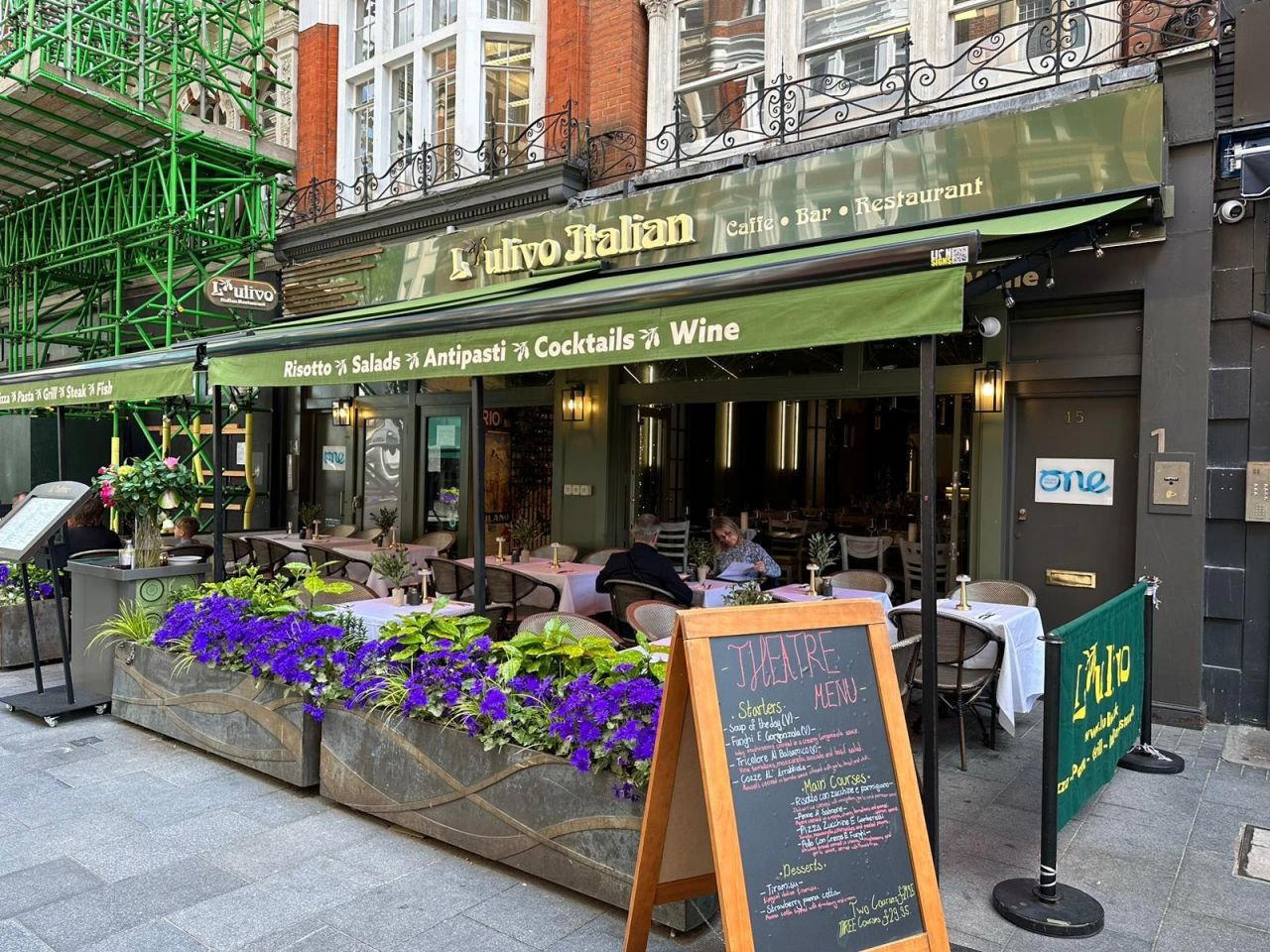
Irving Street and the Problem of Location
The streets immediately surrounding the square have historically served the pre-theatre crowd and the post-cinema rush rather than the kind of diner who plans a meal weeks in advance. That context matters when reading any address here, because it sets the baseline against which any serious cooking has to argue its case. L'ulivo, on Irving Street at the southern approach to the square, operates in that environment, a short walk from the Charing Cross Road, directly in the path of one of London's densest tourist corridors.
What the name signals is worth noting. L'ulivo is Italian for the olive tree, not the olive itself, but the tree, the cultivated perennial that takes decades to mature and is inseparable from the agricultural identity of the Mediterranean. That framing, whether deliberate or coincidental, points toward a set of associations: slow growth, rootedness, a product that carries the character of its soil. In a neighbourhood defined by speed and throughput, it is an unusual register to occupy.
Italian Dining in London's Competitive Middle
London's Italian restaurant market has bifurcated sharply over the past decade. At one end, a tier of high-investment, region-specific addresses has established itself in Mayfair, Marylebone, and Chelsea, drawing on the credentialed traditions of Piedmont, Campania, and Emilia-Romagna with serious wine programmes to match. At the other end, the casual trattoria format has been absorbed by fast-casual operators at scale. The middle ground, sincere neighbourhood Italian, committed to sourcing and technique but without the theatre of a formal tasting menu, is the harder space to occupy convincingly.
Irving Street sits at some distance from the neighbourhoods where Italian dining has consolidated its London reputation. That distance is partly geographic and partly cultural: the West End's dining economy rewards volume and convenience, whereas the Italian kitchens that have built lasting critical recognition in London have generally done so in lower-footfall postcodes where they can price properly and source selectively. This is the structural challenge that any address near Leicester Square faces, regardless of what it puts on the plate.
The Sustainability Frame in Central London Kitchens
Across London's restaurant sector, environmental sourcing has moved from differentiator to baseline expectation among a specific tier of diner. The question of how a kitchen sources, whether it maintains relationships with named producers, how it handles food waste, whether its seafood carries certification, what happens to trim and offcuts, has become a credibility signal in the way that provenance labelling on menus was a decade ago. Addresses with serious intent now tend to have answers to these questions that go beyond vague claims about seasonal British produce.
The olive tree itself is a case study in this logic. Olive cultivation at any serious level is slow, land-intensive, and deeply tied to a specific ecosystem. Restaurants that take the name and the product seriously, that treat quality olive oil as a kitchen input worthy of the same sourcing scrutiny as a piece of aged beef or a day-boat fish, are making a statement about how they think about ingredient chains. Whether that statement is rhetorical or operational is something a diner learns from the menu and the kitchen's actual practice.
CORE by Clare Smyth has built its reputation in part on hyper-local and whole-animal sourcing philosophies. The Ledbury and Dinner by Heston Blumenthal both operate with supply chains that have been a matter of public editorial record. These are the reference points against which any sourcing claim in the London market is now implicitly measured.
What a Leicester Square Address Can and Cannot Do
The practical reality of operating at 14-15 Irving Street is that the surrounding infrastructure shapes the experience whether the kitchen wills it or not. The street is busy, the area is loud, and the diner arriving from Leicester Square tube station passes through one of London's most commercially dense stretches before reaching the door. That is not a flaw that can be corrected by interior design; it is a condition of the location that informs every other decision, from service pace to price positioning.
Kitchens that work well in these conditions tend to succeed by being clear about what they are: efficient, warm, honest about their limitations, and precise in their leading dishes. The addresses that struggle are those that pitch against the neighbourhood's baseline without the formal structure, the booking system, the long lead times, the minimum spend, that gives high-investment kitchens in quieter postcodes their operating margin.
For comparison: the tier of London Italian dining that commands serious critical attention, addresses that could be mentioned in the same breath as the formal European kitchens at Restaurant Gordon Ramsay or Sketch, The Lecture Room and Library, operates with sharply controlled capacity, advance booking windows of several weeks, and sourcing programmes that are documentable and specific. Irving Street's position relative to those venues is structural rather than a matter of quality alone.
Placing L'ulivo in a Wider British Context
Central London is one part of a larger British dining map. For those using a visit to L'ulivo as a starting point for broader planning, the regional Italian and Mediterranean traditions that inform this kind of cooking have found serious expression in destination dining outside the capital. Le Manoir aux Quat'Saisons in Oxford represents the classical French-influenced end of that spectrum; L'Enclume in Cartmel and Moor Hall in Aughton sit at the apex of sourcing-led British cooking. Closer to London, Waterside Inn in Bray and Hand and Flowers in Marlow anchor the Thames Valley as a serious dining corridor. For Italian-rooted cooking with Mediterranean sourcing sensibilities, those comparisons clarify the range of what is possible and where any West End address sits within it.
Gidleigh Park in Chagford through regional highlights including Opheem in Birmingham, Midsummer House in Cambridge, hide and fox in Saltwood, and Restaurant Andrew Fairlie in Auchterarder. For international comparison points in the same Mediterranean and European idiom, Le Bernardin in New York City and Atomix in New York City illustrate what a fully resourced sourcing-led kitchen looks like at its most committed.
Planning a Visit
L'ulivo is located at 14-15 Irving Street, London WC2H 7AU, a short walk from Leicester Square underground station on the Piccadilly and Northern lines. The address is well-placed for pre-theatre dining given its proximity to the West End's main theatre cluster, and the surrounding streets offer direct access from Trafalgar Square and Covent Garden on foot.
Price and Positioning
Comparable venues nearby, for context on price, style, and recognition.
| Venue | Cuisine | Price | Notes |
|---|---|---|---|
| L'ulivo Leicester SquareThis venue — the venue you are viewing | Not listed | $$$ | Not listed |
| San Carlo - London | Not listed | $$$ | St. James's, Authentic Regional Italian with Seafood and Steak |
| O Ver Borough | Not listed | $$$ | Bankside, Authentic Neapolitan Italian with Wood-Fired Pizza |
| Caffè Concerto Knightsbridge | Knightsbridge, Italian Patisserie & Cafe | $$$ | Not listed |
| Il Baretto | Not listed | $$$ | Marylebone, Authentic Italian with Robata Grill |
| Manicomio | Chelsea, Italian Trattoria | $$$ | Not listed |
Continue exploring
More in London
Restaurants in London
Browse all →
Bars in London
Browse all →
Hotels in London
Browse all →

At a Glance
- Cozy
- Rustic
- Classic
- Date Night
- Group Dining
- Casual Hangout
- Open Kitchen
- Extensive Wine List
- Craft Cocktails
- Local Sourcing
Current opening hours
- Monday
- 11:30 AM–11:30 PM
- Tuesday
- 11:30 AM–11:30 PM
- Wednesday
- 11:30 AM–11:30 PM
- Thursday
- 11:30 AM–11:30 PM
- Friday
- 11:30 AM–11:30 PM
- Saturday
- 11:30 AM–11:30 PM
- Sunday
- 11:30 AM–11 PM
Hours can change for holidays and private events. Last verified .
Rustic Mediterranean with exposed stone walls, earthy colors, twisted rope lighting, cozy and inviting like a home kitchen in Italy.