
Los Caracoles has occupied the same address on Carrer dels Escudellers since 1835, making it one of Barcelona's most durable institutions in the Barri Gòtic. The kitchen has long centred on Catalan classics, with whole roast chicken cooked over an open spit visible from the street. For travellers oriented toward the city's creative fine-dining circuit, it represents a different kind of argument: that longevity itself is a form of curation.
Pearl is the En Primeur Club membership app — saves, bookings, and concierge access live there. Same editors, same standards.
- Address
- Carrer dels Escudellers, 14, Ciutat Vella, 08002 Barcelona, Spain
- Phone
- +34933012041
- Website
- loscaracoles.es
- Directions
- Get directions
 Saves & bookings on Pearl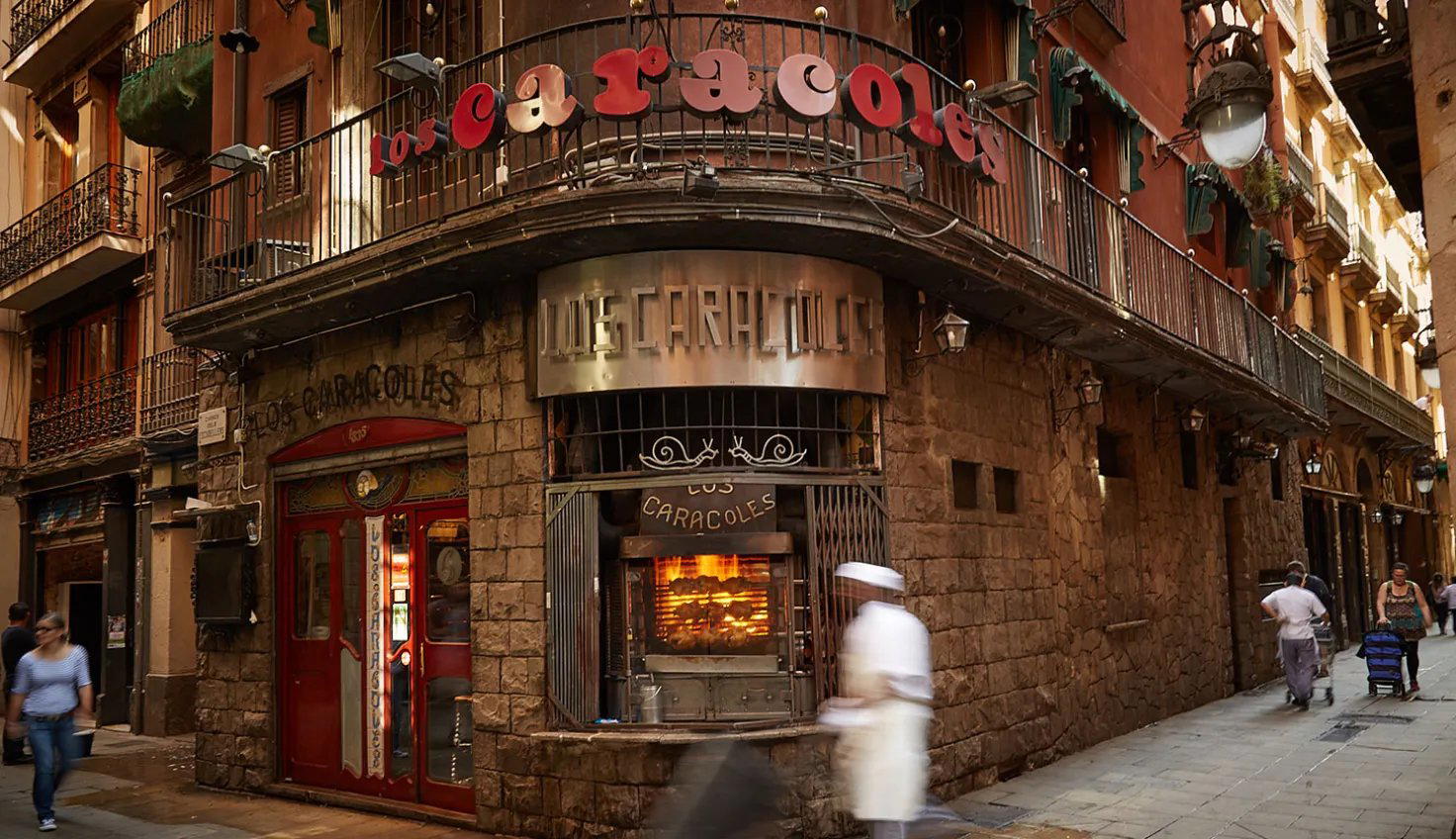
A Street in the Gothic Quarter That Tells Two Stories at Once
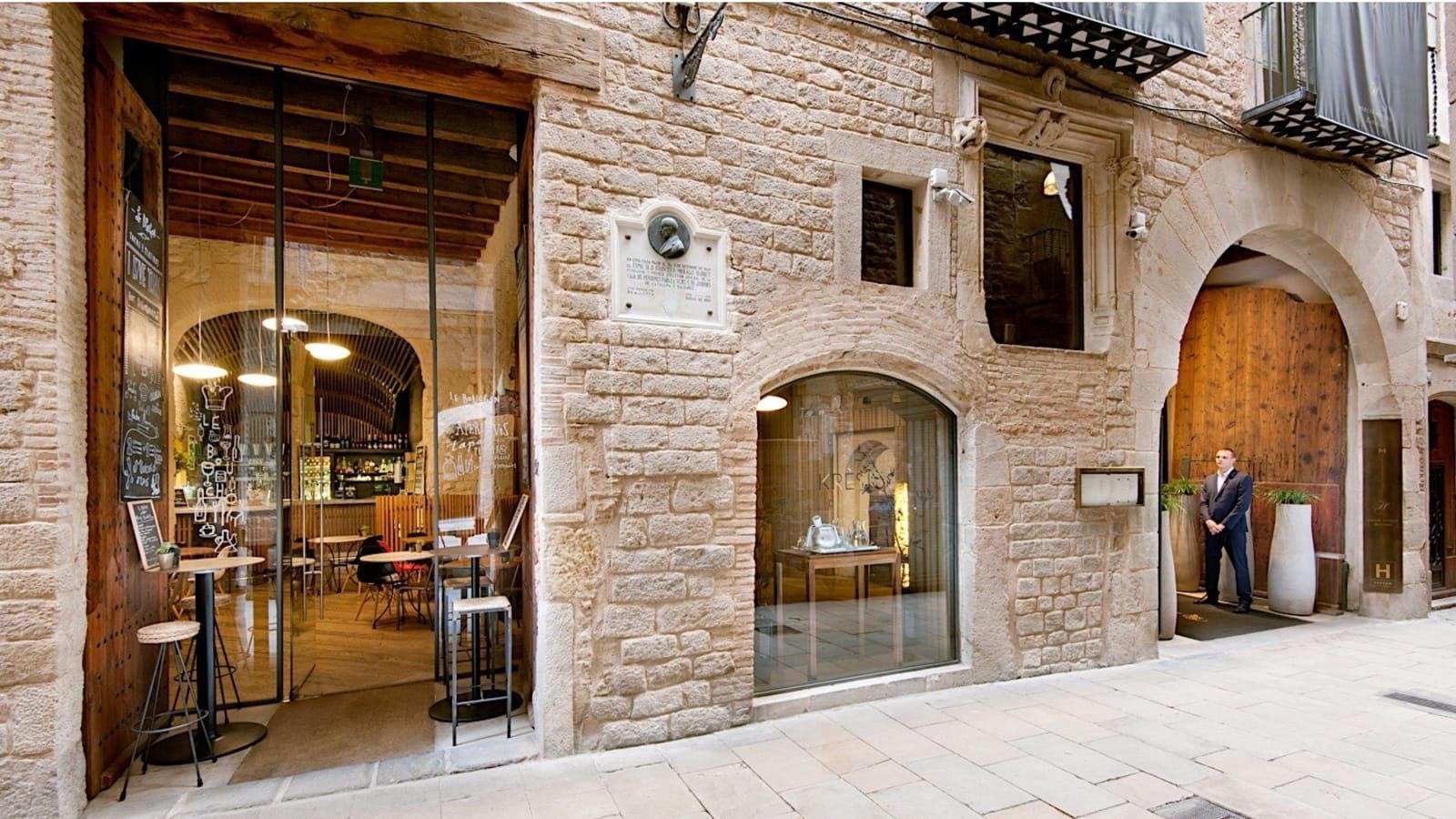
Carrer dels Escudellers runs through the dense medieval core of Ciutat Vella, a narrow lane connecting the Ramblas to the edge of the Barri Gòtic. By night it holds the compressed energy typical of Barcelona's old quarter: foot traffic, the smell of wood smoke from kitchens still cooking over live fire, and façades that predate the city's modern restaurant culture by several centuries. At number 14, Los Caracoles is a restaurant serving traditional Catalan seafood in Barcelona's Ciutat Vella, at Carrer dels Escudellers, 14. The exterior functions almost as a stage set for that history. Strings of garlic and copper pots hang in the window. A rotisserie turns in full view of the pavement, and the chickens rotating on its spit are visible before you reach the door. That transparency is deliberate. In a neighbourhood where tourist traps and genuine institutions occupy the same streets, the open kitchen is a declaration of intent.
The Physical Container: What the Space Communicates
The interior of Los Caracoles does not read as designed in any contemporary sense. It reads as accumulated. Walls carry decades of photographs, hanging ceramic plates, painted tiles, and the occasional framed letter. The dining rooms run across multiple levels connected by narrow passages, each section feeling slightly different in proportion and mood. Dark timber, chequered floors, and low ceilings in the deeper rooms create the sense of a space that has been added to rather than conceived all at once. That accretion is the architecture. Across Barcelona's fine-dining tier, where operators such as Enigma and Disfrutar invest heavily in purpose-built spatial theatrics, Los Caracoles occupies a different position: the room communicates age, not design intent, and the distinction matters to understanding what kind of visit this is.
That credential is not incidental. It positions the restaurant inside a small category of European restaurant institutions where the physical space itself carries meaning independent of the current menu or service team. The building on Carrer dels Escudellers is the product, as much as any dish that emerges from it.
The Catalan Kitchen as Historical Record
Broader Spanish fine-dining story of the past three decades has been defined by invention: molecular technique at El Bulli, the avant-garde offshoots that followed, and the constellation of Michelin-starred rooms that now represent Spain internationally. Operations such as El Celler de Can Roca in Girona, Mugaritz in Errenteria, and Martin Berasategui in Lasarte-Oria define what international audiences expect when they think of Spanish cooking at its most ambitious. Within Barcelona specifically, the creative tier runs from Lasarte to Cocina Hermanos Torres to ABaC, all operating at the €€€€ level with tasting-menu formats and substantial creative ambition.
The restaurant sits outside that framework entirely. Its kitchen has historically anchored itself in Catalan tradition: escudella, fideuà, salt cod preparations, and the whole roast chicken that has become the venue's most recognised signal dish. These are not updated or deconstructed versions of traditional forms. They are the forms. That conservatism is not a weakness in its market position; it is the market position. Travellers arriving in Barcelona after the creative Spanish restaurant circuit, having passed through Quique Dacosta in Dénia or Aponiente in El Puerto de Santa María, often find the return to traditional Catalan format a deliberate counterpoint.
Positioning in the Barri Gòtic Context
The Gothic Quarter poses a sourcing challenge for any serious traveller. The density of the neighbourhood means that undistinguished operations and historically significant ones occupy adjacent buildings, and street-level signals are unreliable guides to quality. The restaurant has been the subject of that debate for years. Critics note that its fame, and the volume of tourist traffic that comes with it, can affect service consistency. Advocates point to the building, the continuity, and the fact that a kitchen cooking over live fire at this address since the nineteenth century has earned a different kind of authority than any restaurant opened in the last decade.
The restaurant functions better as a cultural visit than as a fine-dining destination. It belongs to a different evaluation framework than DiverXO in Madrid or Azurmendi in Larrabetzu. The comparison set is not Michelin-starred creative Spanish cuisine; it is the small group of European restaurant institutions where the experience of eating inside a specific room, in a specific neighbourhood, at a specific address that has been feeding people for nearly two centuries, is itself the substance of the visit.
Planning a Visit
The restaurant is located at Carrer dels Escudellers 14 in the Ciutat Vella district, a short walk from the lower Ramblas and easily reached on foot from the central Gothic Quarter. The neighbourhood is heavily trafficked at most hours, and the restaurant draws both local and international visitors. Given its profile and the volume of passing interest it generates, arriving without a reservation during peak evening service carries meaningful risk. Contacting the venue directly in advance is the practical approach, though booking is recommended. The dress code is smart casual.
Where It Fits
Comparable venues nearby, for context on price, style, and recognition.
| Venue | Cuisine | Price | Notes |
|---|---|---|---|
| Los CaracolesThis venue — the venue you are viewing | Traditional Catalan Seafood | $$$ | Not listed |
| LABARRA ® | Spanish & Catalan Tapas | $$$ | l'Antiga Esquerra de l'Eixample |
| Terrassa Pompeia | Traditional Spanish Mediterranean | $$$ | la Font de la Guatlla |
| Teòric Taverna Gastronòmica | Modern Catalan Taverna | $$$ | la Dreta de l'Eixample |
| Manairo | Modern Catalan Tasting Menu | $$$ | el Fort Pienc |
| Sagardi Centre | Basque Grill & Seafood | $$$ | l'Antiga Esquerra de l'Eixample |
Recognition history
Dated appearances from independent guides and award organizations, with the underlying list record or original source where available.
Macarfi 6.7 Food Rating
Macarfi
Continue exploring
More in Barcelona
Restaurants in Barcelona
Browse all →
Bars in Barcelona
Browse all →
Hotels in Barcelona
Browse all →
At a Glance
- Romantic
- Classic
- Well Known
- Rustic
- Elegant
- Date Night
- Group Dining
- Special Occasion
- Celebration
- Open Kitchen
- Historic Building
- Live Music
- Extensive Wine List
- Local Sourcing
- Street Scene
Current opening hours
- Monday
- 1–3:30 PM, 7–10:30 PM
- Tuesday
- 9 AM–5 PM
- Wednesday
- 1–3:30 PM, 7–10:30 PM
- Thursday
- 1–3:30 PM, 7–10:30 PM
- Friday
- 1–3:30 PM, 7–10:30 PM
- Saturday
- 1–3:30 PM, 7–10:30 PM
- Sunday
- 1–3:30 PM, 7–10:30 PM
Hours can change for holidays and private events. Last verified .
Historic tavern with richly preserved furnishings, wine barrels lining walls, ham leg ceiling mosaic, photographs of celebrity patrons spanning two centuries, and an open kitchen visible upon entry.