Lobster Place
Inside Chelsea Market on Ninth Avenue, Lobster Place operates as one of New York City's most serious seafood retail and dining destinations, where live tanks and a raw bar sit alongside prepared counters in a format that blurs the line between fishmonger and restaurant. The setting is loud, casual, and entirely focused on product quality over ceremony. It draws a cross-section of professional cooks, neighborhood regulars, and visitors who know to look past the dining room format.
Pearl is the En Primeur Club membership app — saves, bookings, and concierge access live there. Same editors, same standards.
- Address
- 75 9th Ave, New York, NY 10011
- Phone
- +1 212 255 5672
- Website
- lobsterplace.com
- Directions
- Get directions
 Saves & bookings on Pearl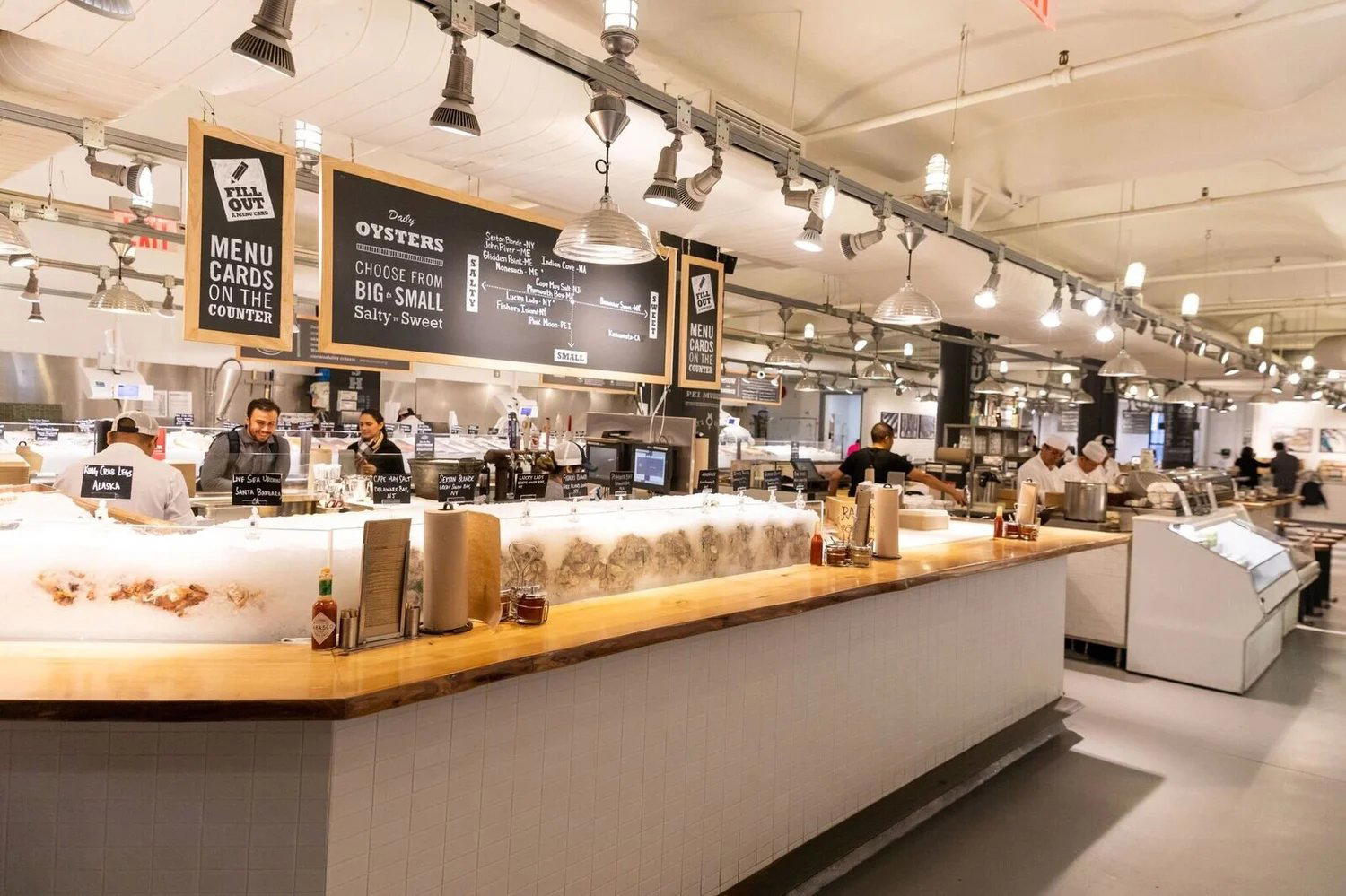
Chelsea Market's Seafood Floor: What to Expect Before You Arrive
Chelsea Market has always functioned less like a food hall and more like a working market that happens to have seating. The building on Ninth Avenue retains its industrial bones, and Lobster Place fits that character: live tanks visible from the aisle, counter service, and the kind of ambient noise that comes from a busy fish operation rather than a curated dining atmosphere. Approaching the counter during peak hours, you are navigating a space that moves at fishmonger speed, not restaurant speed. That distinction shapes everything about the experience, from how you order to where you end up eating.
New York's seafood dining options span an enormous range. At the formal end, Le Bernardin represents the city's most technically precise French seafood cooking, with a prix fixe structure and a wine program that commands full attention. At the other end, counter-service seafood operations like Lobster Place operate on volume and freshness, where the sourcing does the work and the format stays out of the way. These are not competing for the same diner on the same evening; they occupy different positions in how the city eats fish.
The Market Format and What It Demands of the Visitor
Lobster Place rewards preparation more than most casual dining stops in Manhattan. Chelsea Market is open to foot traffic throughout the day, and the restaurant counter draws consistent volume from the lunch hour onward. There are no reservations. Seating is communal and limited. The operative approach is to arrive with patience, clarity about what you want, and timing that accounts for the midday and post-work rushes on Ninth Avenue.
The format places it in a tier of New York seafood that prioritizes access to good raw product over the apparatus of a dining room. This is the same logic that makes certain fish counters in Tokyo's outer markets more interesting to serious eaters than some formal restaurants nearby: when sourcing is the differentiator, ceremony becomes a cost rather than a benefit. New York has a handful of operations that function this way, and the restaurant is among the more prominent in a location that makes it easy to reach from most of lower and midtown Manhattan.
For visitors coming specifically for the Chelsea Market experience, the surrounding context matters. The market sits in the former Nabisco factory building at 75 Ninth Avenue, in the area that connects the Meatpacking District to the southern end of the High Line. The neighborhood has shifted considerably over the past fifteen years, with the High Line's development pulling significant foot traffic northward along what was previously an industrial corridor. Chelsea Market itself has become a destination within that shift, drawing both local workers and visitors in numbers that can make the interior feel compressed during peak periods.
Seafood Sourcing as the Core Proposition
The broader market for high-quality seafood in New York City has grown more competitive as chefs across price points have improved their sourcing relationships. What once differentiated a handful of operations is now more widely distributed. Within that context, the fishmonger-plus-dining format retains a specific advantage: transparency. When the product moves through a retail counter as well as a prepared food operation, the turnover rate tends to stay high and the sourcing tends to stay honest because the same product is being evaluated by retail customers who know fish. That dynamic distinguishes this category from restaurants where the supply chain is invisible to the diner.
Across the country, a small number of seafood-focused operations have built reputations on this kind of vertical integration between retail and dining. Providence in Los Angeles works at the formal restaurant end of sustainable seafood. Addison in San Diego engages coastal sourcing within a fine dining structure. The market-counter model that restaurant represents is a different answer to the same underlying question about how to get the leading fish to the person eating it.
Where Lobster Place Sits in New York's Dining Picture
New York's most decorated restaurants tend toward the formal and the prix fixe. Masa, Per Se, Atomix, and Eleven Madison Park all operate within structures that require advance booking, significant spend, and a commitment of two to four hours. The restaurant asks for none of that. The tradeoff is a different kind of quality signal: not a tasting menu built around a chef's vision, but access to product that a working fish operation stakes its retail reputation on daily.
For visitors building a broader New York itinerary, this placement matters. The restaurant fits into a day that might also include the High Line or the Whitney, where the goal is good food at market pace rather than a seated meal with a reservation window.
Comparable seafood-forward experiences worth noting for context: Single Thread Farm in Healdsburg and Blue Hill at Stone Barns in Tarrytown both integrate sourcing into their identities at a formal dining level. Lazy Bear in San Francisco, Smyth in Chicago, and The French Laundry in Napa each represent the formal-tasting-menu tradition that restaurant explicitly does not occupy. Emeril's in New Orleans, Frasca Food and Wine in Boulder, The Inn at Little Washington, Atelier Moessmer Norbert Niederkofler in Brunico, and Dal Pescatore in Runate complete a reference set of formal dining that clarifies by contrast what a market counter operation does differently and why that difference has its own value.
Planning Your Visit
Chelsea Market is accessible from the Eighth Avenue subway lines at 14th Street, making it a direct stop from most Manhattan neighborhoods. The restaurant operates within the market's general hours, which run through the evening, though counter volume and available product are strongest in the earlier part of the day. No reservation is required or possible; the experience is walk-in by design. Expect to wait during lunch service and on weekend afternoons. Seating inside the market is shared and turnover-dependent, so timing your visit for a weekday mid-morning or early evening will improve the experience considerably.
Accolades, Compared
Comparable venues nearby, for context on price, style, and recognition.
| Venue | Cuisine | Price | Notes |
|---|---|---|---|
| Lobster PlaceThis venue — the venue you are viewing | Fresh Seafood Market & Raw Bar | $$ | Not listed |
| Seahorse | Modern Seafood Brasserie | $$$ | Midtown South-Flatiron-Union Square |
| Docks Off 5th | Seafood Fusion | $$$ | Midtown-Times Square |
| Greenpoint Fish & Lobster Co. | Sustainable Seafood Raw Bar | $$ | Greenpoint |
| Pearl Oyster Bar | New England Seafood | $$ | West Village |
| Crave Fishbar | Sustainable Seafood | $$$ | East Midtown-Turtle Bay |
Continue exploring
More in New York City
Restaurants in New York City
Browse all →
Bars in New York City
Browse all →

Hotels in New York City
Browse all →

Wineries in New York City
Browse all →


At a Glance
- Lively
- Casual
- Casual Hangout
- Open Kitchen
- Beer Program
- Sustainable Seafood
Current opening hours
- Monday
- 11 AM–9 PM
- Tuesday
- 11 AM–9 PM
- Wednesday
- 11 AM–9 PM
- Thursday
- 11 AM–9 PM
- Friday
- 11 AM–9 PM
- Saturday
- 11 AM–9 PM
- Sunday
- 11 AM–9 PM
Hours can change for holidays and private events. Last verified .
Laid-back market hall atmosphere with casual seating for fresh seafood.