At 30 Rue Bonaparte in Saint-Germain-des-Prés, Le Pré aux Clercs occupies one of Paris's most storied dining addresses, where the sixth arrondissement's literary café culture meets the expectations of a contemporary French table. The restaurant sits in a neighbourhood that has shaped and reshaped itself across generations, making it a lens through which to read how classic Parisian dining continues to evolve.
Pearl is the En Primeur Club membership app — saves, bookings, and concierge access live there. Same editors, same standards.
- Address
- 30 Rue Bonaparte, 75006 Paris, France
- Phone
- +33143544173
- Website
- lepreauxclercs.shop
- Directions
- Get directions
 Saves & bookings on Pearl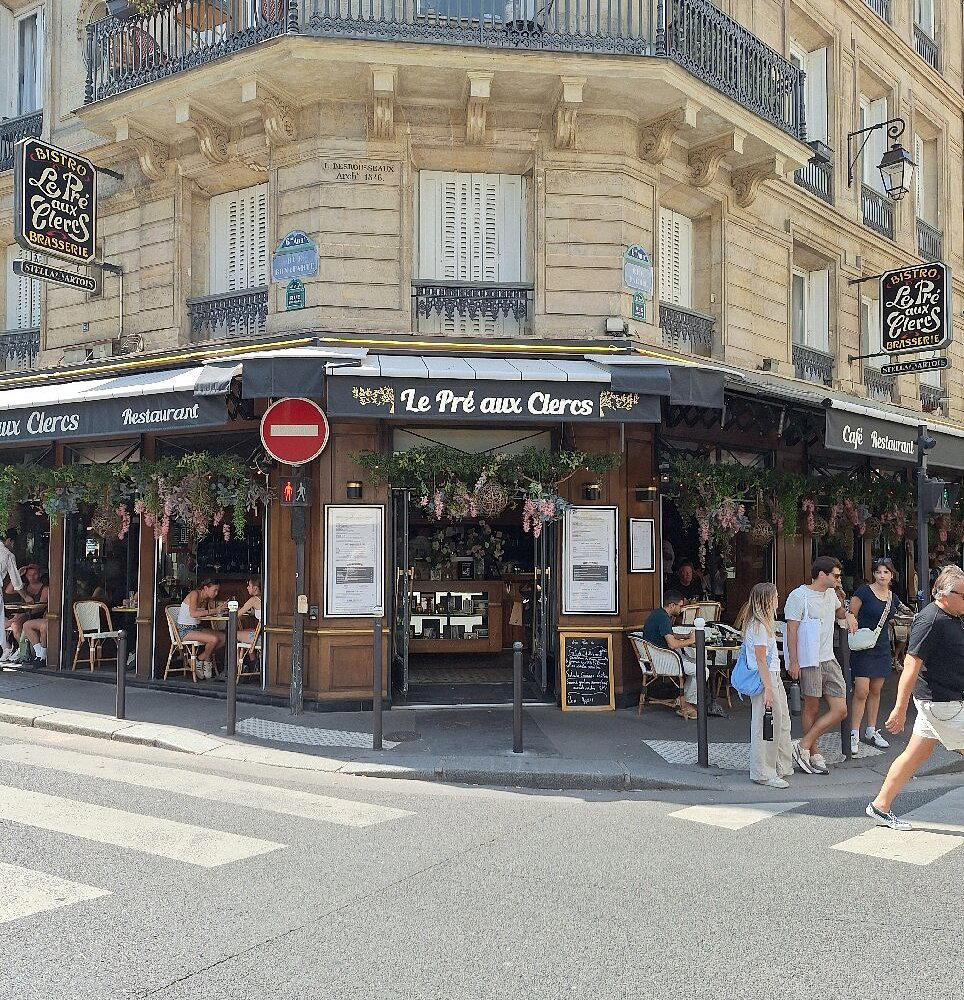
A Saint-Germain Address With Layers
Rue Bonaparte runs south from the Seine through the heart of the sixth arrondissement, past the École des Beaux-Arts and toward the Luxembourg Gardens, threading through a neighbourhood that has been home to painters, publishers, philosophers, and the kind of restaurants that outlast all of them. Le Pré aux Clercs sits at number 30 along this stretch, where the stone facades and the rhythm of foot traffic carry the particular weight of a quartier that has never had to announce itself. In Saint-Germain-des-Prés, the address does a great deal of the editorial work before a single dish arrives at the table.
The sixth arrondissement operates as one of Paris's most legible dining registers. Brasseries and bistros that have traded for decades coexist with newer tables making quieter arguments about what French cooking in this city should look like now. Le Pré aux Clercs belongs to a tradition-conscious tier of that neighbourhood, where the room's weight and the street's associations create an expectation that the kitchen is expected to either honour or consciously push against. Neither position is neutral here.
How the Room Has Changed
The evolution of classic Parisian restaurants over the past two decades follows a recognisable arc. Many properties that built their reputations on formal service and codified French technique have had to make decisions about how much of that scaffolding to retain as the city's dining tastes shifted toward the more relaxed registers favoured by a younger, internationally mobile clientele. The question for any long-standing address is not simply whether to modernise, but how to do so without dissolving the qualities that gave the room its authority in the first place.
Le Pré aux Clercs has navigated this tension in a way that mirrors a broader pattern visible across comparable Saint-Germain establishments. The physical environment on Rue Bonaparte retains the formality implied by the neighbourhood's architecture, while the approach at the table has moved, incrementally, toward the less ceremonial mode that now characterises much of Paris's mid-to-upper tier dining. This is not an uncommon trajectory. Across the city, restaurants in similar positions have found that the room can hold its character while the service style relaxes around it, a recalibration rather than a reinvention.
For context on how French fine dining continues to evolve at the highest register, the contrast is instructive. At the three-Michelin-star level, establishments like Alléno Paris au Pavillon Ledoyen and Arpège represent one pole of ambition, where reinvention is total and the kitchen's position is explicitly avant-garde. L'Ambroisie on the Place des Vosges represents another: a deliberate refusal to modernise, where the classical language is maintained with a rigour that functions as its own form of statement. Kei, in the first arrondissement, and Le Cinq at the Four Seasons George V chart different hybrid paths. Le Pré aux Clercs sits outside that starred tier, in the territory where the cooking is assessed against neighbourhood expectations rather than city-wide critical benchmarks, which is a different and in some respects more demanding form of accountability.
The Neighbourhood as Context
Saint-Germain-des-Prés rewards the kind of visitor who reads a meal as part of a broader day rather than as an isolated event. The sixth arrondissement is walkable in a way that few Parisian quarters match at this density of interest: the Musée d'Orsay is across the river, the Jardin du Luxembourg is minutes south, and the galleries along Rue de Seine are a short detour from Rue Bonaparte itself. A lunch at Le Pré aux Clercs fits naturally into an afternoon structured around the neighbourhood rather than a dedicated dining pilgrimage, which is, in any case, how most locals in this arrondissement approach their tables.
This matters when thinking about the timing of a visit. The sixth arrondissement lunch trade draws a mix of gallery professionals, academics from the nearby Sciences Po campus, and the kind of Parisian who still treats the midday meal as the primary one. Dinner in Saint-Germain skews toward a more tourist-adjacent clientele, simply because many of the neighbourhood's daytime regulars have dispersed by evening. For a more local-feeling experience at any address in this part of the city, the weekday lunch hour remains the sharper read.
French Dining Beyond Paris
Any serious engagement with what Paris represents in the broader French dining context benefits from a comparative map. The country's most decorated provincial tables — Mirazur in Menton, Troisgros in Ouches, Bras in Laguiole, Auberge de l'Ill in Illhaeusern, Flocons de Sel in Megève, Paul Bocuse in Collonges-au-Mont-d'Or, Assiette Champenoise in Reims, Au Crocodile in Strasbourg, Auberge du Vieux Puits in Fontjoncouse, and AM par Alexandre Mazzia in Marseille — demonstrate that French cooking's most ambitious contemporary expressions have, in many cases, moved away from the capital. Paris retains its authority as a dining city through volume, variety, and the particular prestige of its addresses rather than through dominance at the leading edge of technique. A Saint-Germain table like Le Pré aux Clercs operates within that Parisian paradigm: its value is partly locational and contextual, not solely culinary. For international reference, the French dining tradition's global reach can be traced through houses like Le Bernardin in New York, which carries the classical French seafood tradition into an American context, and contrasted with newer formats like Atomix, which represents a entirely different set of priorities in the same city.
Planning a Visit
Le Pré aux Clercs is located at 30 Rue Bonaparte, 75006 Paris, a few minutes' walk from the Saint-Germain-des-Prés metro station on line 4. The address is also reachable on foot from Odéon (lines 4 and 10), making it convenient from both the Left Bank's main corridors. Given the limitations of available booking data, prospective diners should approach the restaurant directly to confirm current hours, pricing, and reservation availability, all of which are subject to change. The neighbourhood itself operates with the predictable rhythms of a residential quarter: quieter on Monday, busiest from Wednesday through Saturday, and at its most atmospheric in the early evening when the galleries are closing and the light along Rue Bonaparte is at its most sympathetic.
For a broader view of where Le Pré aux Clercs fits within the city's dining options, see our full Paris restaurants guide, which maps the capital's tables across neighbourhoods, price tiers, and culinary registers.
Continue exploring
More in Paris
Restaurants in Paris
Browse all →
Bars in Paris
Browse all →
Hotels in Paris
Browse all →



At a Glance
- Classic
- Elegant
- Brunch
- Business Dinner
- Casual Hangout
- Terrace
- Street Scene
Current opening hours
- Monday
- 7 AM–1 AM
- Tuesday
- 7 AM–1 AM
- Wednesday
- 7 AM–1 AM
- Thursday
- 7 AM–1 AM
- Friday
- 7 AM–1 AM
- Saturday
- 7 AM–1 AM
- Sunday
- 7 AM–1 AM
Hours can change for holidays and private events. Last verified .
Bustling yet welcoming atmosphere with superb service in a traditional brasserie setting.
Know Before You Go
- Getting there
- 30 Rue Bonaparte, 75006 Paris, France