Le Gothique
Le Gothique occupies a dining room inside the Royal Victoria Patriotic Building, a Victorian-Gothic landmark in Wandsworth that has served as an orphanage, a wartime interrogation centre, and a film set before finding its current life as a restaurant. The setting alone places it in a different category from London's conventional dining options, drawing visitors who seek architectural theatre alongside their meal.
Pearl is the En Primeur Club membership app — saves, bookings, and concierge access live there. Same editors, same standards.
- Address
- The Royal Victoria Patriotic Building, John Archer Way, London SW18 3SX, United Kingdom
- Phone
- +442088706567
- Website
- legothique.co.uk
- Directions
- Get directions
 Saves & bookings on Pearl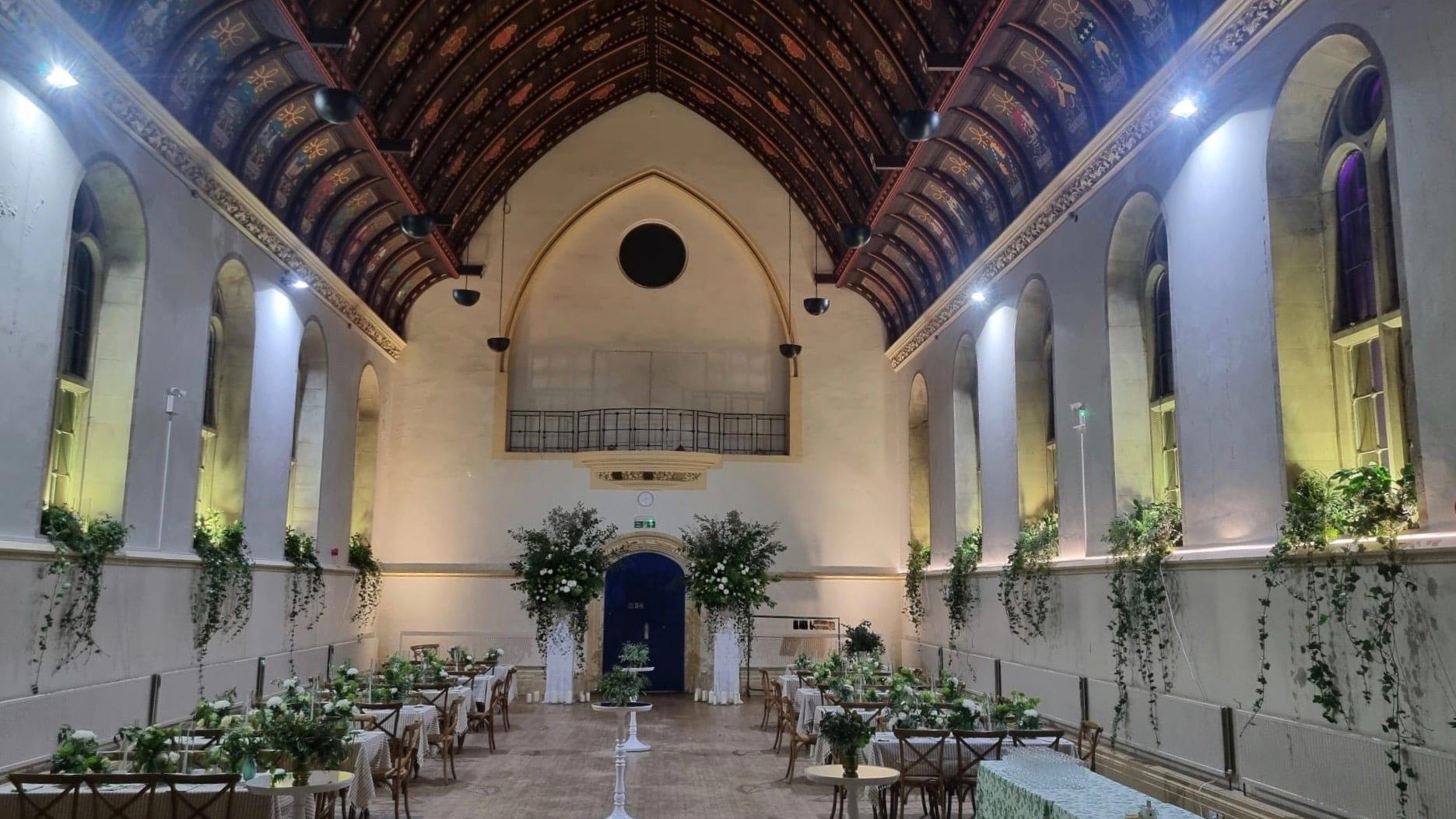
A Victorian Fortress Finds Its Dining Identity
Few buildings in London carry a stranger CV than the Royal Victoria Patriotic Building in Wandsworth. Completed in 1859 as an orphanage for the daughters of soldiers killed in the Crimean War, it subsequently served as a wartime intelligence centre where MI5 processed refugees and suspected spies during the Second World War, and has since appeared as a location stand-in for everything from Hogwarts to Cold War thrillers. That accumulated weight of history is not incidental to the dining experience at Le Gothique: it is the entire frame. The building's soaring Gothic Revival turrets, chapel, and grand entrance hall are not a backdrop that the restaurant happens to occupy. They are the reason the restaurant exists in the form it does, and understanding how that relationship has evolved over the years is one useful lens through which to approach a visit.
Gothic Revival Dining in South-West London
Restaurants that trade on architectural drama occupy a particular niche in any major city. London has several, from the ornate Lecture Room at Sketch, The Lecture Room and Library in Mayfair to the listed interiors housing Dinner by Heston Blumenthal at the Mandarin Oriental, but most of those properties sit within established hospitality zones. Le Gothique's position on the south-west fringe of the city, in a neighbourhood that receives only modest dining traffic by central-London standards, gives it a different character. The journey itself, a walk from Wandsworth Common station through residential streets, heightens the impact of arriving at the building. That contrast between setting and surroundings has defined the restaurant's identity through multiple reinventions.
The category of heritage-building restaurant is well-established across the United Kingdom. Country-house properties like Le Manoir aux Quat'Saisons in Oxford and Gidleigh Park in Chagford have long demonstrated that notable architecture can anchor a dining destination and pull guests well beyond any reasonable convenience radius. Le Gothique operates on a related logic, though within an urban setting rather than a rural retreat, and without the overnight-stay component that gives country-house restaurants a secondary reason to visit.
The Evolution of the Space
Buildings like the Royal Victoria Patriotic Building have a tendency to outlast any single hospitality concept, and the restaurant has moved through distinct phases since it began operating as a restaurant. The core challenge facing any operator in this kind of space is the same one that confronts heritage venues broadly: how much to let the architecture speak, and how much to impose a contemporary identity on top of it. Lean too far into the history and the result risks feeling like a period piece or a themed attraction rather than a working restaurant. Move too aggressively toward modernisation and the building's singular quality becomes merely ornamental.
That tension is visible across the British dining scene. At Midsummer House in Cambridge, the Victorian setting is held in deliberate tension with technically precise contemporary cooking. At L'Enclume in Cartmel, the converted smithy's history informs the aesthetic without constraining the kitchen. The restaurant has negotiated its own version of this balance, with the dining room's Gothic stonework and ecclesiastical scale remaining the dominant sensory fact regardless of what sits on the table.
The restaurant's position within the RVPB complex has also shifted over time as the building's broader use has evolved. The site now houses a mix of residential units, creative studios, and event spaces alongside the restaurant, which means the restaurant has moved from being a near-solitary occupant of a repurposed Victorian institution to being one component within a more active cultural and residential community. That shift has changed the foot-traffic dynamic and, in turn, the type of diner the restaurant attracts on any given evening.
Where Le Gothique Sits in the London Dining Picture
London's restaurant landscape at the leading end is heavily concentrated in a handful of postcodes. The Michelin-recognised tier, which includes CORE by Clare Smyth, Restaurant Gordon Ramsay, and The Ledbury, operates from W1, W11, SW3, and SW10 with near-total consistency. The restaurant in SW18 occupies a different tier and a different logic. Its proposition is not built around kitchen accolades in the way that formal fine-dining destinations in Notting Hill or Chelsea are. The draw is architectural and experiential, making it more useful to compare it with event-oriented dining formats than with award-chasing tasting-menu counters.
Internationally, the model has clear parallels. Restaurants embedded within historically significant buildings, whether converted abbeys, fortified towers, or repurposed civic institutions, tend to attract a diner who is buying context as much as cooking. Those parallels extend well beyond London: Le Bernardin in New York City or Atomix in New York City represent the technically obsessive, kitchen-first model. The restaurant's equivalent comparable set is smaller, more local, and defined by place rather than plate.
For those planning a wider trip through notable dining in the UK, the country-house circuit remains the reference point. Properties such as Waterside Inn in Bray, Moor Hall in Aughton, Hand and Flowers in Marlow, hide and fox in Saltwood, Opheem in Birmingham, and Restaurant Andrew Fairlie in Auchterarder each make a strong case based on culinary credentials. The restaurant's case rests primarily on the building, which is either a limiting factor or the whole point, depending on what you are looking for.
Comparison Snapshot
Comparable venues nearby, for context on price, style, and recognition.
| Venue | Cuisine | Price | Notes |
|---|---|---|---|
| Le GothiqueThis venue — the venue you are viewing | Traditional French Bistro | $$ | Not listed |
| Twenty Eight Fifty | Modern European Wine Bar | $$ | Holborn |
| Elsa | Alsace-Inspired French Bistro | $$$ | Fitzrovia |
| Chancery | Classic French Brasserie | $$ | Holborn |
| Cafe Boheme | Classic French Bistro | $$ | Soho |
| Orrery By Pierre Minotti | Modern French Fine Dining | $$$$ | Marylebone |
Continue exploring
More in London
Restaurants in London
Browse all →
Bars in London
Browse all →
Hotels in London
Browse all →

At a Glance
- Romantic
- Cozy
- Historic
- Elegant
- Intimate
- Date Night
- Special Occasion
- Group Dining
- Garden
- Historic Building
- Private Dining
- Local Sourcing
- Garden
Current opening hours
- Monday
- Closed
- Tuesday
- Closed
- Wednesday
- 12–3 PM, 6–11 PM
- Thursday
- 12–3 PM, 6–11 PM
- Friday
- 12–11 PM
- Saturday
- 12–11 PM
- Sunday
- 12–4 PM
Hours can change for holidays and private events. Last verified .
Warm, romantic atmosphere in a dark, cosy mezzanine with dramatic Victorian architecture and courtyard seating.