La Mela Ristorante
On Mulberry Street in the heart of Little Italy, La Mela operates as one of the neighbourhood's most enduring family-style Italian tables. The format is communal, the portions are generous, and the room draws a crowd that arrives ready to share. It sits squarely in the tradition of red-sauce Italian dining that shaped how New York understood Italian food for generations.
Pearl is the En Primeur Club membership app — saves, bookings, and concierge access live there. Same editors, same standards.
- Address
- 167 Mulberry St, New York, NY 10013
- Phone
- +12124319493
- Website
- lamelarestaurant.com
- Directions
- Get directions
 Saves & bookings on Pearl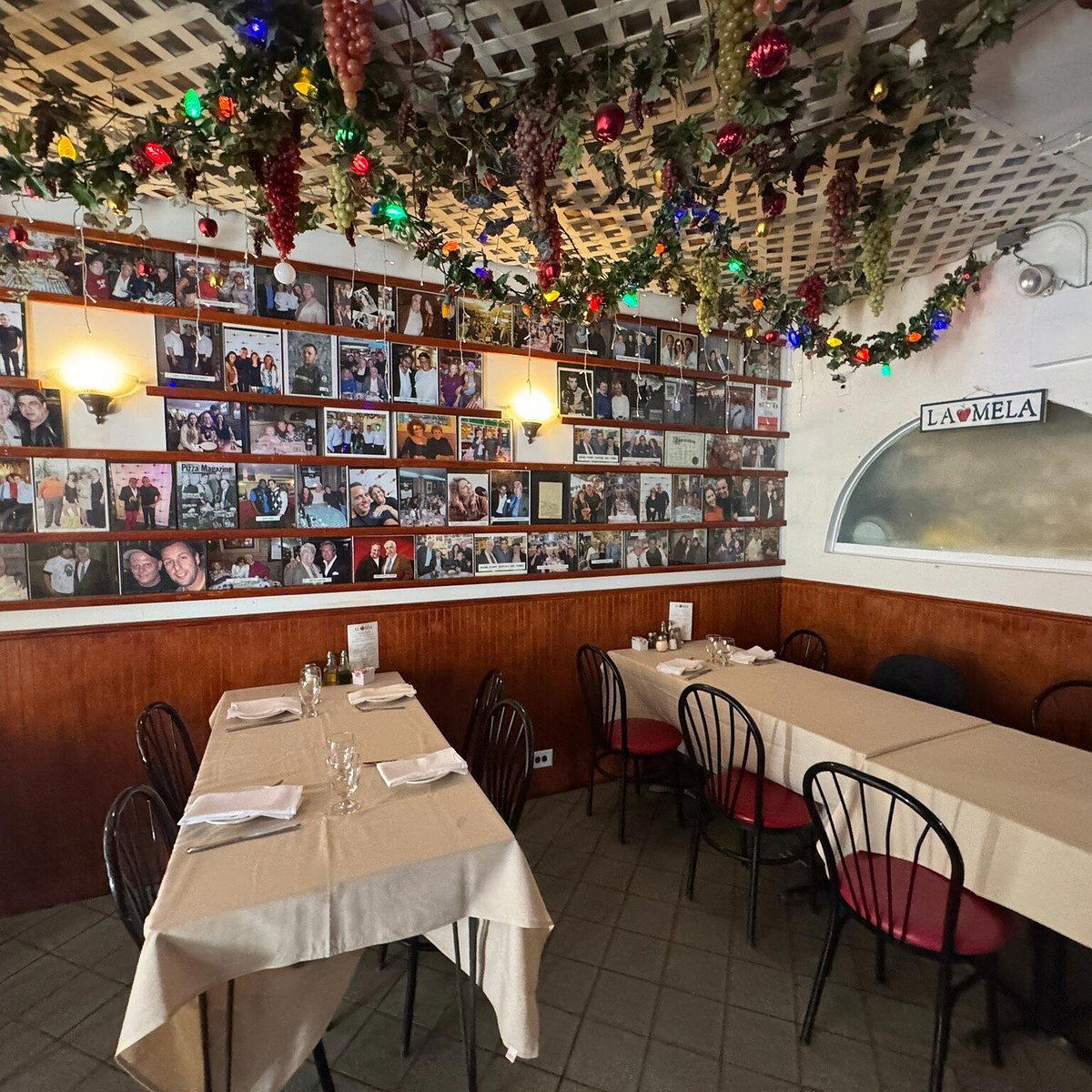
Mulberry Street and the Grammar of Little Italy
La Mela is a Traditional Southern Italian restaurant at 167 Mulberry St, New York, NY 10013, with. Walk south on Mulberry Street past the souvenir shops and the clusters of tourists debating which awning to sit under, and you arrive at a block that has been feeding New York its idea of Italian-American dining for more than a century. Little Italy's geography has compressed since its peak, the neighbourhood now occupies a narrower strip than it did in the mid-twentieth century, squeezed between an expanding Chinatown to the south and SoHo's retail sprawl to the north, but Mulberry Street itself retains a recognisable character. At 167, La Mela occupies that tradition directly: a family-style Italian restaurant operating in one of the country's most recognisable Italian-American corridors.
The room signals its intent before the food arrives. Long tables, a preference for groups, and a format built around sharing rather than individual plating place La Mela in a dining category that New York has mostly moved away from at the premium end. Where restaurants like Le Bernardin, Per Se, and Atomix operate on tasting menus and exacting individual service, La Mela's proposition is older and less choreographed. That is not a criticism. It is a category distinction that shapes what kind of evening you are booking.
The Italian-American Table and Where Ingredients Enter the Story
Italian-American cooking in New York was built on substitution and adaptation. Immigrant cooks in the early twentieth century arrived with techniques shaped by specific regional Italian traditions, Sicilian, Neapolitan, Calabrian, and applied them to ingredients available in New York markets. The result was a cuisine that diverged meaningfully from its Italian source material: tomato sauces became richer and more heavily cooked, portions grew larger to reflect American abundance, and dishes that were weekday staples in Italy became restaurant centrepieces in New York. That process of adaptation is the actual history being served on Mulberry Street, and understanding it changes how you read the menu at any restaurant in this corridor.
Ingredient sourcing in this tradition has always been transactional rather than ideological. Little Italy's original markets sourced from Lower East Side wholesalers, local gardens in the outer boroughs, and eventually from the industrial supply chains that fed mid-century American restaurants. This contrasts sharply with the farm-to-table commitment you find at Blue Hill at Stone Barns in Tarrytown, or the hyper-local sourcing frameworks at Single Thread Farm in Healdsburg. Those operations treat provenance as the organising principle of every dish. The Italian-American red-sauce tradition treats provenance differently: the point is the recipe, the technique, and the communal format, not the biography of any single ingredient.
That said, the sourcing question is worth raising at La Mela because the neighbourhood's positioning depends on it. A restaurant on Mulberry Street benefits from the cultural capital of Italian-American history, but that capital is only as credible as the cooking behind it. The dishes that have defined this block, baked clams, rigatoni in meat sauce, chicken marsala, tiramisu served in portions designed for sharing, are simple enough that ingredient quality registers immediately. There is nowhere to hide in this kind of cooking, which is either the appeal or the liability depending on execution.
Family-Style Dining as a Format, Not a Compromise
Family-style service is a specific format choice with real implications for how a meal unfolds. Dishes arrive at the centre of the table; individual plating is secondary; the rhythm of the meal is social rather than sequential. This model is less common at the higher price tiers of New York dining, Masa and Jungsik New York both operate on the opposite logic, where the chef's sequencing controls the entire arc of the evening. La Mela's format inverts that relationship: the table controls the pace.
For groups of four or more, that is often a better fit than a choreographed tasting menu. The format rewards conversation, accommodates different appetites at the same table, and produces a bill that is easier to split than a per-person omakase. It also explains why La Mela's crowd skews toward celebratory occasions and tourist groups rather than the solo diner or the serious couple working through a wine list. The room is not designed for quiet introspection. It is designed for noise, sharing, and the particular pleasure of a table that never quite empties.
Little Italy in the American Dining Context
New York's Italian-American restaurants occupy a curious position in the national dining conversation. At the serious end, New York's Italian dining has moved toward regional Italian specificity, Emilian pasta, Ligurian seafood preparations, Sardinian wine lists, rather than the broad Italian-American synthesis that Mulberry Street represents. But that synthesis remains the reference point for Italian food in the American popular imagination, which is why restaurants like La Mela continue to attract visitors who are as much seeking a cultural experience as a meal.
Comparable community anchors exist in other cities, Bacchanalia in Atlanta holds a different but analogous position as a place that defines a city's dining identity over time, though the specific tradition La Mela represents is distinctly New York and distinctly of this neighbourhood. For visitors exploring New York's dining geography more broadly, the contrast between Mulberry Street and the city's more decorated contemporary restaurants provides useful orientation.
At the international end of Italian fine dining, the distance from La Mela's format is even greater. Alain Ducasse at Louis XV in Monte Carlo represents what happens when French classical technique meets Mediterranean ingredients at the luxury end. 8½ Otto e Mezzo Bombana in Hong Kong applies Italian techniques to a non-Italian market. Neither is in conversation with what La Mela does, but positioning them together clarifies the spectrum: Italian food as a global fine-dining language on one side, Italian-American food as a New York neighbourhood institution on the other.
Cuisine and Recognition
Comparable venues nearby, for context on price, style, and recognition.
| Venue | Cuisine | Price | Notes |
|---|---|---|---|
| La MelaThis venue — the venue you are viewing | Traditional Southern Italian | $$ | Not listed |
| Song' E Napule | Authentic Neapolitan Pizza | $$ | Greenwich Village |
| San Marzano | Italian Pasta | $$ | East Village |
| Trattoria Pesce Pasta | Northern Italian Seafood Trattoria | $$ | West Village |
| Tavola | Authentic Sicilian Wood-Fired Pizza & Pasta | $$ | Hell's Kitchen |
| Il Forno | Modern Italian Trattoria | $$ | Hell's Kitchen |
Continue exploring
More in New York City
Restaurants in New York City
Browse all →
Bars in New York City
Browse all →
Hotels in New York City
Browse all →





At a Glance
- Lively
- Classic
- Well Known
- Rustic
- Group Dining
- Family
- Celebration
- Casual Hangout
- Private Dining
- Historic Building
- Standalone
- Beer Program
- Street Scene
Current opening hours
- Monday
- 11:30 AM–10 PM
- Tuesday
- 11:30 AM–10 PM
- Wednesday
- 11:30 AM–10 PM
- Thursday
- 11:30 AM–10 PM
- Friday
- 11:30 AM–10 PM
- Saturday
- 11:30 AM–10 PM
- Sunday
- 11:30 AM–10 PM
Hours can change for holidays and private events. Last verified .
Noisy, upbeat, and unpretentious with a quintessential New York energy; warm hospitality and honest restaurant personality.