Koshary Hekaya sits in Dokki, one of Cairo's most lived-in residential districts, serving Egypt's most democratic dish in a neighbourhood context that keeps it far from tourist circuits. Koshary — lentils, rice, pasta, tomato sauce, fried onions, vinegar — is Cairo's original fast food, and places like Hekaya are where the city actually eats it.
 Discover on Pearl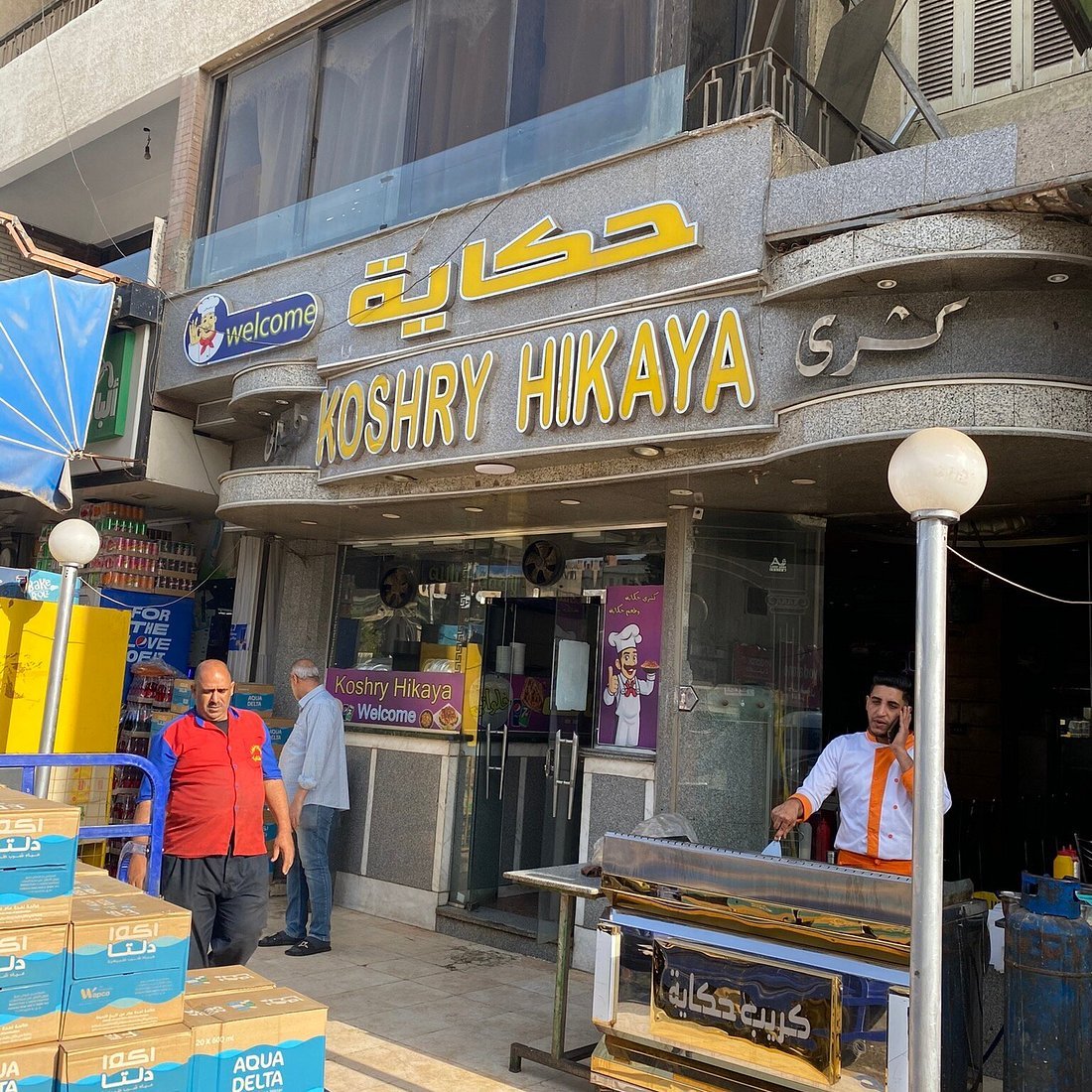
Dokki and the Street That Feeds Cairo
Dokki occupies a middle register in Cairo's geography: not the polished Zamalek riverside, not the dense commercial churn of Downtown, but a residential grid where government workers, university students, and long-settled families share the same pavements. It is precisely this kind of neighbourhood — unglamorous, functional, locally oriented — where koshary shops have always thrived. The dish does not need a tourist-facing address. It needs density, foot traffic, and a population that eats on a schedule dictated by work and transit rather than occasion. Dokki supplies all three, and Koshary Hekaya operates within that logic.
For visitors arriving from the more curated dining options along the Nile or in New Cairo's mall-anchored restaurant strips, the shift in register is immediate. There are no reservations, no dress codes to consider, and no sommelier to consult. The transaction is fast, the seating is practical, and the room fills with the sound of ordinary Cairo going about its day. This is the format koshary was built for, and it is the format that has sustained the dish across generations.
The shortlist, unlocked.
Hard-to-book tables, cellar releases, and concierge-planned trips.
Get Exclusive Access →Koshary as Cultural Infrastructure
To understand a koshary shop in Cairo, it helps to understand what koshary actually is within Egyptian food culture. The dish is a layered assembly: short-grain rice cooked with lentils, macaroni, chickpeas, a sharp tomato sauce spiked with cumin and garlic, crispy fried onions on leading, and a vinegar-chilli condiment on the side that diners adjust to their own heat preference. Each component is cooked separately and assembled to order, which gives even a basic operation a degree of kitchen choreography that faster food formats do not require.
The dish's origins are debated , culinary historians trace various components to Italian and Indian influences brought through Alexandria and the Canal cities in the nineteenth and early twentieth centuries , but its current form is entirely Egyptian, deeply specific to Cairo's particular metabolism of cheap carbohydrates, long working days, and communal public life. It is the dish that crosses class lines more thoroughly than almost anything else in the Egyptian food system. A plate costs a fraction of what any sit-down restaurant charges, and the same shop serves a construction worker and a university professor within the same lunch hour.
That social function is worth stating directly: koshary is not street food in the sense of a regional specialty preserved for cultural tourism. It is active, daily sustenance for millions of people in a city of over twenty million. Shops like Koshary Hekaya are not curating an experience , they are providing a service that Cairo depends on. The distinction matters when placing a venue in its correct context. For other Egyptian restaurant formats, including the Egyptian Modern cooking at Khufus in Giza or the Egyptian Mediterranean approach at Le Restaurant in El Gouna, the frame is one of creative interpretation and contemporary positioning. Koshary Hekaya operates in a different register entirely: tradition maintained rather than tradition reinterpreted.
The Dokki Neighbourhood Frame
Dokki sits on the west bank of the Nile, connected to central Cairo by bridges at Tahrir and Giza. It developed primarily in the mid-twentieth century as a residential and administrative district, and its street-level retail reflects that history: pharmacies, stationers, bakeries, and food counters that answer practical needs rather than aspirational ones. A koshary shop here is not a curiosity or a destination , it is part of the district's basic service infrastructure.
This neighbourhood context matters for visitors calibrating expectations. Dokki is not difficult to reach from central Cairo or from Zamalek, but it requires a deliberate decision to step away from the better-known dining circuits. Those circuits have their own appeal , Pier 88 in Zamalek and Kazoku in Cairo represent very different points on the city's restaurant range , but they do not offer what a functional neighbourhood koshary counter offers, which is a direct read on how the city actually feeds itself at volume.
Cairo's dining range is genuinely wide. On one end, kitchens like Chinoix Restaurant in New Cairo and Mayrig in Sheikh Zayed address diners looking for international or Armenian cooking in contemporary settings. On the other, neighbourhood operations like Koshary Hekaya anchor the local food economy in something older and more functional. Both ends of that range are worth knowing. For a fuller picture of where each fits, our full Cairo restaurants guide maps the city's dining character across neighbourhoods and price points.
What the Format Delivers
Koshary shops in Cairo operate on a model of high throughput and very low cost. The kitchen produces a limited set of components in large quantities throughout the day, assembling plates rapidly as orders come in. Customisation is real but bounded: portion size, the ratio of components, and the amount of vinegar-chilli sauce are adjusted on request, but the dish itself does not change. There is no rotating menu, no seasonal variation, and no chef's special. The discipline of the format is its point.
For a visitor whose Cairo dining has moved through the Armenian cooking at Mayrig, the charcoal-grill tradition at Abou Shakra in Al Haram, or the European formats at Andrea El Mariouteya in Sheikh Zayed City, a koshary counter provides a different kind of instruction. It shows what the city's food system looks like when stripped of hospitality performance and reduced to the transaction itself: a hot plate, a reasonable price, and a room full of people with somewhere to be.
Planning a Visit
Koshary Hekaya is located in Dokki, reachable by taxi, ride-hailing apps, or the Cairo Metro (Dokki station on Line 2 places you within the district). Lunch service hours at koshary shops typically run from mid-morning through early evening, with peak demand at midday and again in the late afternoon. No booking is required or possible , the format is walk-in only. Prices for koshary in Cairo remain among the lowest in the city's food economy, making this one of the few dining stops where budget is not a variable worth calculating in advance. Dress is casual by default; the neighbourhood and the format demand nothing else.
For visitors building a broader Egypt itinerary beyond Cairo, the range of contexts shifts considerably: Castle Zaman in Noweiba operates in a desert-coastal setting with a completely different hospitality logic, while international references like Le Bernardin in New York City or Atomix in New York City illustrate how far the global fine dining spectrum extends from where a Dokki koshary counter sits. Neither comparison diminishes the other. They are simply different answers to different questions about what eating well means in a given place.
Frequently Asked Questions
- Is Koshary Hekaya good for families?
- Yes , koshary is one of Cairo's most practical family meals, the price is low even by Egyptian standards, and the format moves fast enough to accommodate children who cannot sit through a long dinner.
- Is Koshary Hekaya better for a quiet night or a lively one?
- If you want quiet, go early in the afternoon before the post-work rush; if Cairo's ambient noise and pace is part of what you came for, the lunch peak and early evening hours deliver exactly that energy without any of the production that comes with a formal dining room.
- What should I order at Koshary Hekaya?
- Order the koshary , there is no other category on the menu worth deliberating over. Ask for a medium or large portion, request extra fried onions if they are available separately, and use the vinegar-chilli condiment incrementally rather than all at once; it sharpens the dish considerably but the heat builds.
- Is koshary from a Dokki neighbourhood shop different from the version served at Cairo's larger koshary chains?
- The components are standard across the city , rice, lentils, pasta, chickpeas, tomato sauce, fried onions , but neighbourhood shops in residential districts like Dokki tend to operate for a local repeat clientele rather than tourists or first-time visitors, which often means the ratios and seasoning are calibrated to local preference rather than adjusted for unfamiliar palates. That is a meaningful distinction in a dish where proportion and sauce intensity define the eating experience.
For the broader range of Cairo dining, including formats from neighbourhood Egyptian cooking to international restaurants across the city's districts, see our full Cairo restaurants guide. Other neighbourhood-level options worth considering include Cairo Caizer in Nasr, Carbs in Al Ameria, and What the Crust in Al Bassatin. For Japanese formats across Cairo and its surrounding districts, Mori Sushi in Al Nozha and Izakaya in 6th of October map that end of the market. And for a regional comparison outside Egypt entirely, Maharaja Restaurant offers a different South Asian context for thinking about how rice-and-lentil traditions travel and transform across cuisines.
Price and Recognition
These are the closest comparables we have in our database for quick context.
| Venue | Price | Awards | Notes |
|---|---|---|---|
| Koshary Hekaya | This venue | ||
| Khufus | World's 50 Best | Egyptian Modern | |
| Le Restaurant | Egyptian Mediterranean | ||
| La Maison Bleue | Egyptian Mediterranean | ||
| Kazoku | World's 50 Best | ||
| Reif Kushiyaki Cairo | World's 50 Best |
Need a table?
Our members enjoy priority alerts and concierge-led booking support for the world's most difficult tables.
Get Exclusive AccessThe shortlist, unlocked.
Hard-to-book tables, cellar releases, and concierge-planned trips.
Get Exclusive Access →