Kimganae
Kimganae sits on Union Street in Flushing, Queens, in the heart of among the more concentrated Korean dining corridors outside Seoul. The address places it inside a neighbourhood where culinary credibility is earned through the loyalty of a demanding, knowledgeable local community rather than through Manhattan press cycles. For visitors crossing the borough line, that distinction matters.
Pearl is the En Primeur Club membership app — saves, bookings, and concierge access live there. Same editors, same standards.
- Address
- 39-12 Union St, Flushing, NY 11354
- Phone
- +1 718 888 3100
- Website
- kimganaeny.com
- Directions
- Get directions
 Saves & bookings on Pearl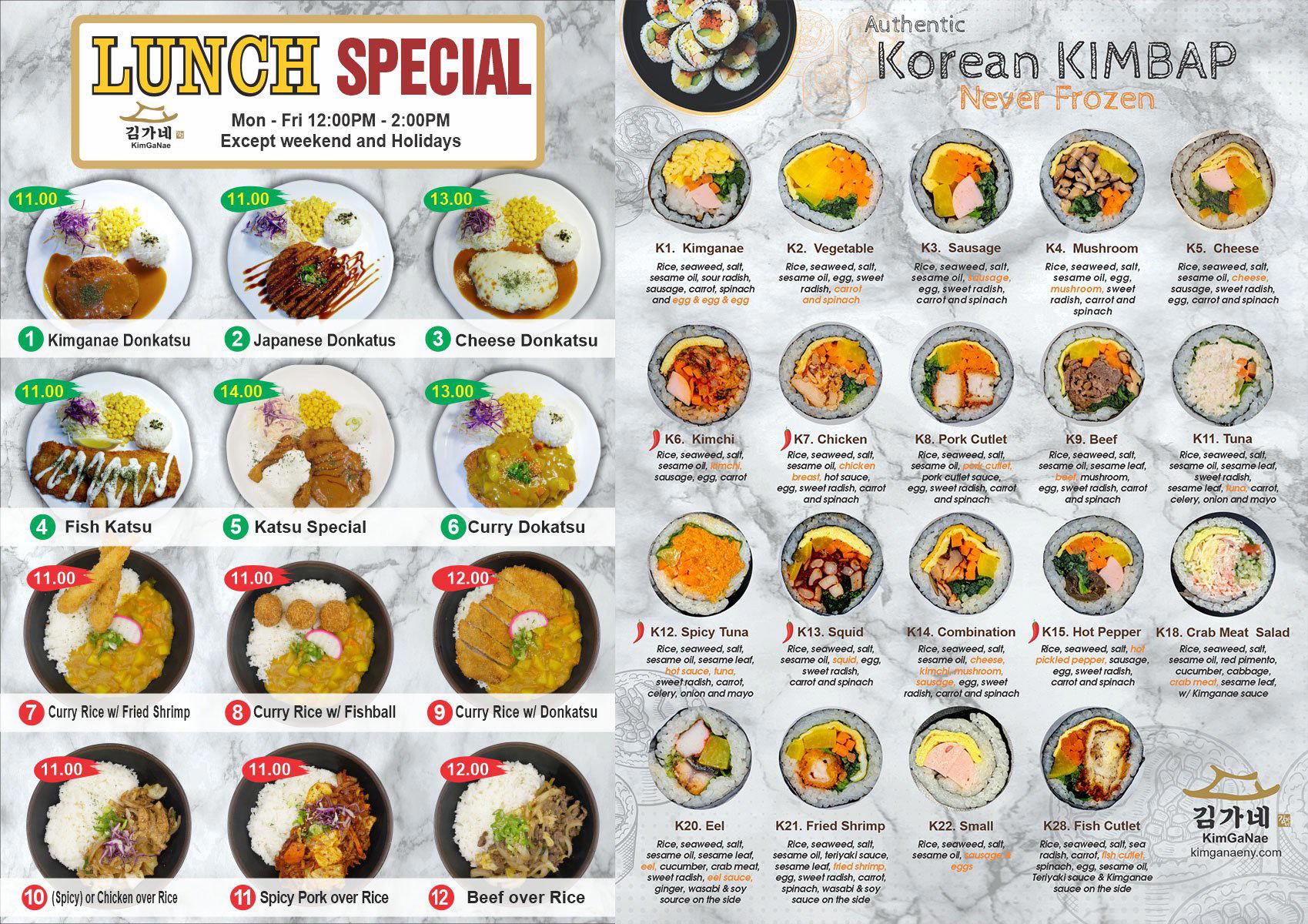
Where Flushing Sets the Standard
Arrive at 39-12 Union Street and the first thing you notice is that the block does not perform for outsiders. Flushing's Korean dining corridor operates on its own logic: signage in Hangul, lunch crowds that arrive at 11:30 and know exactly what they want, and a baseline of culinary literacy among the regulars that keeps quality accountable in ways no review platform fully captures. Kimganae sits at 39-12 Union St in Flushing and serves Korean Bunsik Comfort Food. In a neighbourhood where the competition is relentless and the customer base deeply familiar with the source material, longevity and repeat traffic are the operative trust signals.
This is a different calculus from what governs a Manhattan dining room. At Atomix in Midtown, the Korean fine-dining conversation is mediated through tasting menus, wine pairings, and an international press apparatus. In Flushing, the conversation happens between the kitchen and a clientele that grew up eating the food. Both matter. But they measure success against entirely different standards.
Korean Dining in Queens: The Broader Context
Flushing's food scene has been building for decades, accelerating through waves of immigration from Korea, China, and across Southeast Asia. By the 2010s, the stretch around Union Street and Northern Boulevard had developed into among the more densely competitive dining corridors in the five boroughs, with Korean barbecue houses, regional Chinese specialists, and Taiwanese street-food operators all drawing from the same extraordinarily demanding local audience. What's notable about the Korean segment specifically is how it mirrors, in compressed form, the diversity you'd find across Seoul's own neighbourhoods: the grilled-meat specialists operating alongside soup houses, pojangmacha-style drinking food, and more formal banquet-style dining.
For visitors who typically orient their New York dining around Le Bernardin, Eleven Madison Park, or Per Se, the shift to Flushing requires a recalibration. The signals that indicate quality here are community-embedded rather than award-committee-generated. That doesn't make them less reliable; in many cases, it makes them more so. The regulars at a Flushing Korean restaurant have a reference point that no Michelin inspector can replicate.
The Address and What It Signals
Union Street in Flushing functions as a kind of internal benchmark street within the neighbourhood's Korean food corridor. Restaurants here are not positioning for tourism; they are operating for a base of customers who will return three times a week if the food merits it, and who will not return at all if it doesn't. Kimganae's placement at 39-12 Union Street puts it within this competitive cluster, which functions as an organic quality filter. Survival in that environment is its own form of credential, operating independently of the award cycles that govern recognition at places like Masa or the farm-to-table rigor tracked at Blue Hill at Stone Barns in Tarrytown.
The contrast with Manhattan's fine-dining tier is instructive rather than hierarchical. What Single Thread Farm in Healdsburg or The French Laundry in Napa validate through agricultural sourcing narratives and wine program depth, a Flushing neighbourhood institution validates through the sustained approval of people for whom the food is not a cultural exploration but a baseline expectation.
On Beverage Programs in the Korean Dining Context
Korean dining's relationship with its own beverage culture is undergoing a quiet shift that most of the English-language food press has been slow to track. Soju remains the default, and makgeolli has built a modest following among younger diners, but the more interesting development is the increasing seriousness with which some Korean dining establishments are approaching wine. This mirrors a broader pattern visible in Seoul's restaurant scene, where sommeliers trained in France and Japan are building lists that pair deliberately with fermented, spiced, and deeply savory Korean flavors.
In Flushing specifically, the beverage conversation lags the Seoul curve, as it does in most diaspora communities where the primary loyalty is to the food rather than the drink. But the direction of travel is clear. The Korean fine-dining operators who have pushed wine programming hardest in New York have tended to operate in Manhattan, where the prix-fixe model and the clientele's existing wine literacy create the conditions for it. Community-embedded Flushing restaurants like Kimganae operate in a different register, where the beverage program, whatever its scope, serves the food rather than signals the price tier. That is not a limitation; it is a different set of priorities entirely, and one that venues like Frasca Food and Wine in Boulder or Addison in San Diego would recognize as a coherent position.
Placing Kimganae in the Wider Map
For readers building a New York itinerary that goes beyond the obvious circuit, the Flushing Korean corridor deserves the same seriousness as any destination dining strip. Flushing sits in the latter category. The comparison set for a Union Street Korean restaurant is not Smyth in Chicago or Providence in Los Angeles; it is the dozen other Korean restaurants within a five-minute walk, all drawing from the same ingredient suppliers and the same demanding audience.
That local competition is more instructive than any external benchmark. It is also why venues like Lazy Bear in San Francisco or The Inn at Little Washington are useful as contrast points rather than comparators: they operate in a world where the dining experience is curated from entry to exit, with every variable controlled. Flushing operates in a world where the food does the talking and the room makes no promises.
Planning Your Visit
Kimganae is located at 39-12 Union Street, Flushing, NY 11354, accessible by subway on the 7 train to Flushing-Main Street, a direct Queens connection from Midtown Manhattan. Current hours are Monday through Sunday, 9 AM to 9 PM, and the restaurant is walk-in friendly with a casual dress code.
| Venue | Cuisine | Price Tier | Booking Model |
|---|---|---|---|
| Kimganae (Flushing) | Korean | Not confirmed | Not confirmed |
| Atomix (Midtown) | Modern Korean | $$$$ | Advanced reservation |
| Le Bernardin (Midtown) | French, Seafood | $$$$ | Advanced reservation |
| Eleven Madison Park (Flatiron) | French, Vegan | $$$$ | Advanced reservation |
Accolades, Compared
Comparable venues nearby, for context on price, style, and recognition.
| Venue | Cuisine | Price | Notes |
|---|---|---|---|
| KimganaeThis venue — the venue you are viewing | Korean Bunsik Comfort Food | $$ | Not listed |
| Han Bat | Authentic Korean | $$ | Midtown-Times Square |
| KPOT Korean BBQ & Hot Pot | Korean BBQ & Hot Pot | $$ | Coney Island-Sea Gate |
| Soju Haus | Korean Pub | $$ | Midtown South-Flatiron-Union Square |
| Nangman BBQ | Korean BBQ | $$ | Midtown South-Flatiron-Union Square |
| Osamil | Modern Korean Gastropub | $$$ | Midtown South-Flatiron-Union Square |
Continue exploring
More in New York City
Restaurants in New York City
Browse all →
Bars in New York City
Browse all →
Hotels in New York City
Browse all →




At a Glance
- Cozy
- Casual Hangout
- Family
Current opening hours
- Monday
- 9 AM–9 PM
- Tuesday
- 9 AM–9 PM
- Wednesday
- 9 AM–9 PM
- Thursday
- 9 AM–9 PM
- Friday
- 9 AM–9 PM
- Saturday
- 9 AM–9 PM
- Sunday
- 9 AM–9 PM
Hours can change for holidays and private events. Last verified .
Warm, cozy neighborhood spot with a no-frills, casual atmosphere.