A Service Model Built Around Team Dynamics
Across the American fine-dining tier, from Le Bernardin in New York City to The French Laundry in Napa, the restaurants that hold their position over years rather than months tend to be those where the relationship between kitchen and floor is institutionally embedded rather than personality-dependent. When a chef changes, the service rhythm should absorb the transition. When a server is new, the system should carry them. This kind of institutional coordination is harder to build than a strong menu, and it is what separates restaurants with longevity from those that peak on opening buzz.
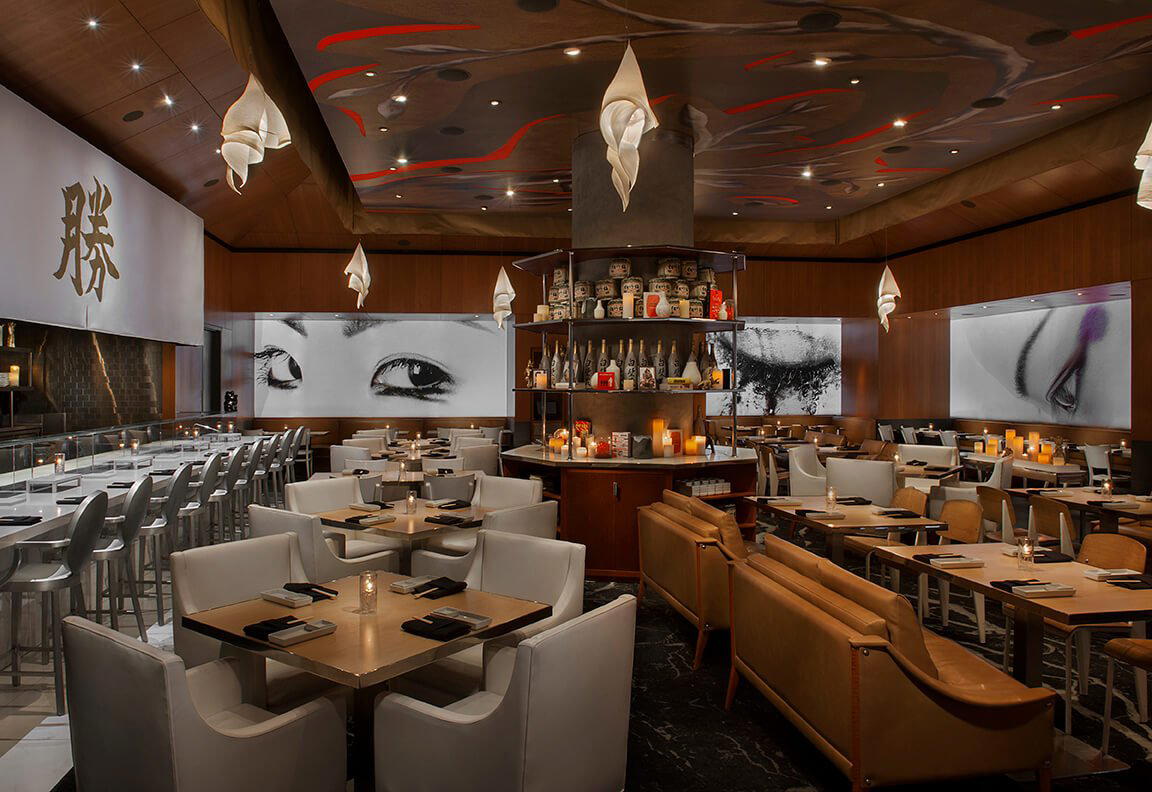
Katsuya's team dynamic fits that model. The floor staff operate with enough knowledge of the kitchen's pacing to manage a table through a longer menu without the guest feeling rushed or stalled. The bar program functions as a genuine complement to the food rather than an afterthought, which matters in Japanese restaurant contexts where the pairing of drinks, whether sake, Japanese whisky, or a considered cocktail, can either amplify or undercut the kitchen's register. In Los Angeles, restaurants operating at this coordination level include venues like Somni and Providence, both of which treat front-of-house as a programmatic element rather than a staffing necessity.
Peer operations in the city's upper Japanese tier, including those with tasting-menu formats and strict counter seating, often concentrate their excellence in the chef's hands at the cost of floor depth. Katsuya inverts that weighting somewhat: the experience is broadly accessible across the room, not reserved for a counter seat nearest the kitchen. That accessibility is a deliberate operational choice, and it shapes the kind of dining audience the restaurant has built over time.
Where Katsuya Sits in Los Angeles Japanese Dining
Los Angeles supports more distinct Japanese dining formats than almost any other American city outside New York. Omakase counters, ramen specialists, izakayas, and multi-format Japanese restaurants with broad menus coexist across the city's neighbourhoods, and the Century City-to-West Hollywood corridor has increasingly become home to the more polished, higher-ticket end of that spectrum. Hayato in the Arts District occupies one rarified tier: a strict kaiseki format with limited seats and a months-long wait. Katsuya operates in a more accessible register without sacrificing the operational seriousness that keeps it relevant in a competitive field.
For comparison, the broader Los Angeles restaurant field at the high-coordination end includes Osteria Mozza in Hollywood, where Italian-American hospitality has been institutionalised over years of consistent execution, and Kato in the Arts District, where New Taiwanese cuisine operates at a tasting-menu format with a small, tightly managed team. Nationally, venues operating with similar team-coordination philosophies include Single Thread Farm in Healdsburg, Blue Hill at Stone Barns in Tarrytown, and Addison in San Diego, all of which treat the relationship between kitchen, sommelier or bar program, and floor as a single integrated system.
Katsuya's position in this company is as a West Los Angeles anchor for Japanese dining that doesn't require the diner to adopt a specialist format, no counter-only booking, no fixed tasting menu obligation, while still delivering an experience that coheres as a whole rather than arriving in disconnected parts. That is a harder thing to sustain than it appears.
The Editorial View
Los Angeles restaurants that survive more than a decade in a high-traffic location do so because their regulars trust them across multiple visit types: a business dinner, a celebration meal, a spontaneous weeknight booking. Katsuya has built that kind of trust in Century City, and the team coordination model is the mechanism through which it does so. The room doesn't overreach. The service doesn't perform. The kitchen and floor share a common tempo, and that tempo is legible to the diner from the first exchange with the host.
For those building a broader sense of the American fine-dining field, useful reference points include Lazy Bear in San Francisco, Alinea in Chicago, Bacchanalia in Atlanta, The Inn at Little Washington, and Atomix in New York City. Beyond the US, 8 1/2 Otto e Mezzo Bombana in Hong Kong offers a useful comparison in terms of how a restaurant maintains institutional identity across a long operational life. Emeril's in New Orleans demonstrates a different model of longevity in a specific American dining city. The full picture of what makes Los Angeles its own distinct dining city, with its Japanese influence, its produce access, and its format pluralism, is mapped in our full Los Angeles restaurants guide.
Know Before You Go
Planning Notes
- Address: 10268 Santa Monica Blvd, Los Angeles, CA 90067
- Neighbourhood: Century City, West Los Angeles
- Booking: Reservations are advisable for evening seatings, particularly Thursday through Saturday. Walk-in availability is more likely at the bar.
- Timing: Weekday lunch hours typically offer more room flexibility than weekend dinner service.
- Parking: Century City has structured parking adjacent to the Santa Monica Boulevard retail and restaurant corridor; street parking is limited.
- Dress: Smart casual is the operative standard for the room; the crowd skews business-adjacent without requiring formal attire.