
Tokyo’s curry culture is often read through speed, price and personal routine rather than luxury signals. kalala belongs to that everyday specialist tier: a Shinjuku Gyoemmae curry-and-cafe counter with 16 seats, cash-only payment, Tabelog Curry TOKYO 100 selections in 2023 and 2024, and a lunch-and-dinner budget listed at JPY 1,000–1,999.
Pearl is the En Primeur Club membership app — saves, bookings, and concierge access live there. Same editors, same standards.
- Address
- 東京都新宿区富久町16-14 シティフラット富久町 102
- Phone
- +81333414181
- Website
- tabelog.com
 Saves & bookings on Pearl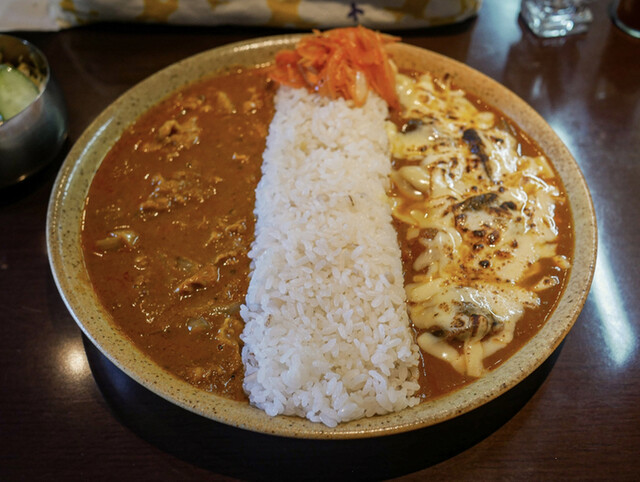
Approaching Tokyo’s smaller curry rooms, the city changes scale. Department-store dining floors and station complexes give way to narrow shopfronts, counter seats, hand-written rhythms and the low-friction choreography of lunch service. This is where curry in Tokyo becomes less about spectacle than repeatability: a compact room, a short service window, a plate built for regulars, and a price band that keeps the category connected to daily life rather than occasion dining.
kalala sits inside that tradition. The format is curry and cafe, not tasting-menu theatre, and its recognition matters because Tabelog’s Curry TOKYO 100 list tends to reward specialist consistency in a city where curry ranges from student staples to chef-led spice kitchens. Selection in both 2023 and 2024 places it in a competitive urban category where durability counts. The opening date, 1993, adds another signal: this is not a recent concept riding Tokyo’s spice-curry wave, but part of the older layer of neighborhood curry culture that predates the current appetite for mapped, ranked food itineraries.
Tokyo curry at counter scale, not luxury scale
Tokyo curry is often misunderstood by visitors who expect either Indian restaurant orthodoxy or Japanese curry-rice nostalgia. The city’s stronger curry addresses usually work between those poles: spice-led but not doctrinaire, personal but not necessarily chef-branded, practical but capable of deep loyalty. That middle zone explains why a low-price, small-seat-count restaurant can carry serious dining value. In Tokyo, a 16-seat counter can say more about a genre than a high-budget room, because the cooking has nowhere to hide behind ceremony.
The room structure reinforces the point. Eleven kitchen-counter seats and five window-counter seats put the meal in close quarters, with the service model closer to a focused lunch counter than a lingering restaurant. That format also aligns with a quieter form of environmental discipline common to compact Japanese dining: limited seating, controlled production, concise purchasing and minimal table infrastructure. Sustainability here should not be inflated into a manifesto. The credible reading is more practical. Small rooms with narrow menus and predictable demand can reduce excess because they are built around repetition rather than breadth.
That matters in curry. A genre built on simmering, spice balance and batch discipline rewards kitchens that know their daily cadence. The restaurant’s take-out service extends the format without turning it into a delivery-first operation, while the no-smoking policy reflects the modern baseline for small dining rooms where aroma and turnover both matter. Shochu and wine are listed, but the intellectual center remains the curry-cafe identity rather than a drinks program.
Shinjuku Gyoemmae's quieter food logic
Shinjuku is often flattened into neon, rail traffic and late-night density, but Shinjuku Gyoemmae works differently. Around the garden and the side streets beyond the station, the dining character is more residential, more lunch-driven, and less dependent on destination glamour. That setting suits curry. The genre has enough range to attract food-focused travelers, but enough everyday utility to survive on local repetition.
Compared with Tokyo venues in broader mid-priced and dinner-led categories, the value proposition here is sharply different. CHEF’S and TAIZEN occupy higher dinner brackets while retaining lower lunch budgets; Shokudo Wata sits in an izakaya frame. Curry at kalala asks a narrower question: how much character can a small specialist format deliver inside an everyday spend? The answer is not about luxury substitution. It is about choosing a category where precision, speed and familiarity carry their own authority.
The relocation note also gives useful historical texture. Moving from Fuji Building in Shinjuku in October 2006 places the restaurant’s current chapter within a longer local timeline, rather than the churn of openings built for social-media discovery. Tokyo rewards that kind of continuity. Many of the city’s serious casual addresses become meaningful because they keep solving the same small problem for years: feed a defined audience well, at a scale the kitchen can control.
How to read the meal in Tokyo's wider dining map
The sharper way to use kalala is as a counterpoint to Tokyo’s reservation-heavy dining culture. Sushi counters, kappo rooms and ambitious yakitori restaurants often require planning and budget separation; curry specialists can deliver a more democratic kind of assessment. The signals are different: seat count, queue tolerance, payment expectations, service rhythm and whether the cooking has enough focus to justify crossing neighborhood lines.
For a wider Tokyo frame, compare curry with other casual and specialist formats across Our full Tokyo restaurants guide, then place it against the city’s hospitality, drinking and culture layers through Our full Tokyo hotels guide, Our full Tokyo bars guide, Our full Tokyo wineries guide and Our full Tokyo experiences guide. Nearby and adjacent food references include 12/10 Shinjuku ten, 2D Cafe, 3 Chome no Curry Ya San, 124. KAGURAZAKA (Yakitori) and. 鮪と炭火焼き うお炭 秋葉原店. For a broader Japan-and-beyond comparison set, see -Grilled beef Sukiyaki- KAMAKURA TANUKIAN 鎌倉 たぬき庵 in Kamakura.cafe in Osaka.know in Kumamoto, (Shoku) Vietnam in Kawasaki, [Curry Senmon Ten] Maruyama Kyoju. in Sapporo, [ki:] in Kyoto, Jōdo Saké Bar in Los Angeles and Onigiri Time in Pasadena.
The editorial case is clear: this is a small Tokyo curry address with enough longevity and third-party recognition to merit attention, but its value lies in category literacy rather than grandeur. Read it as part of the city’s low-waste, counter-driven food culture, where tight formats, modest spend and repeat customers can produce a more honest meal than many louder rooms.
Peers in This Market
Comparable venues for cuisine and category context.
| Venue | Cuisine | Price | Notes |
|---|---|---|---|
| kalalaThis venue — the venue you are viewing | Japanese-style curry & cafe | $ | Not listed |
| Kanda Coffee | Traditional Japanese coffee shop (kissaten) | $ | Chiyoda |
| PANCH MAHAL | Curry & Soup Curry Shop | $ | Chiyoda |
| Ore no Bakery Ebisu | Bakery & café with Italian terrace | $ | Shibuya |
| BEAVER BREAD | Bakery | $ | Chūō |
| BOULANGERIE KEN | Artisan Bakery & Sandwiches | $ | Itabashi |
Recognition history
Dated appearances from independent guides and award organizations, with the underlying list record or original source where available.
Tabelog 100 #98 · No. 98
Tabelog · Tabelog 100 - Curry - TOKYO - 2024












At a Glance
- Cozy
- Quiet
- Solo
- Casual Hangout
- After Work
- Standalone
A small, relaxed hideout-style curry counter with just 16 non-smoking seats, simple interiors, and a calm, low-key atmosphere suited to solo diners or friends looking for a quiet lunch.