Huong Binh
Our verdict
On South Jackson Street in Seattle's International District, Huong Binh operates as a community-anchored Vietnamese restaurant whose menu spans northern, central, and southern regional traditions, a breadth that separates it from mainstream-facing Vietnamese spots. This is neighborhood dining at its most specific: no design ambitions, no press apparatus, and a kitchen that knows the difference between Hue and Saigon on a plate.

Pearl is the En Primeur Club membership app, where members save venues, book tables and use the concierge.
The menu
What to order
- Banh Hoi Thit Nuong
- Bun Bo Hue
South Jackson Street and the Vietnamese Corridor That Anchors It
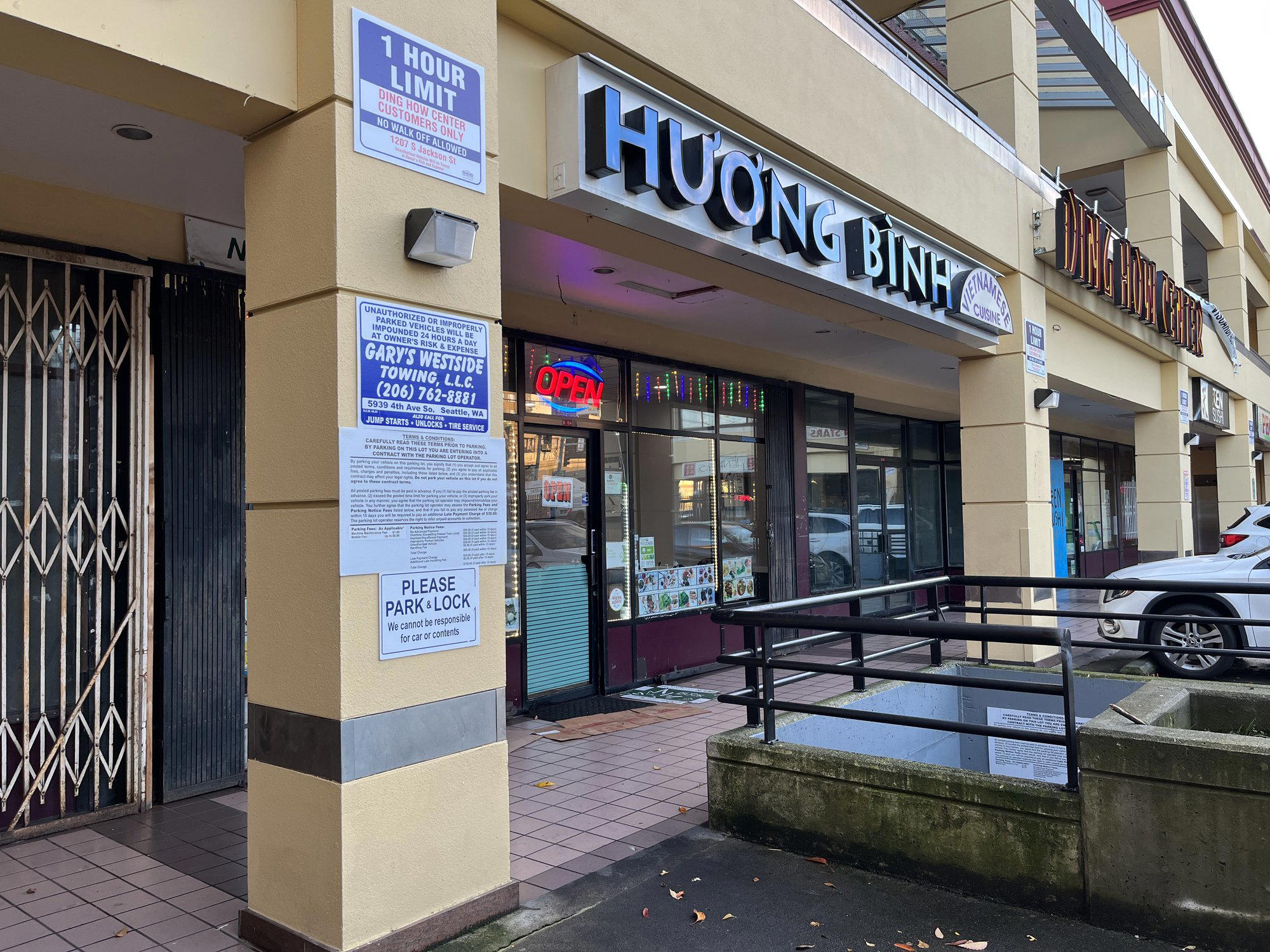
The stretch of South Jackson Street running through Seattle's International District carries a particular kind of weight. This is not a neighborhood assembled for food tourism, it is a working, multigenerational community where restaurants survive because locals return, not because algorithms recommend them. Huong Binh, at 1207 S Jackson St, sits inside that fabric. The address is a suite in a modest commercial block, the signage is functional rather than designed, and the dining room makes no gestures toward the aesthetic expectations that have come to define much of Seattle's contemporary restaurant culture. What it offers instead is a menu built on the logic of Vietnamese home cooking: broad, specific, and organized around what different regions of the country actually eat.
How the Menu Is Built, and What That Reveals
Vietnamese restaurant menus in the United States tend to compress a diverse national cuisine into a narrow band of recognizable dishes: pho, banh mi, spring rolls, maybe a bun bowl or two. That compression reflects what sells in markets where the cuisine is not yet widely understood. The menus at restaurants embedded in Vietnamese-American communities read differently. They are wider, more internally specific, and they often carry dishes that have no English-language shorthand because they have never needed one outside the community.
Huong Binh's menu follows that second model. The range covers northern, central, and southern Vietnamese preparations, which is itself an editorial statement: a kitchen that distinguishes between regional traditions is one where the cooking is not being flattened for convenience. Central Vietnamese food, rooted in Hue, tends toward more complex spice profiles and smaller-portioned dishes. Southern Vietnamese cooking runs sweeter, with broader use of fresh herbs and more pronounced herb-plate accompaniments. A menu that holds both without collapsing them into a single house style signals a coherent culinary position, the kitchen knows what it is doing and why.
In Seattle's Vietnamese dining scene, that specificity places Huong Binh in a different competitive tier than restaurants aiming at broader accessibility. Ba Bar, for instance, operates with a polished format and a menu calibrated for a mixed audience. Huong Binh does not operate on that axis. It functions closer to the specialist end of the spectrum, where the menu's internal logic matters more than its surface legibility to first-time visitors.
The International District Context
Understanding Huong Binh requires understanding the International District's role in Seattle's dining geography. While much of the city's restaurant conversation centers on Capitol Hill, South Lake Union, and Ballard, the International District has maintained a parallel food culture that operates largely outside that conversation. The neighborhood's Vietnamese, Chinese, Cambodian, and Japanese restaurants serve communities first and draw destination diners secondarily, a reversal of the priority structure at most places covered in mainstream Seattle food media.
This is not an oversight by critics so much as a structural feature of how food coverage works: restaurants that do not seek press rarely receive it. For a visitor oriented around the broader Seattle dining scene, Canlis for special-occasion New American, Joule for New Asian precision, 1415 1st Ave for whatever is currently generating attention downtown, the International District represents a genuinely different register of eating. The food is not lesser for its absence from those conversations; it is often more consistent, because it is not performing for external audiences.
Seattle's position on the Pacific Rim has historically given its Vietnamese community access to ingredients and supply chains that support cooking at a level of authenticity that matters to Vietnamese diners. That context is relevant here: the community institutions along South Jackson Street have had decades to build those supply relationships, and they show in the specificity of what arrives on the table.
Where Huong Binh Sits in the Category
Comparing Huong Binh to the tier occupied by award-recognized American restaurants, the Le Bernardin or Alinea end of the spectrum, or even the West Coast's own The French Laundry, Providence, Lazy Bear, or Single Thread Farm, would misread what makes it worth attention. Huong Binh belongs to the category of essential community restaurant, a type that formal award systems are structurally poor at recognizing. The James Beard Foundation has made efforts to address this with its America's Classics awards, and that category exists precisely because the dominant credentialing systems were missing an entire tier of important restaurants. The Vietnamese diaspora restaurants of the International District, Huong Binh among them, sit squarely in that overlooked tier.
For readers whose reference points run through Blue Hill at Stone Barns, Atomix, or Addison: those restaurants are making arguments about food through format, sourcing philosophy, and tasting-menu architecture. Huong Binh is making a different kind of argument, one about continuity, community, and the regional specificity of Vietnamese cuisine in a city that has a large enough Vietnamese population to support that specificity. Both arguments are legitimate. They are simply aimed at different readers.
Planning Your Visit
Huong Binh is located at 1207 S Jackson St, Suite 104, in Seattle's International District, accessible from downtown Seattle by the First Hill Streetcar (stop at 12th and Jackson) or by a short drive south from Capitol Hill. The suite-within-a-building address means first-time visitors should look for the building entrance rather than a street-front restaurant facade. Parking along South Jackson is available, and the area is walkable from several nearby transit stops. As with most community-anchored restaurants in the neighborhood, walk-in dining is the norm, reservation infrastructure is typically minimal or absent at this category of restaurant, and weekday lunches tend to offer easier seating than weekend midday service, which draws larger family groups. Pricing at restaurants of this type in the International District runs well below the averages at Seattle's destination-dining tier; this is a neighborhood lunch and dinner spot where a full meal typically costs a fraction of what comparable time at a tasting-menu counter would require. For a broader map of where Huong Binh fits among Seattle's restaurants, see our full Seattle restaurants guide, which also covers options along 1744 NW Market St and other neighborhood corridors.
Frequently asked questions
What should I order at Huong Binh?
Can I walk in to Huong Binh?
Is Huong Binh a good choice for someone exploring Seattle's Vietnamese food scene beyond pho and banh mi?
Cuisine and Awards Snapshot
Comparable venues nearby, for context on price, style, and recognition.
| Venue | Cuisine | Price | Notes |
|---|---|---|---|
| Huong BinhThis venue (the venue you are viewing) | Authentic Central Vietnamese | $10–20 | Not listed |
| Pho Than Brothers | Authentic Vietnamese Pho | $10–20 | Broadway |
| Lan Hue | Vietnamese Banh Mi Sandwiches | Not listed | Chinatown-International District |
| Little Ting's Dumplings | Authentic Northern Chinese Dumplings | $10–20 | Broadview |
| Marination Station | Hawaiian-Korean Fusion | Not listed | First Hill |
| Bamboo Garden Vegetarian Cuisine | Vegetarian Chinese | Not listed | Lower Queen Anne |
Continue exploring
More in Seattle
Restaurants in Seattle
All restaurants in Seattle →
Bars in Seattle
All bars in Seattle →
Details
- Cozy
- Casual Hangout
- Family
- A La Carte
- Vegetarian Friendly
Current opening hours
- Monday
- 8 AM–8 PM
- Tuesday
- 8 AM–8 PM
- Wednesday
- 8 AM–8 PM
- Thursday
- 8 AM–8 PM
- Friday
- 8 AM–8 PM
- Saturday
- 8 AM–8 PM
- Sunday
- 8 AM–8 PM
Hours can change for holidays and private events. Hours as of .
Welcoming casual atmosphere with focus on authentic home-style Vietnamese flavors.