Few beer halls in Europe carry the institutional weight of Hofbräuhaus München. Planted at Platzl 9 in Munich's Altstadt since the sixteenth century, it operates at a scale that most hospitality venues cannot approach: thousands of seats across multiple floors and a courtyard, drawing locals, tourists, and Oktoberfest veterans alike. The Bavarian staples here are the point, not a backdrop for something else.
Pearl is the En Primeur Club membership app — saves, bookings, and concierge access live there. Same editors, same standards.
- Address
- Platzl 9, 80331 München, Germany
- Phone
- +49 89 290136100
- Website
- hofbraeuhaus.de
- Directions
- Get directions
 Saves & bookings on Pearl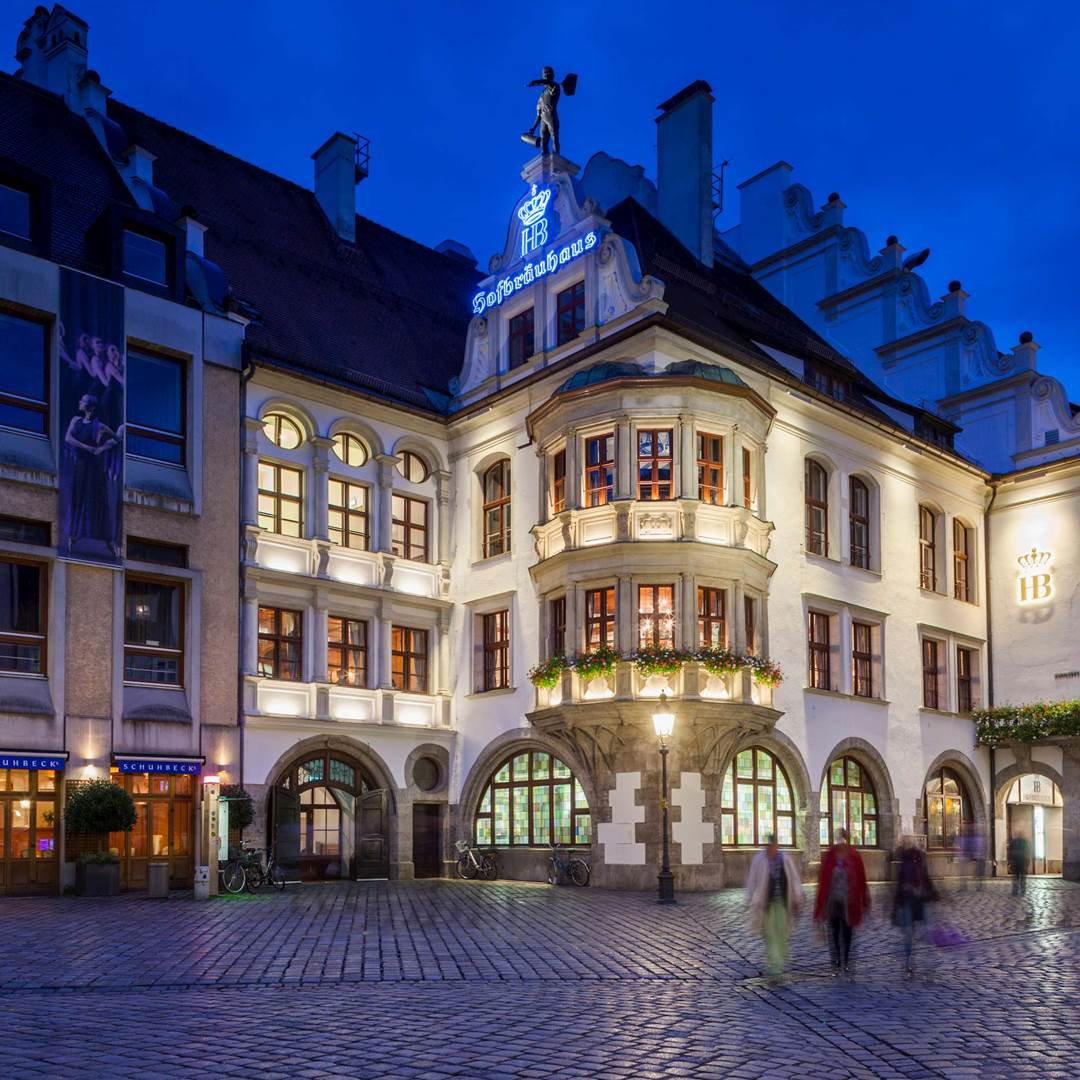
A Hall Built on Scale, Tradition, and the Logic of Volume
The approach to Platzl 9 gives you the measure of what you're dealing with before you've crossed the threshold. The street narrows, the sound of a brass band reaches you from inside, and the crowds at the entrance suggest something closer to a public institution than a restaurant. Hofbräuhaus München operates at a scale that most hospitality venues cannot replicate: multiple halls, a vaulted ground floor, an upper dining room, and a courtyard that fills on warmer evenings. The building has been part of Munich's civic fabric since the late sixteenth century. What stands today is the product of centuries of reconstruction, but the social function has remained consistent: a place where people of different stations sit at communal tables, order from a short, repeated menu, and drink from one-litre ceramic steins.
In the broader context of German beer hall culture, Hofbräuhaus sits at the extreme end of the capacity spectrum. Venues like this one developed their formats long before modern hospitality categories existed, they predate the restaurant as we understand it, and their operating logic reflects that. The food exists to sustain the drinking; the drinking exists inside a social ritual shaped by proximity and noise. That context matters when you're deciding how to place this kind of venue against Munich's contemporary dining options.
Bavarian Food as Document, Not Performance
The editorial angle that applies to a place like this is not sustainability in the reductive sense of composting or carbon offsets. It is, rather, the sustainability of a culinary tradition: the capacity of a regional food culture to persist without reinvention. Munich's fine-dining tier has moved decisively toward internationalism and technique. Tantris anchors the modern French side of the city's serious restaurant scene, while Tohru in der Schreiberei represents the German-Japanese fusion that has become a recognisable strand of contemporary German cooking. Alois - Dallmayr Fine Dining and Atelier both operate in the creative, tasting-menu format that defines the city's Michelin tier. Against that backdrop, a hall that still builds its menu around pretzels, roast pork knuckle, white sausage, and Obatzda, a Bavarian cheese spread that has appeared on this type of menu for generations, is not failing to modernise. It is serving a different function entirely.
The Weisswurst tradition in particular illustrates how deeply rooted Bavarian food culture can be. The pale veal sausage, traditionally eaten before noon and always peeled before eating, is the kind of dish that carries a set of customs so specific they amount to a local etiquette. Ordering it here is not a nostalgic act; it is participation in a practice that Bavaria has transmitted with unusual fidelity compared to other European regional cuisines. Where French brasserie food has been largely reinterpreted and Italian regional cooking has globalised, Bavarian beer hall food has stayed legible to its own terms.
Germany's broader dining circuit, which includes Schwarzwaldstube in Baiersbronn, Aqua in Wolfsburg, and Vendôme in Bergisch Gladbach, has built international recognition around technical ambition and local sourcing. Venues like CODA Dessert Dining in Berlin and Victor's Fine Dining by Christian Bau occupy a different tier of intention entirely. But Hofbräuhaus has never competed in that category, and understanding that distinction is what allows you to use it correctly as a traveller.
The Question of Authenticity at Scale
The word authenticity gets misapplied here almost constantly. Critics who dismiss Hofbräuhaus as a tourist trap are, in most cases, describing its visitor demographics rather than its food or format. The Bavarian state has owned the Hofbräuhaus brand since its origins as a royal brewery, and the recipes and service format have been maintained under a governance structure that doesn't answer to the kind of market pressure that typically erodes culinary specificity. That is, paradoxically, an argument for the place's consistency rather than against it. Other large-scale beer halls have either closed or reinvented themselves around craft beer concepts and contemporary menus; this one has not. For a site of this age and scale, that degree of continuity is a verifiable fact, not a marketing position.
Contrast this with the model represented by newer German destination restaurants such as ES:SENZ in Grassau, Schanz in Piesport, or Waldhotel Sonnora in Dreis, where the dining format is deliberate, controlled, and built around a specific chef vision. Munich's own creative tier, including JAN, operates by a completely different set of values. Hofbräuhaus doesn't intersect with any of those reference points. It belongs to a category that predates the chef-driven restaurant model by at least three centuries.
Placing It in Your Munich Planning
From a practical standpoint, Hofbräuhaus accepts walk-in visitors throughout the day, with peak occupation during early evening and during the Oktoberfest period in late September and early October, when the adjacent festival grounds shift the city's entire hospitality logic. Outside those windows, daytime visits, particularly midweek mornings or early lunches, offer the hall at something closer to a working rhythm. The address at Platzl 9 sits in the Altstadt, within easy walking distance of Marienplatz and the major central museums.
For context on what else Munich's restaurant scene offers, the full Munich restaurants guide maps the city's coverage from beer hall through to Michelin-starred tasting counters. Those looking for comparison points further afield might consider Restaurant Haerlin in Hamburg or Bagatelle in Trier for German fine dining reference, or international benchmarks such as Le Bernardin in New York City and Lazy Bear in San Francisco for premium experiential formats that represent a different set of dining priorities.
A Lean Comparison
Comparable venues nearby, for context on price, style, and recognition.
| Venue | Cuisine | Price | Notes |
|---|---|---|---|
| Hofbräuhaus MünchenThis venue — the venue you are viewing | Altstadt, Traditional Bavarian Beer Hall | $$ | Not listed |
| Zur Festwiese | Not listed | $$ | Theresienwiese, Traditional Bavarian Gasthaus |
| Augustiner Gutshof Menterschwaige | Not listed | $$ | Prinz Ludwigshoehe, Traditional Bavarian Gasthausbrauerei |
| Restaurant Central Café | Theresienwiese, Traditional Bavarian | $$ | Not listed |
| Giesinger Bräustüberl | Au, Bavarian Brewery | $$ | Not listed |
| Café Ludwig | Milbertshofen, German Café | $$ | Not listed |
At a Glance
- Lively
- Well Known
- Rustic
- Energetic
- Group Dining
- Celebration
- Casual Hangout
- Live Music
- Historic Building
- Terrace
- Beer Program
- Local Sourcing
Current opening hours
- Monday
- 11 AM–12 AM
- Tuesday
- 11 AM–12 AM
- Wednesday
- 11 AM–12 AM
- Thursday
- 11 AM–12 AM
- Friday
- 11 AM–12 AM
- Saturday
- 11 AM–12 AM
- Sunday
- 11 AM–12 AM
Hours can change for holidays and private events. Last verified .
Festive and boisterous with live folk music, communal long tables, and a warm, traditional beer hall glow from wooden interiors.