Grotta Palazzese
Our verdict
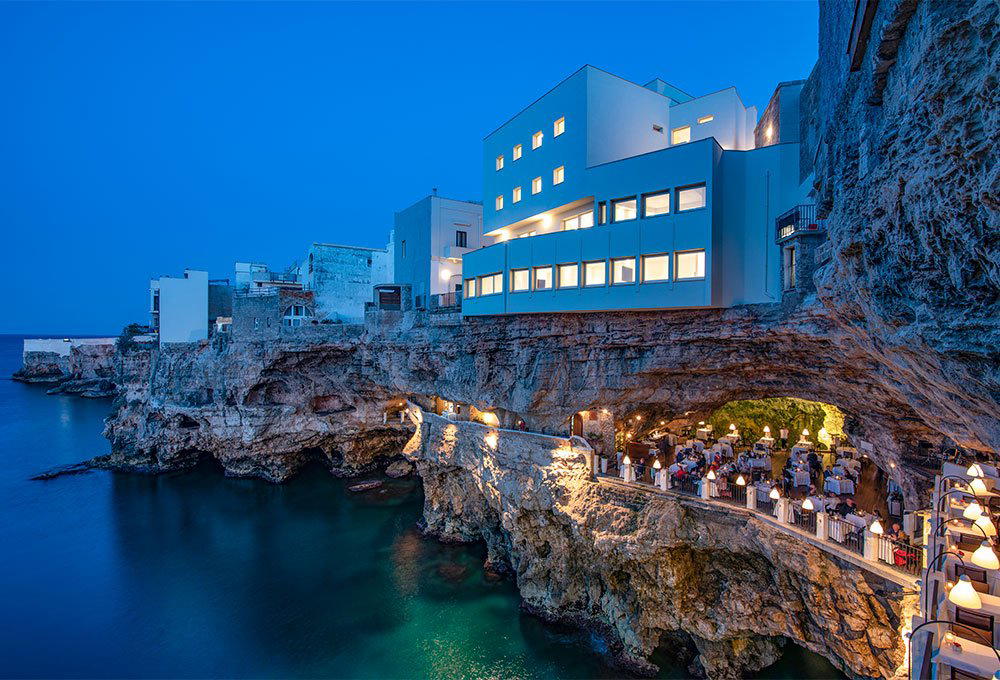
Grotta Palazzese occupies a sea cave carved into the limestone cliffs above the Adriatic at Polignano a Mare, a setting that has drawn diners since the eighteenth century. The restaurant sits on a natural terrace open to the water, placing it in a category of coastal dining where the physical context is inseparable from the plate. For the Puglia region, it represents the most internationally visible expression of cliff-side dining on the southern Adriatic coast.

Pearl is the En Primeur Club membership app, where members save venues, book tables and use the concierge.
The menu
What to order
- Scallops with guacamole and macadamia nuts
- Cacio e pepe ravioli with prawns and caviar
- Sea bass with turnip tops
- Fassona beef
- Espresso martini tiramisu
Where the Cliff Meets the Table: Dining on the Adriatic at Polignano a Mare
The approach to Grotta Palazzese sets the terms before you reach your seat. The old town of Polignano a Mare sits on a limestone promontory above the Adriatic, its streets narrowing toward the cliff edge where the sea has carved a series of caves and grottos into the rock over millennia. This is the geological fact that defines both the town and the restaurant: the cave itself is a natural formation, and the dining terrace occupies a ledge within it, open on one side to the open sea. At night, with the rock illuminated and the Adriatic audible below, the physical experience registers before any food arrives. That setting has made it one of the most photographed dining rooms in southern Italy, a distinction that shapes expectations in both directions.
Polignano sits in the heart of the Itria Valley coastline, roughly midway between Bari and Brindisi, in a stretch of Puglia where the agricultural interior transitions abruptly to cliffs and coves. The town itself is compact, and the restaurant is at Via Narciso, 59, at the cliff edge. Arriving by car from Bari takes approximately forty minutes; the local train line stops at Polignano a Mare station, a short walk from the old town. For travellers positioning Grotta Palazzese within a wider Puglia itinerary, the timing matters: summer months concentrate both demand and the full visual impact of the cave setting, but they also concentrate crowds in the town itself. The shoulder seasons, late spring and early autumn, offer a cleaner version of the same experience without the peak-season pressure on the surrounding streets.
The Adriatic Larder: What Puglia's Southern Coast Puts on the Plate
The ingredient logic of this stretch of the Adriatic coast has a clear internal structure. Puglia is one of Italy's most productive agricultural regions, the country's leading source of olive oil, a significant producer of durum wheat, and a coastline that supplies sea urchin, octopus, cuttlefish, clams, and the day-catch varieties that define southern Italian seafood cooking. At Grotta Palazzese, the sourcing context is the same as the broader coastal tradition: proximity to the water is not decorative but functional, because the Adriatic shelf here produces fish and shellfish that travel minutes rather than hours to the kitchen.
That sourcing geography places Grotta Palazzese in a category of Italian coastal restaurants where the setting and the supply chain reinforce each other. Italy's most discussed seafood-focused fine dining rooms, Uliassi in Senigallia on the northern Adriatic, Quattro Passi in Marina del Cantone on the Amalfi coast, share this structural logic: the kitchen's credibility is built on the relationship between location and ingredient. The distinction at Polignano is the Pugliese inflection: olive oil from the centuries-old cultivars of the Valle d'Itria, local orecchiette traditions, and the bolder salinity of the southern Adriatic's shellfish compared to the milder northern varieties. The regional specificity matters because it is what separates this table from a generically scenic coastal restaurant.
For Italian fine dining more broadly, the sourcing argument has become central to how serious kitchens position themselves. Operations like Atelier Moessmer Norbert Niederkofler in Brunico have made hyper-local alpine sourcing an explicit philosophical and gastronomic framework. At Dal Pescatore in Runate, a Lombard-Po valley larder defines the menu's character across generations. The southern Italian coastal version of this argument is less codified but no less genuine: the Adriatic dictates what is served, and the season dictates when.
Positioning in the Italian Fine Dining Tier
Italy's highest-recognition fine dining addresses, Osteria Francescana in Modena, Le Calandre in Rubano, Enoteca Pinchiorri in Florence, Piazza Duomo in Alba, Enrico Bartolini in Milan, operate in a tier defined by sustained critical recognition and technical ambition. Da Vittorio in Brusaporto, Casa Perbellini 12 Apostoli in Verona, and Reale in Castel di Sangro each hold strong positions within that critical architecture. Grotta Palazzese occupies a different and somewhat distinct space: its international recognition derives primarily from its physical setting rather than from a competition-facing culinary program. That is not a diminishment, it is an accurate description of what category of dining it represents.
Within Polignano itself, the restaurant exists alongside a smaller cohort of modern addresses. Jamantè operates in the modern cuisine register at the €€€ tier; Meraviglioso Osteria Moderna takes a contemporary approach at a similar price point; Casanova completes the local options for travellers building a multi-meal itinerary in the town. Grotta Palazzese sits above this local tier in terms of international profile and price positioning, and the comparison is instructive: it shows that the setting carries a premium that the others, which compete more directly on food execution, do not command. For reference points on coastal seafood dining at the upper end of the international spectrum, Le Bernardin in New York City and Atomix in New York City represent what technical ambition at that price tier looks like in a very different cultural context.
The honest framing for Grotta Palazzese is this: it is a restaurant where the setting is the primary event and the kitchen's role is to deliver food that is worthy of the surroundings rather than food that would justify the price on its own merits in a neutral room. Visitors who understand that distinction tend to leave satisfied; those expecting a technically ambitious tasting menu in the mould of northern Italy's leading addresses may find the gap between expectation and reality significant.
Planning the Visit
Grotta Palazzese is a seasonal operation that runs through the warmer months; the cave terrace is not a practical winter venue given its exposure to the sea. Demand during high season is predictable and sustained by the restaurant's global social media profile, which means reservations require advance planning, weeks rather than days for summer dates. The address at Via Narciso, 59 is at the old town's cliff edge, and the approach on foot through Polignano's centro storico is itself part of the experience. For travellers building a broader Puglia itinerary, our full Polignano a Mare restaurants guide covers the town's dining options in full context. Dress code expectations at this type of cliff-terrace setting in southern Italy typically run toward smart casual at minimum; the setting is formal enough to make effort appropriate.
Frequently asked questions
Is Grotta Palazzese child-friendly?
The cliff-edge terrace at Grotta Palazzese sits directly above open Adriatic water, which creates obvious practical concerns for young children. At Polignano a Mare's premium price tier, the format and setting are oriented toward adults. Families with older children who can manage a formal dining pace and an exposed terrace edge will find it manageable, but it is not a setup designed around younger guests.
What should I expect atmosphere-wise at Grotta Palazzese?
The setting does most of the work: a natural limestone cave carved into the promontory at Polignano a Mare, open to the Adriatic on one side, with the sea visible and audible throughout the meal. This is not a technically austere tasting-menu environment in the northern Italian mode. The atmosphere is theatrical by geology rather than design, and the dining room fills with international visitors who have come specifically for that spectacle.
Is Grotta Palazzese open year-round, or only during summer?
Grotta Palazzese operates as a seasonal venue, with the cave terrace exposed directly to the Adriatic making winter service impractical. Operations run through the warmer months, typically spring through early autumn, though exact dates vary by year. If your travel window falls outside peak summer, confirm current opening dates directly before booking, the season's start and close can shift depending on conditions.
What do regulars order at Grotta Palazzese?
What the Pugliese coastal kitchen reliably delivers in this latitude is sea urchin, local orecchiette preparations, raw fish from the Adriatic, and lamb from the inland plateau. Those are the reference points of the regional larder that any serious kitchen in Polignano a Mare works from.
Where is Grotta Palazzese located?
Grotta Palazzese is located at Via Narciso, 59, 70044 Polignano a Mare BA, Italy, Polignano a Mare.
What's the best way to book Grotta Palazzese?
Book directly with the restaurant and plan well ahead, Polignano a Mare is a small town, and Grotta Palazzese draws international demand across its seasonal window. Summer tables, particularly weekend evenings in July and August, require lead times measured in months rather than weeks. Contact via the restaurant's official channels and confirm the seasonal opening dates before committing travel plans around a specific date.
Comparison Snapshot
| Venue | Cuisine | Price | Awards | Notes |
|---|---|---|---|---|
| Grotta PalazzeseThis venue (the venue you are viewing) | Upscale Italian Seafood | $200–300 | Not listed | Not listed |
| Jamantè | Modern Puglian Seafood | $50–100 | Michelin Plate | Modern Cuisine |
| Meraviglioso Osteria Moderna | Modern Italian Seafood Osteria | $50–100 | Michelin Plate | Contemporary |
| Casanova | Modern Italian Fine Dining | $200–300 | Michelin Plate | Not listed |
Continue exploring
More in Polignano a Mare
Restaurants in Polignano a Mare
All restaurants in Polignano a Mare →
Bars in Polignano a Mare
All bars in Polignano a Mare →


Details
- Romantic
- Scenic
- Well Known
- Elegant
- Sophisticated
- Date Night
- Special Occasion
- Celebration
- Business Dinner
- Waterfront
- Panoramic View
- Terrace
- Historic Building
- Hotel Restaurant
- Extensive Wine List
- Local Sourcing
- Sustainable Seafood
- Waterfront
- Set Menu
- A La Carte
- Wine
- Vegan Options
- Pescatarian Friendly
Elegant and romantic, with dramatic cave surroundings, sea views, and a sheltered open-air terrace suspended between cliff and water.