Bar Library sits in Ostuni’s library area rather than on a coastal promenade, which places it in the quieter, town-centred side of Puglian drinking culture. With, the useful read is contextual: treat it as an Ostuni bar to assess by format, bartender confidence, and how well the drinks hold their own before or after dinner in the white city.

Pearl is the En Primeur Club membership app — saves, bookings, and concierge access live there. Same editors, same standards.
- Address
- Via Giosuè Pinto, 60/A, 72017 Ostuni BR (library area)
- Directions
- Get directions
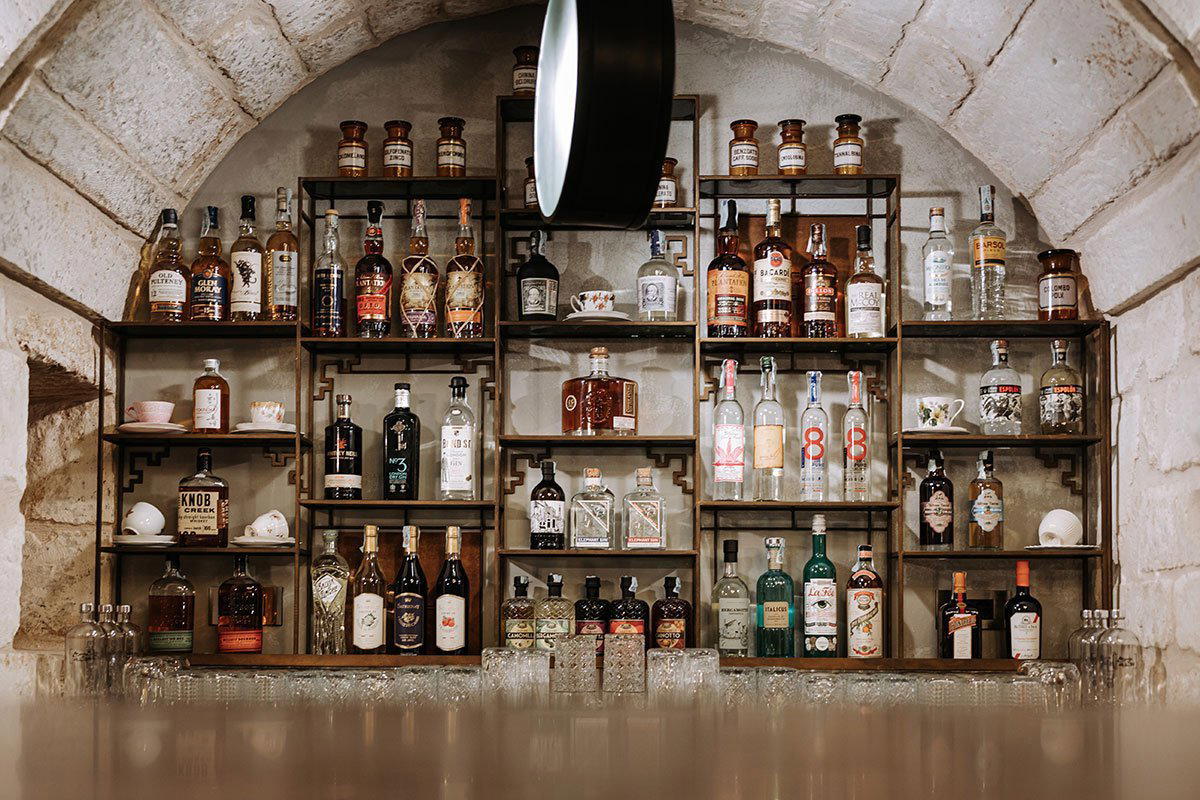
Ostuni's after-dark drinking scene begins away from the beach
Ostuni changes texture after sunset. The limestone glare softens, the lanes around the old town turn from sightseeing routes into social corridors, and the evening starts to divide between aperitivo, dinner, and a later drink that does not need to behave like either. Bar Library belongs to that inland rhythm. Its listed address, Via Giosuè Pinto, 60/A, places it in the library area of Ostuni rather than on a resort-facing strip, which already tells the reader something useful: this is town drinking, not beach-club drinking.
That distinction matters in Puglia. Along the Adriatic and Ionian coasts, cocktails often work as part of a view-led proposition, with spritzes, gin and tonics, and easy aperitivi doing practical service around heat, salt, and holiday pace. In Ostuni’s centro and adjoining civic streets, the better bar experience usually depends less on panorama and more on proportion: how a room holds noise, how long a table can keep a conversation going, and whether the drinks list has enough structure to survive beyond the first round. The fair editorial reading is therefore disciplined: expect a bar defined by its town setting and concept cues, then judge the cocktail programme on execution rather than reputation.
For the wider city context, compare this address with Our full Ostuni bars guide. That broader view is useful because Ostuni’s drinking options are not a single category. There are casual aperitivo counters, seasonal terrace operations, restaurant-adjacent bars, and smaller cocktail rooms that attract a later crowd. A venue in the library area enters a different competitive set from the places that sell themselves through sunset exposure. It has to make the drink, the pacing, and the room do heavier work.
The cocktail programme, judged by what can be verified
That absence should not be treated as a flaw to fill with invention. In a town such as Ostuni, where many bars operate with a seasonal audience and variable online documentation, the more useful question is how to read a cocktail bar when the public data does not do the sorting for the guest.
Start with format. A serious cocktail programme does not require a famous bartender, but it does require internal logic. In contemporary Italian bars, that may mean a short list built around aperitivo bitterness, a classics-led menu with proper dilution and temperature control, or a more technical list using clarified citrus, infusions, or low-ABV constructions. Without a published list for Bar Library, the first intelligent test is not novelty; it is whether the bartender can explain the structure of the list in clear terms. If the room is operating at a higher level than a generic mixed-drink bar, the staff should be able to move between a Negroni, a Martini, a sour, and a local-ingredient variation without turning the order into theatre.
Ostuni also sits inside a region where the drinking culture is naturally aperitivo-literate. Bitter liqueurs, vermouth, citrus, almonds, herbs, and local wines give bars plenty of material, but the difference between a competent drink and a lazy regional gesture is precision. A Puglian reference does not automatically improve a cocktail. It has to change balance, texture, aroma, or finish in a measurable way. In this sense, the stronger bar programmes in smaller Italian cities often behave more like compact kitchens than lounges: they edit, they repeat, and they know when not to decorate a glass into confusion.
That is where Bar Library’s concept cue is interesting. The name suggests slowness, reference, and some degree of curation. The record does not prove a book-lined interior or a literary menu, so those claims should be avoided. Still, as a reader decision, the useful expectation is a bar that should be assessed on focus. If the menu reads like a tight set of ideas rather than a long inventory of crowd-pleasers, the venue belongs closer to the specialist cocktail end of Ostuni’s bar spectrum. If it leans on volume and familiar serves, then the value lies in location and mood rather than technique.
How it compares with Italy's stronger cocktail rooms
Italian cocktail culture has become more technical in the last decade, but the country has not abandoned its older strengths: aperitivo timing, bitter structure, restrained sweetness, and the social intelligence of a drink that prepares the table rather than overwhelms it. Rome, Milan, Florence, Naples, and Venice each express that shift differently. Salotto 42 in Rome sits in a capital-city model where the bar participates in the theatre of the piazza. Moebius Milano in Milan reflects a more design-conscious, metropolitan style of drinking. Gucci Giardino` in Florence belongs to the fashion-house hospitality conversation, where brand environment and drink execution are inseparable for many guests.
Southern Italy creates a different question. In Naples, L'Antiquario in Naples shows how a destination cocktail room can operate with a strong identity inside a city better known internationally for food than drinks. Venice, represented here by B Bar in Venice, has the hotel-bar and grand-tour tradition in the background. Outside Italy, Lost & Found in Nicosia and Café La Trova in Miami offer useful comparisons because both show how strong bar identity can grow from a city’s habits rather than from imported luxury language.
Ostuni should not be forced into those larger-city templates. Its bar scene is smaller, more seasonal, and more dependent on the transition between local life and visitor demand. That makes the bar counter a revealing place. A drink that works in Milan may feel overdesigned in a whitewashed hill town after a hot August day. A casual aperitivo that works at 6 p.m. may feel thin at midnight.
What the setting changes about the evening
Ostuni’s old-town appeal can make visitors overvalue scenery and undervalue logistics. A bar in the library area has a different kind of usefulness. It can function before dinner for guests eating in the historic centre, after dinner for those who want a final drink without committing to a late club environment, or as a pause between town wandering and a drive back to a masseria.
The same caution applies to booking. That means advance planning should be practical rather than ceremonial. In shoulder months, walking in may be plausible for many Ostuni bars, especially earlier in the evening. In July, August, holiday weekends, and during local events, capacity pressure in the town can change quickly. If the plan is flexible, treat it as part of a bar crawl rather than the single fixed point of the night.
The address also helps define the audience. Via Giosuè Pinto is not described in the record as a hotel lobby, beach venue, or restaurant extension. That makes the experience more likely to be judged as a standalone bar decision: does the room give enough reason to linger, and does the drink programme show enough confidence to support a second round? In small Italian cities, that second-round test is often more revealing than the first. The first drink can ride on mood. The second exposes balance, pacing, and staff judgement.
Where it fits in an Ostuni itinerary
Ostuni rewards a compact itinerary. The town can be paired with countryside stays, Adriatic swimming, olive-grove drives, and long dinners built around Puglian produce. For restaurants, use Our full Ostuni restaurants guide to plan the table before placing a bar stop around it. The useful sequencing is simple: lighter bitter drinks before dinner, spirit-led classics after dinner, and lower-ABV choices when the evening involves driving or a hot next morning.
Hotels shape the rhythm as much as restaurants. Guests staying in town will read Bar Library differently from guests based outside Ostuni in a masseria or coastal property. The former can let the evening run late without transport anxiety. The latter should plan the return before the first drink. Our full Ostuni hotels guide is the better tool for understanding that trade-off, because accommodation location in this part of Puglia determines how relaxed the night can feel.
For a broader trip, the bar belongs to a network rather than an isolated stop. Our full Ostuni wineries guide is relevant for travellers who want daytime drinking to be wine-led, especially around Puglia’s indigenous varieties and the region’s olive-and-vine agricultural identity. Our full Ostuni experiences guide helps frame the cultural side of the town, from craft and architecture to countryside formats. A cocktail stop works better when it is not asked to carry the entire sense of place. It should sharpen the evening after the day has already done some of that work.
Editorial verdict: read the bar by discipline, not fame
With no awards, published price tier, chef or bartender biography, signature serves, seat count, or verified menu details in the record, Bar Library cannot be evaluated through the usual trust shortcuts. That does not make it irrelevant. It makes the bar a useful example of how smaller-city drinking should be read: by setting, programme discipline, and fit within the evening, not by imported prestige markers.
The case for going is strongest for travellers who want an Ostuni drink away from the pure view economy and who are willing to assess the bar on the fundamentals: temperature, balance, service tempo, and whether the menu has a point of view. The case is weaker for guests who need a documented award trail, a named bartender, a published signature cocktail, or guaranteed booking infrastructure before committing. In a city with strong seasonal swings, that distinction is fair. Some nights require certainty. Others benefit from leaving space for a smaller room, a quieter street, and a drink programme that has to prove itself in the glass.
Planning notes
- Address: Via Giosuè Pinto, 60/A, 72017 Ostuni BR, listed in the library area.
- Category: Bar.
- When to plan carefully: High summer, holiday periods, and weekends in Ostuni can put pressure on small venues. If timing matters, check current local contact details before setting the evening around one stop.
- How to use it: Place it before dinner for aperitivo-style drinking or after dinner for a quieter town-centred nightcap, then compare other options in Our full Ostuni bars guide.
Continue exploring
More in Ostuni
Bars in Ostuni
Browse all →
Restaurants in Ostuni
Browse all →
Hotels in Ostuni
Browse all →




Details
- Sophisticated
- Elegant
- Intimate
- Date Night
- After Work
- Solo
- Special Occasion
- Hotel Bar
- Standalone
- Seated Bar
- Lounge Seating
- Classic Cocktails
- Craft Cocktails
- Low Abv