

Goichi places Osaka yakitori in a serious counter format: chicken skewers, chicken dishes, sake and shochu, with recognition from Tabelog’s 2025 Yakitori WEST 100 selection and OAD’s 2026 Japan Recommended list. The appeal is not spectacle but calibration: smoke, timing, portioning and a room built for close attention rather than long-form ceremony.
Pearl is the En Primeur Club membership app — saves, bookings, and concierge access live there. Same editors, same standards.
- Address
- 8-16 Doyamacho, Kita Ward, Osaka, 530-0027, Japan
- Phone
- +81 6-6363-7739
- Website
- yoyaku.toreta.in
 Saves & bookings on Pearl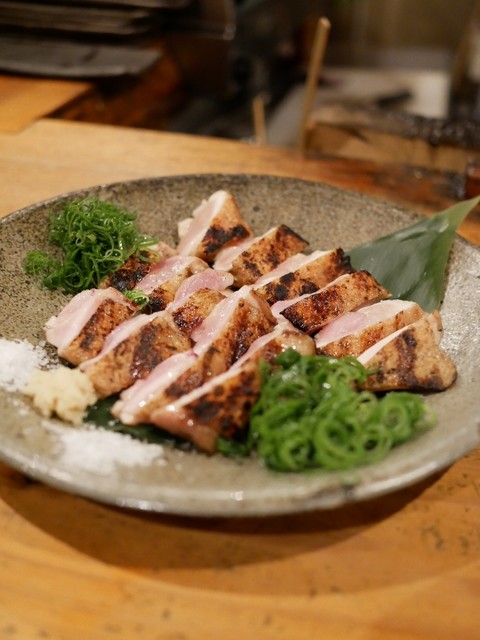
Doyamacho changes character after dark: station traffic, late-night drinking routes, small signs stacked above narrow streets, and restaurants that assume the evening will run past a single stop. In that setting, yakitori has a useful grammar. It is compact, social, technical and direct. Goichi belongs to the more disciplined side of that Osaka tradition, where the counter is not decoration but the operating system: heat, pacing and handwork are visible enough to become part of the meal.
Osaka’s food reputation often gets flattened into takoyaki, okonomiyaki and loud informality, but its serious casual restaurants are more interesting than that shorthand. Yakitori sits neatly between everyday drinking culture and chef-led precision. The format rewards small decisions: how a cut is portioned, when salt is enough, how tare is used without turning the grill sweet, and how smoke reads against sake or shochu. Goichi’s placement in Tabelog’s 2025 Yakitori WEST 100 and OAD’s 2026 Japan Recommended list puts it in that higher-attention bracket rather than the quick-skewer tier.
Yakitori treated as craft, not a prelude to drinking
Japanese chicken cookery has always been regional in practice even when the word yakitori looks simple on a menu. The craft depends on using multiple parts of the bird and treating each as its own problem of fat, texture and heat. Global technique enters less as fusion than as control: the modern counter borrows the precision of tasting-menu kitchens while keeping the elemental Japanese structure of charcoal, skewer, seasoning and timing.
That intersection matters in Osaka because the city is particularly good at formats that appear casual until the bill, the rhythm and the ingredient sourcing say otherwise. A yakitori counter in this register is not competing with low-cost izakaya skewers; it competes with other compact, reservation-led dining rooms where the craft is concentrated into a shorter sequence. In the comparison group, Dontaku and Niku Ryori PINE occupy lower spend bands, while Yakiniku Horumon Uchida sits in a different meat-driven lane. Goichi asks to be read as a chicken specialist, not as a general grill room.
The Tabelog category is useful here because it is specific: Yakitori WEST, not a broad restaurant roll call. That distinction separates regional specialists from citywide popularity contests. The OAD Recommended listing adds another kind of signal, less about domestic user scoring and more about international dining attention. Taken together, the recognition says that this is a narrow craft restaurant with cross-audience credibility, which is often the exact profile that serious travelers should look for in Japan.
The room favors counter discipline over ceremony
Counter seating changes the contract. It removes much of the theatrical architecture found in luxury dining and puts scrutiny on sequence, temperature and service tempo. In yakitori, that restraint is an advantage. The grill does not need a long explanation when the room is organized around watching small pieces of chicken move from raw preparation to finished skewer. The pleasure is cumulative, built through repetition with variation.
The drink register also points to local logic rather than imported luxury cues. Sake and shochu suit yakitori because they can absorb smoke, salt and chicken fat without demanding that the kitchen change its center of gravity. Wine programs can work with grilled chicken, but in Kansai the sharper pairing question is usually how rice-based and distilled Japanese drinks carry the meal without overwhelming it. That is where a specialist counter can feel more grounded than a restaurant trying to signal international polish.
For travelers mapping Osaka through restaurants, Goichi is better understood as part of a circuit than a single trophy stop. The city rewards moving between scales: bakery mornings at 52CHO-ME BAKERY, casual local staples such as 551 Horai (551蓬莱), and sharper dinner formats like a canto (Italian) or 99 Pizza Napoletana Gourmet. Even a spare daytime stop such as .cafe helps show how Osaka dining often works through specialization rather than grand statements.
How to place it in an Osaka itinerary
The smart use case is a dinner built around attention rather than grazing. Yakitori can be deceptively filling, and the better counters make less sense as a quick stop between two large meals. Plan it as the anchor of an evening in Kita, then let the neighborhood supply the before-and-after: a bar, a walk through the late-night streets, or a second, lighter drink elsewhere. For wider planning, Our full Osaka restaurants guide, Our full Osaka bars guide, Our full Osaka hotels guide, Our full Osaka experiences guide and Our full Osaka wineries guide give the city more useful shape than a single dining reservation can.
Japan’s grill culture also becomes clearer when seen against other regional specialisms. Beef-focused formats such as -Grilled beef Sukiyaki- KAMAKURA TANUKIAN 鎌倉 たぬき庵 in Kamakura and seafood-led charcoal cooking at. 鮪と炭火焼き うお炭 秋葉原店 in Tokyo show how the grill adapts by ingredient, not by formula. Other Japanese dining references, from.know in Kumamoto to (Shoku) Vietnam in Kawasaki, [Curry Senmon Ten] Maruyama Kyoju. in Sapporo and [ki:] in Kyoto, underline the same point: Japan’s casual-looking formats often carry serious technical boundaries.
For overseas readers, the useful comparison may be less another Osaka restaurant than a Japanese-drink context abroad. Jōdo Saké Bar in Los Angeles frames sake through an American dining lens, while Onigiri Time in Pasadena shows how a narrow Japanese format can travel without becoming a tasting menu. Goichi’s value is more local and more specific: Osaka yakitori with enough recognition to justify planning around it, but without turning the meal into a ceremony detached from the neighborhood around it.
Pricing, Compared
Comparable venues for context, by category and price tier.
| Venue | Cuisine | Price | Notes |
|---|---|---|---|
| GoichiThis venue — the venue you are viewing | Not listed | $$$ | Not listed |
| Taishu Shokudo Kawaramachi Blanc | Not listed | $$$ | Kita, Japanese Western (Yoshoku) Bistro |
| Tempura nuu nuu | Kita, Seasonal Tempura Omakase | $$$ | Not listed |
| Sushi Akazu | Not listed | $$$ | Kita, Traditional Edomae Omakase Sushi with Red Vinegar Rice |
| epais | Kita, Premium Tonkatsu & Curry | $$$ | Not listed |
| Kitashinchi Shabushabu Sukiyaki Kiraku | Not listed | $$$ | Kita, Traditional Wagyu Shabu-shabu & Sukiyaki |
Recognition history
Dated appearances from independent guides and award organizations, with the underlying list record or original source where available.
Opinionated About Dining Top Restaurants in Japan Recommended
Opinionated About Dining
Tabelog 100 #56 · No. 56
Tabelog · Tabelog 100 - Yakitori - WEST - 2025
Continue exploring
More in Osaka
Restaurants in Osaka
Browse all →




Bars in Osaka
Browse all →




Hotels in Osaka
Browse all →



Wineries in Osaka
Browse all →
At a Glance
- Lively
- Cozy
- Intimate
- Date Night
- After Work
- Late Night
- Casual Hangout
- Solo
- Chefs Counter
- Open Kitchen
- Standalone
- Sake Program
- Beer Program
Current opening hours
- Monday
- 5 PM–12 AM
- Tuesday
- 5 PM–12 AM
- Wednesday
- 5 PM–12 AM
- Thursday
- 5 PM–12 AM
- Friday
- 5 PM–12 AM
- Saturday
- 5 PM–12 AM
- Sunday
- 5 PM–12 AM
Hours can change for holidays and private events. Last verified .
Compact counter-focused yakitori with close-up views of the grill, warm but simple interiors, and a lively, bustling atmosphere typical of popular local Osaka joints.