Tabelog 100 #42
Our verdict
Gen-soba Nonaka gives Tokyo soba a quieter, suburban frame: a Nakamurabashi house-restaurant format with serious buckwheat credentials rather than Ginza polish. Its repeated Tabelog 100 Soba selections, including EAST 2025, place it among the city’s recognized specialists, while the menu structure keeps the focus on noodles, sake, shochu, and the discipline of a narrow Japanese category.

Pearl is the En Primeur Club membership app, where members save venues, book tables and use the concierge.
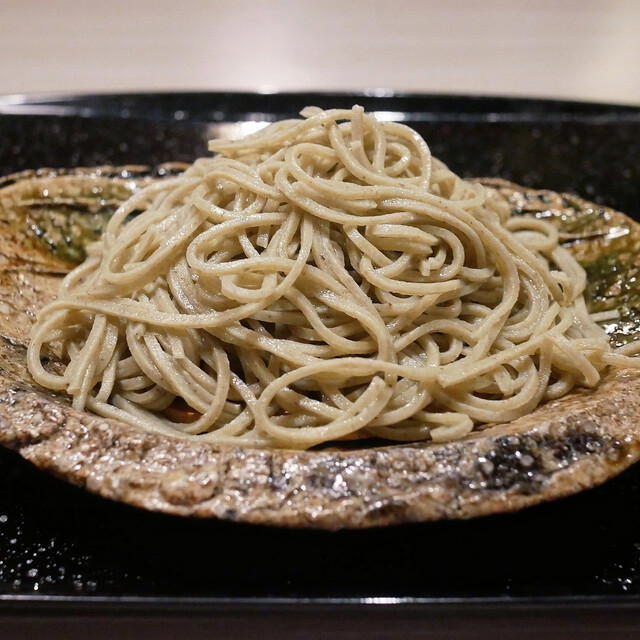
Approaching a Tokyo soba shop shapes the meal before ordering: focused expectations, simple framing, and a category that rewards attention to small differences. Gen-soba Nonaka is best read through its public facts: a Tokyo soba venue recognized in Tabelog’s Soba 100 EAST 2025 selection, with a listed score of 3.68.
Tokyo prestige dining often favors sushi counters, kappo rooms, and imported luxury formats, yet soba is one of the city’s sharpest tests of restraint. Buckwheat noodles expose weakness fast: texture, temperature, dipping sauce, and pacing allow little distraction. Recognition in Tabelog’s Soba 100 EAST 2025 selection, alongside a listed 3.68 score, signals a specialist address judged within a category that depends on repeat local eating as much as destination planning.
A soba menu built around narrow choices, not abundance
Read the restaurant through menu architecture rather than personality. The public category is Soba (Buckwheat noodles), which is already a strong statement. In Tokyo, soba meals can range from very concise noodle orders to broader arrangements with accompaniments, but the core test remains the same: whether buckwheat, broth, and pacing hold the diner’s attention without needing excess decoration.
Gen-soba Nonaka sits in that disciplined lane. Its public classification is Soba (Buckwheat noodles), which is revealing. Tokyo has many restaurants where noodles are one chapter in a broader casual menu. Here, the listed identity is narrower by design. Soba at this level is not best treated as a side order or a quick station meal. It is the meal’s grammar: noodles first, condiments and broth as calibration, the rest of the table as support.
The price band places it in an important Tokyo middle tier: Dinner is listed at JPY 2,000 - JPY 2,999, and lunch is also listed at JPY 2,000 - JPY 2,999. Compared with other Tokyo dining rooms that sit in higher spend brackets, it occupies a zone where technique must justify a modest but intentional outing. That is often Tokyo specialist cooking at its most persuasive: enough spend to expect care, not so much that the meal must perform luxury.
For travelers building a Tokyo eating week, this table works differently from a night built around heat, smoke, sequence, or urban density in other Tokyo dining rooms. Those formats lean on theatrical cooking rhythms or busier urban energy. Soba asks for a quieter appetite and repays attention in smaller increments.
Tokyo gives the meal a different tempo
Tokyo is not only the version many first-time visitors picture when mapping dinner around hotel lobbies, department-store basements, and railway-terminal dining floors. A soba stop can shift the experience away from destination gloss toward a simpler specialist format, where the category itself carries the interest rather than central-city tasting-counter choreography.
This makes the specialist format more than atmosphere. Tokyo preserves dining types less compressed by inbound tourism: soba shops, tonkatsu counters, neighborhood sushi, curry rooms, and gyoza specialists. They are not necessarily casual in technique, but rely less on performance signals. Gen-soba Nonaka’s value lies in that daily-life Tokyo register, not only in special-occasion Tokyo.
For visitors, the decision is practical as much as culinary. Gen-soba Nonaka is in Tokyo, and it fits best when the day allows a meal organized around a single category rather than a tightly stacked itinerary.
The broader Tokyo map clarifies the category. If the day includes other Tokyo dining or a gyoza comparison against Nogata Gyoza Honten, the soba meal supplies another axis: grain, quiet, and shorter menu logic. For wider planning, Our full Tokyo restaurants guide is the companion; travelers pairing dining with sleep, drinks, regional producers, or cultural programming can cross-reference Our full Tokyo hotels guide, Our full Tokyo bars guide, Our full Tokyo wineries guide, and Our full Tokyo experiences guide.
Why this matters in a city of specialists
Tokyo rewards diners who stop treating specialization as limitation. The city’s depth comes from rooms that narrow their brief and repeat it with discipline: soba, yakitori, curry, onigiri, sake, sukiyaki, and regional Japanese cooking all sharpen when the menu is not trying to satisfy every mood. Gen-soba Nonaka’s Soba 100 EAST 2025 recognition places it within that specialist logic rather than a broad restaurant hierarchy.
The restaurant is best understood as a calibration point, not a trophy. It shows how Tokyo can turn a modest category into a serious meal without importing fine-dining signals. It also reminds premium travelers that not every meaningful Tokyo meal is expensive or chef-biographical. Some of the city’s more instructive meals happen when the menu refuses breadth and asks the diner to care about one material.
The same principle appears across Japan and beyond in generic form. Focused sukiyaki addresses, concise café formats, compact curry rooms, sake-led bars, and tightly defined rice-ball counters all point to the value of formats that know what they are. That lens helps explain why a soba specialist such as Gen-soba Nonaka can feel more coherent than broader menus chasing range.
Verdict is restrained by design: go for soba as a category, not spectacle. The meal suits diners who want to understand Tokyo through a recognized buckwheat specialist, with the category’s narrowness doing the critical work. In a city where abundance can blur judgment, that focus is the draw.
Frequently asked questions
What should I expect atmosphere-wise at Gen-soba Nonaka?
Expect a Tokyo soba specialist framed around the Soba (Buckwheat noodles) category rather than a broad dining-room format. The Tabelog 100 Soba EAST 2025 selection signals a venue known for its soba focus.
What should I budget for a meal at Gen-soba Nonaka?
Pricing at Gen-soba Nonaka is listed as JPY 2,000 - JPY 2,999 for dinner and JPY 2,000 - JPY 2,999 for lunch.
What are Gen-soba Nonaka's hours?
Current hours are not provided in the supplied venue facts; confirm directly with Gen-soba Nonaka before going.
What part of town is Gen-soba Nonaka in?
Tokyo.
What's the signature at Gen-soba Nonaka?
The clear signature is soba itself, backed by selection in Tabelog 100 Soba EAST 2025 and a listed 3.68 score. The public category is Soba (Buckwheat noodles), which fits the house’s noodle-first format in Tokyo.
Can Gen-soba Nonaka handle vegetarian requests?
Soba is the core draw here, so vegetarian diners have a plausible starting point, but any request should be checked directly against the specific noodles, broth, and accompaniments. The listed lunch and dinner budget is JPY 2,000 - JPY 2,999.
Fast Comparison
Comparable venues at a similar level for quick context.
| Venue | Cuisine | Price | Awards | Notes |
|---|---|---|---|---|
| Gen-soba NonakaThis venue (the venue you are viewing) | Traditional Soba | $10–20 | Tabelog 100 #42 | Not listed |
| Japanese Soba Noodles Tsuta (Japanese Soba Noodles 蔦) | Michelin-Starred Japanese Soba Ramen | $20–30 | Tabelog 100 #32 | Yoyogi-Uehara |
| Kirimugi Ya Jinroku | Udon and Tempura | $10–20 | Tabelog 100 #68 | Shinjuku |
| Teuchi Udon Sumita | Japanese Udon | $10–20 | Tabelog 100 #20 | Kita |
| AFURI Ebisu | Modern Yuzu Ramen | $10–20 | Not listed | Shibuya |
| Yakiniku Horumon Kinju | Japanese Yakiniku BBQ | $50–100 | Tabelog 100 #45 | Minato |
Recognition history
Dated appearances from independent guides and award organizations, with the underlying list record or original source where available.
Tabelog 100 #42 · No. 42
Tabelog · Tabelog 100 - Soba - EAST - 2025